


The Story
Vidyakul, a Gurugram-based learning platform for Hindi-medium state-board students, has raised ₹10 crore in debt from the Michael & Susan Dell Foundation. The company announced the financing in a press release without disclosing the interest rate or the tenure.
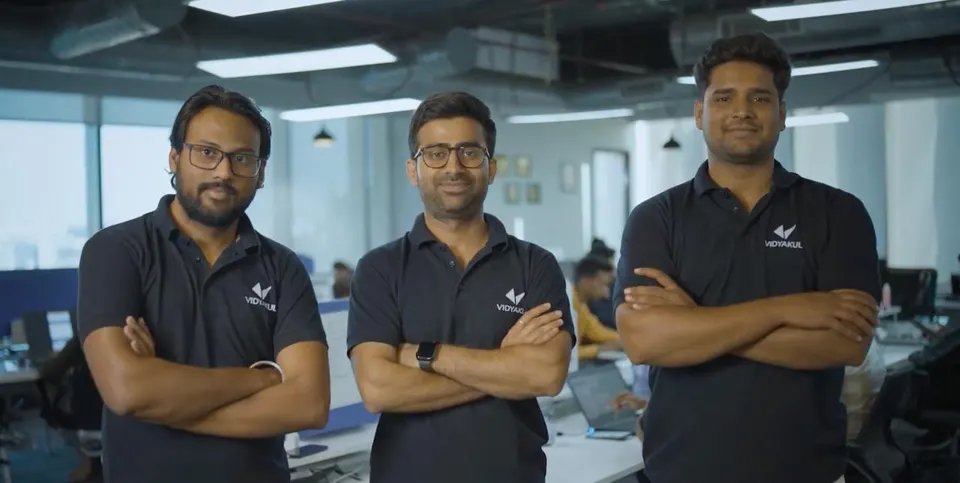
Tarun Saini started Vidyakul in 2018 with Raman Garg, now its chief technology officer. Saini grew up in a farming family in a Haryana village, travelled 35 to 40 km to Ambala for tuition, and worked in education in Australia before coming home. Akhil Hari Angira, who joined as an intern, was made co-founder and chief business officer in 2024. Saini says he has seen "what one good teacher can do for a child in a small town."
Vidyakul sells live and recorded courses for Classes 9 to 12 on the Bihar, Uttar Pradesh and Gujarat boards. The company says more than 1.17 lakh students enrolled in its paid programmes in the 2025-26 academic year. Its YouTube channels have more than 15 million subscribers, and it says over 11 lakh students use its free content each year. It also says 99.8% of its Bihar Class 12 students who sat the 2026 board exams passed, against the board's statewide rate of 85.19%, and that 70% secured first division.
The money will go into courses and assessments, and into AI tools that answer students' questions in Hindi, building on about 1.2 million questions the company says it resolves each month. It will also build pathways for students after Class 12, extending the CUET and NDA preparation courses its app already lists.
Vidyakul's last announced equity round was a ₹12 crore pre-Series A in July 2022, led by JITO Angel Network.
Why It Matters
Vidyakul's market is defined by board and language. When Saini started, his research found that about 70% of India's school students were in state-board schools and that the UP board alone had more students than CBSE. Bihar's Class 12 exam alone drew about 13 lakh candidates this year. Much of Indian edtech was built for English-medium CBSE students and competitive exams; Vidyakul built for the rest.
The engine is a free-to-paid funnel. YouTube does the marketing at little cost and paid courses do the earning: subscriptions made up 94% of operating revenue in FY24, TheKredible reported. Set against the 11 lakh students the company says use its free content each year, 1.17 lakh paid enrolments suggest roughly one in ten pays, if the two figures describe the same pool of students.
The cost sits in teaching. A live class scales well; answering individual questions does not. That is why AI in Hindi sits at the centre of the plan. At 1.2 million questions a month, each one answered by software is one a teacher does not have to handle.
The numbers suggest the model is improving. Revenue rose from ₹2.09 crore in FY23 to ₹11.39 crore in FY24 as the net loss narrowed from ₹7.02 crore to ₹5.10 crore, TheKredible reported. Inc42 puts FY25 revenue at ₹17.9 crore, up 57%. A loss figure for FY25 has not been reported.
The Strategic Read
The choice of debt says as much as the amount. Vidyakul has not announced an equity round since 2022, and Saini held 48.68% of the company at TheKredible's last count. Borrowing funds growth without diluting him, after a period in which equity investors pulled back from edtech. The cost is repayment: ₹10 crore is more than half of FY25 revenue, to be serviced by a company whose latest reported accounts still show a loss.
The lender is unusual. The Dell Foundation has put debt into Indian education before, including a $3 million pay-for-performance facility for school lender Varthana in 2017 that rewarded participating schools for improving learning outcomes. Neither side has said whether Vidyakul's facility carries such terms. If it does, the pass rate becomes a contractual metric rather than a marketing one.
That 99.8% figure needs care either way. It covers Vidyakul's own Bihar students who sat the exam, a group that selects for motivation and family support, and it comes from the company rather than an audit. The statewide 85.19% includes every candidate. A fair test would compare similar students with and without Vidyakul.
Competition is the other pressure. PhysicsWallah, founded by YouTube educator Alakh Pandey and listed in 2025, proved how far a Hindi-led free-to-paid funnel can go, and it competes for the same screens. Vidyakul's edge is depth in state-board syllabi and regional languages, a segment the national players have focused on less. Its 1.17 lakh paid students are a small share of a market where one state's Class 12 exam draws 13 lakh candidates.
The move beyond Class 12 is the strategic one. A student who finishes school leaves the funnel; courses for what comes next keep the relationship and spread the cost of acquiring each student over more years. Whether Vidyakul can do that while servicing a loan will show up in its FY26 accounts.
For daily, sharp analysis of the biggest moves in the Indian business and startup ecosystem, follow StartupFox.