
 Michael & Susan Dell Foundation
 Z47
Z47 Lok CapitalNNorinchukin Capital
 Alteria Capital
The Story
Seeds Fincap has raised more than ₹100 crore, about $10.4 million, in a Series B round led by the Michael & Susan Dell Foundation. Existing investors Z47 and Lok Capital participated, alongside Japan's Norinchukin Capital and Alteria Capital.
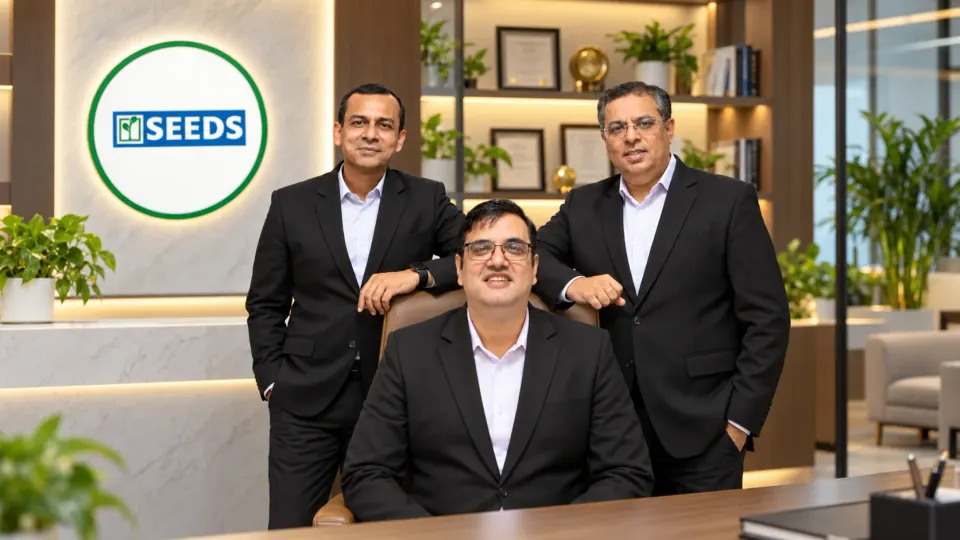
The Gurugram non-banking financial company lends to nano enterprises, small businesses and individuals, with loans from ₹50,000 to ₹10 lakh. Subhash Chandra Acharya, Avishek Sarkar and Sumeet Dhall founded it in 2021. Acharya is managing director and chief executive, and Sarkar is whole-time director and chief risk officer.
It assesses borrowers on their cash flow rather than on formal financial records, which most of its customers do not have. Field teams handle sourcing, onboarding, credit assessment, documentation, collections and portfolio monitoring, with technology supporting each step. Its products include unsecured and secured loans for people running trading, manufacturing, service and dairy businesses with at least three years in the same line of work, and group lending for women entrepreneurs.
Assets under management stood at ₹722 crore as of August 2026, across 164 branches and more than 70,000 active borrowers. The company disbursed about ₹620 crore in FY26 and says it was profitable in both FY25 and FY26. In July 2024 it had 100 branches across eight states, including Uttar Pradesh, Bihar, Rajasthan and Haryana, and a loan book of a little over ₹330 crore.
The money goes into expanding into new markets and strengthening the branch network, technology and risk management. The company is targeting ₹1,000 crore in assets under management by March 2027 while keeping its focus on credit assessment and portfolio quality.
It previously raised ₹50 crore in a round led by Z47 and Lok Capital in August 2025, and more than $8.5 million in a Series A led by Lok Capital and Matrix Partners India, now Z47, in July 2024. That same month it raised over $4.5 million in debt through non-convertible debentures from its first development finance institution.
Why It Matters
A dairy farmer with a dozen cows, a kirana owner turning over a few thousand rupees a day, a small workshop making steel furniture for the district market: each runs a real business with steady cash flow, and almost none of them can prove it on paper. There are no audited accounts, often no tax filings, and a thin or empty credit history. A bank's underwriting starts from documents, these businesses do not have them, and so the answer is no regardless of whether the business could repay.
That gap has defined small-business credit in India for decades. Below a certain size, the choice has been a moneylender at punishing rates, or microfinance, where loans are small, often group-based and capped well below what a growing business needs. Above it, banks will lend, but only to businesses that already look like bank customers. The space between, a working business that needs ₹2 lakh or ₹5 lakh and cannot document why it deserves it, is where Seeds operates.
Cash-flow underwriting is the answer to the documentation problem, and it is labour. A loan officer visits the business, looks at the stock, watches the customers, checks what the household earns from all sources, and builds a picture of what the borrower can actually repay. It is slow and expensive per loan, which is exactly why banks avoid it at these ticket sizes, and why lenders that do it build branch networks rather than apps. Technology trims the cost at the edges, in onboarding, documentation and collections, but the judgement still happens in person, and 164 branches is what that looks like.
Done well, it is a durable business, because the underwriting knowledge lives in people and processes that take years to build and are hard for a new entrant to copy. Done badly, it produces loans that look fine until a poor monsoon or an over-borrowed village exposes them all at once.
The Strategic Read
Start with what the money does. For a lender, equity is not mainly spent; it is the foundation that borrowing sits on. RBI rules limit how far an NBFC can lever its own capital, so each rupee of equity supports several rupees of borrowed money, and the borrowed money is what becomes loans. Earlier this week Bharat Housing Network raised green bonds, which is debt, the raw material of lending. This is the other half of the same machine: ₹100 crore of equity is what lets Seeds borrow several hundred crore more, and that is the route from ₹722 crore to the ₹1,000 crore it is targeting by March 2027. It is also around the asset size at which the Reserve Bank's scale-based rules move a non-deposit-taking NBFC into the middle layer, with tighter capital, governance and disclosure requirements.
The average loan is the number worth calculating. ₹722 crore across 70,000 active borrowers is roughly ₹1 lakh each. The advertised range runs to ₹10 lakh, but the book itself is dominated by small loans, which puts much of it closer to microfinance in borrower profile than to small-business lending. That matters because Indian microfinance and small-ticket lending went through a period of rising stress in 2024 and 2025, driven largely by borrowers taking loans from several lenders at once. Seeds says it stayed profitable through FY25 and FY26. That is the strongest claim in this announcement, and the one that most needs evidence.
The evidence that would settle it is asset quality, and it has not been disclosed. There is a specific reason to want it. The loan book has more than doubled since mid-2024, which means most loans outstanding today are young, and young loans have not had time to go bad. Fast-growing lenders almost always report flattering delinquency ratios for this reason, because the book grows faster than problems surface. The real test is how each year's batch of loans performs as it ages, and that data sits with the company and its investors rather than in the announcement.
The cap table says something about how this business gets valued. The lead investor is a family foundation rather than a fund, whose India work centres on financial inclusion. Alongside it are Lok Capital, one of the longer-standing impact investors in Indian lending, Z47 backing the company for a third time, Japanese capital through Norinchukin, and Alteria, best known for venture debt. Lenders rarely produce the outsized exits venture capital is built around. Their equity value compounds slowly with the book and is eventually priced as a multiple of it. Patient, mission-aligned capital is the natural owner of that, and a foundation leading a Series B is a reasonable sign the company is being backed for durability rather than speed.
The branch arithmetic is the last thing to hold onto. ₹722 crore across 164 branches is about ₹4.4 crore per branch, and growth here comes from adding branches, each of which takes time to recruit, train and mature. Expansion into new markets is the first stated use of this money. It is also the part of the business where underwriting discipline is hardest to transfer, because the judgement that works in one district has to be rebuilt in the next.
For daily, sharp analysis of the biggest moves in the Indian business and startup ecosystem, follow StartupFox.