

The Story
Botsync, a robotics company with offices in Singapore and India, has raised $11 million (about ₹104.5 crore) in a Series B round led by IvyCap Ventures. Existing investor Capital 2B took part along with AppWorks, Iterative, AngelCentral, Genesis Alternate Investments and angel investor Nalin Advani. The valuation was not disclosed.
IvyCap first invested in Botsync's $5.2 million Series A in June 2024, which Capital 2B and Betatron Venture Group led. Singapore's SGInnovate added an extension in January, and the company has now raised more than $20 million in total.
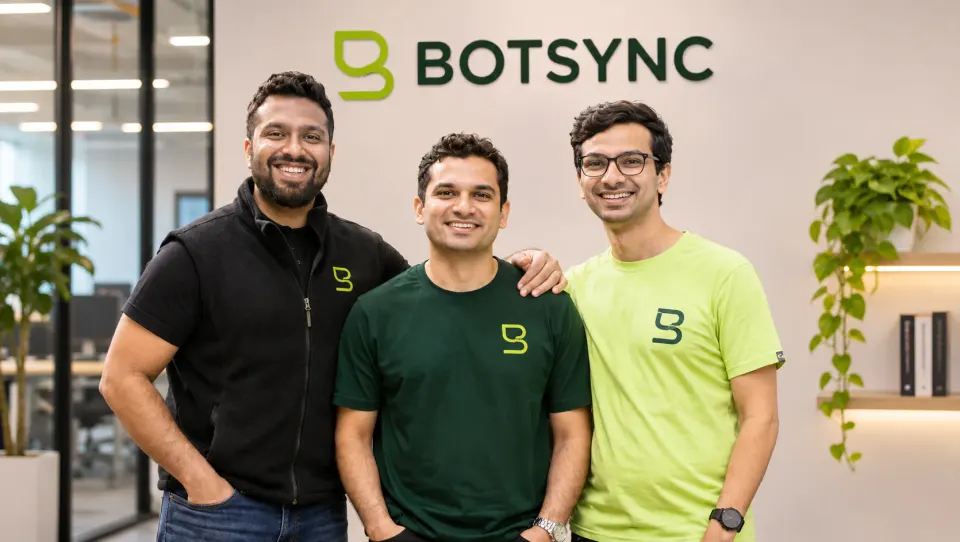
Rahul Nambiar, the chief executive, co-founded Botsync in Singapore in 2017 with Nikhil Venkatesh, Prashant Trivedi and Singaram Venkatachalam. It sells to automotive and FMCG manufacturers and to distribution centres. Its MAG autonomous mobile robots move materials around factories and warehouses, replacing forklifts and manual trolleys. SyncOS, its no-code software, connects robots and machines with enterprise systems so a plant can manage them from one place. Botsync names Caterpillar, Ford, Nestlé and Honda among its customers, and operates in Indonesia, Thailand and Australia as well as Singapore and India.
In January, the company said revenue had grown 230%, mostly from existing customers widening their deployments, and that its robots crossed one million live production trips in 2025. It has not disclosed absolute revenue or the size of its fleet.
The company says the money will go into AI features for SyncOS, including throughput optimisation and predictive maintenance, and into improving the reliability of the MAG range. It also plans to expand its engineering and customer-facing teams. Outside Asia, it wants a bigger presence in Australia and a go-to-market operation in the US.
Why It Matters
Botsync's pitch rests on a problem that grows as factories automate. Large plants rarely buy all their robots from one supplier. A site may run mobile robots from several makers alongside conveyors and lifts, each with its own control software that does not talk to the others. Coordinating traffic between them and wiring them into the plant's production and warehouse systems is integration work that usually falls to system integrators.
SyncOS is meant to own that layer, and the company describes it as vendor-agnostic. If it works, Botsync earns from orchestrating the whole fleet rather than only from the robots it sells. Software also carries higher gross margins than hardware and is harder to remove once it is embedded in a plant's systems.
The MAG robots supply hardware revenue and a first foothold. Customers buy them on payback: in a case study Botsync has published on an Ashok Leyland engine plant, where three MAG robots run around the clock, the company cites a return on investment within two and a half years. One plausible path is that a customer starts with a few MAG units, adopts SyncOS to run them and then brings other machines under it. Growth that came mostly from existing customers fits that pattern.
The model has a built-in tension. Botsync competes with the AMR makers whose robots it wants SyncOS to coordinate, and those rivals have little reason to make integration easy. The company has not said how many third-party robot brands SyncOS runs in live deployments.
The Strategic Read
IvyCap moving from Series A participant to Series B lead is the strongest signal in the round. An existing investor has seen the company's numbers from the inside, and choosing to raise its exposure suggests the expansion revenue has held up.
The market assumption is that manufacturers in Asia will automate internal logistics over the next few years and will want one layer to run mixed fleets rather than lock into a single robot maker. The case is strongest where labour is expensive or scarce, as in Singapore and Australia. In India, where labour is cheaper, automation is usually justified on throughput and consistency, which makes payback periods harder to hit.
Competition is the main risk. Global AMR makers such as Locus Robotics and Geek+ sell their own fleet software, and large automation vendors such as Dematic and Swisslog bundle orchestration into bigger warehouse projects. Capital is also flowing to Indian robotics companies: Unbox Robotics raised $28 million in January, and Peppermint Robotics closed a ₹100 crore round this month. Botsync's defence is neutrality. A plant that wants several vendors on one screen has a reason to choose an orchestration layer that is not tied to its main robot supplier, as long as Botsync keeps that layer genuinely open.
The US plan is where the round will be tested. Botsync has talked about entering the US since at least 2024 and has signed a partner there, but the market is crowded with better-funded suppliers. Australia and South Africa have also featured in recent expansion plans, which is a lot of ground for an $11 million round to cover.
The next proof point is disclosure. Names such as Ford and Nestlé show Botsync can clear enterprise procurement, but it has not said whether those accounts are single-site deployments or multi-plant rollouts. Absolute revenue and the share of fleets running third-party robots under SyncOS would show whether the orchestration thesis is becoming a business.
For daily, sharp analysis of the biggest moves in the Indian business and startup ecosystem, follow StartupFox.