



The Story
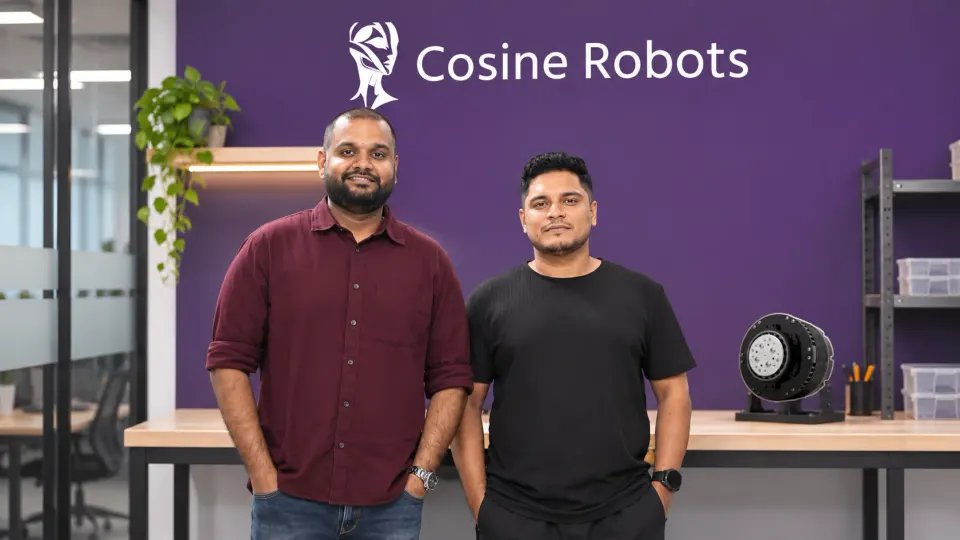
Cosine Robots, a Bengaluru startup that builds the actuators that move robot joints, has raised ₹22.36 crore (about $2.4 million) in a round led by Avaana Capital. WEH Ventures and unnamed angel investors also took part. The company did not disclose a valuation or give the round a stage name.
Kiran Mathew Koshy and Delip Thomas, who studied engineering a year apart at IIT Patna, set up the company in October 2024. Koshy, the chief executive, had spent about a decade as a software engineer at Amazon and Google, and Cosine began in his apartment.
Its products are integrated servo actuators: a motor, gearbox, sensors, electronics and control software packed into a single joint module. The range covers cycloidal and planetary designs at different torque levels, aimed at industrial robotic arms, collaborative robots, four-legged robots and humanoids. The company says its control system combines dual-position sensing with a 25 kHz control loop, or 25,000 updates a second. Its website lists five actuator models with a TypeScript SDK and browser-based setup, pitched at developers, students and researchers.
The money will fund a Bengaluru facility that brings precision machining, assembly, calibration and endurance testing under one roof, along with engineering hires. The founders have said they aim to launch the servo actuator range commercially around February 2027, selling to robot makers in India and abroad.
Cosine has not disclosed revenue, customers or how the ₹22.36 crore splits between investors.
Why It Matters
An actuator is a robot's muscle and joint in one, and it is where much of a robot's cost sits. A six-axis industrial arm needs six of them; a humanoid needs two dozen or more. Each has to deliver high torque from a small package and hold position precisely over millions of cycles.
Cosine's bet is integration. Selling the motor, gearbox, encoders, drive electronics and control firmware as one tested unit spares a robot maker the work of sourcing and tuning each part, and lets Cosine earn a margin on the whole module rather than on a single component. Fast control loops and dual-position sensing are what keep a joint stiff and accurate under load, which matters most for arms and legged robots carrying weight.
Selling joints was always the first step. In 2024, Koshy told Swarajya that Cosine would sell its actuators and use the profits to build its own humanoid, priced at about $4,000 when basic models cost around $10,000. He was aiming for $300 to $400 per actuator, against more than $1,000 for precise industrial joints. Investors were not convinced then; he said deeptech funds had been burnt by robotics startups.
The cost structure is that of a precision manufacturer. Machining, calibration and endurance testing need equipment and skilled people well before revenue arrives, and that gap is what this round pays for.
The Strategic Read
The change in the pitch is the story. In 2024 the actuators were a way to pay for a humanoid. In this week's announcement they are the business, and WEH's Deepak Gupta framed the opportunity as a "high capability merchant actuator company." A merchant supplier sells to everyone building robots rather than competing with them, which lets Cosine grow with every kind of robot without having to pick the winning one.
That is the assumption Avaana and WEH are underwriting: that robot makers in India and abroad will buy their joints rather than build them, and will buy them from a Bengaluru supplier. Some of the best-funded humanoid companies design their own actuators because the joint decides so much of a robot's performance and cost. Cosine's natural customers are the many smaller makers who cannot afford to.
Much of the competition sits in China and Japan, where scale sets prices for gearboxes and finished joints. Cosine's answer is integration and control software, along with being close to Indian customers. Integration becomes a moat through design-ins: once a robot is engineered around a joint's size and torque curve, switching suppliers means redesigning the robot. Design-ins take time, and robot makers want reliability data before they commit, which is why endurance testing sits inside the new facility.
Execution is the risk. Cosine is moving from selling to developers and researchers to supplying manufacturers, a shift that brings stricter demands on quality and volume. The ₹22.36 crore is enough for a facility and a team but not for high-volume production, so the next round will depend on design wins after the planned February launch.
The 2024 price targets are the measure worth tracking. If Cosine can sell joints near the $300 to $400 it aimed for, at industrial reliability, robot makers will come to it.
For daily, sharp analysis of the biggest moves in the Indian business and startup ecosystem, follow StartupFox.