


The Story
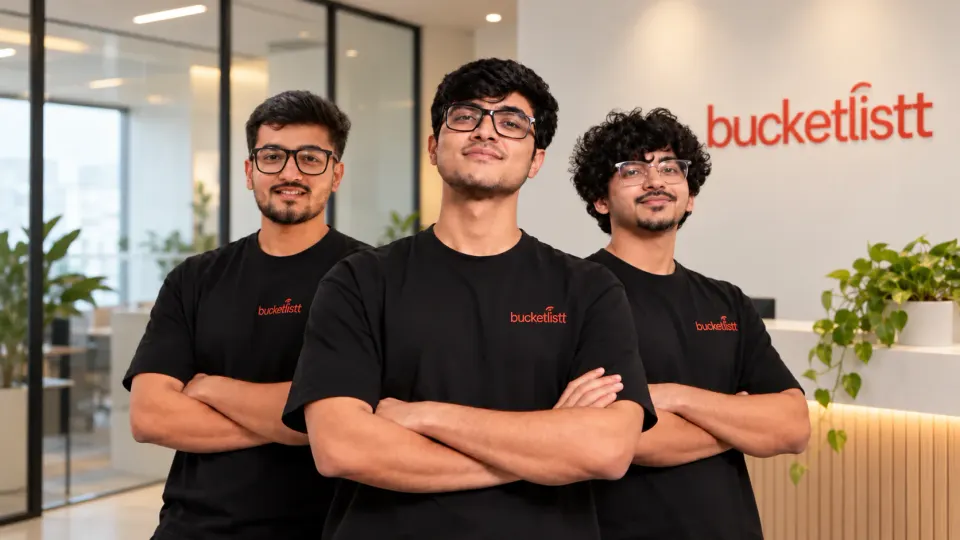
Bucketlistt.com has raised ₹7.6 crore, about $0.8 million, in a seed round led by Kairon Capital. Titan Capital, Divisa Family Office and Kunal Popat, founder of R for Rabbit, also participated. The valuation was not disclosed. It follows a ₹1.07 crore pre-seed round in June at a post-money valuation of ₹10.07 crore, from angel investors including Arvind Choudhary, Aenik Shah, Kartik Khatri and Yash Mehta.
Shubham Makhecha, Nitant Desai and Divyam Shah founded the company in 2025, and the three are all under 25. Makhecha and Desai are chartered accountants, and Makhecha is also a certified paragliding pilot and trek leader who has guided more than 3,000 participants. The platform is operated by Kovans Ventures Private Limited, incorporated in Ahmedabad, with operations based in Rishikesh.
Bucketlistt.com lets travellers discover and book verified experiences across India, from skydiving in Mount Abu and front-row seats at the Ganga Aarti in Rishikesh to dinner with royal families in Jaipur. It launched in Rishikesh in December 2025, and Desai says its first 100 customers came from posters handed out in the town.
Working directly with operators led the founders to build OkGhumo, launched in March 2026. It is software that experience providers use to manage bookings, inventory, agents, payments and daily operations, replacing phone calls, WhatsApp messages and spreadsheets. Leading adventure operators in Rishikesh use it daily, and it gives the marketplace live inventory so travellers receive instant confirmations.
In its first ten months, the company says, Bucketlistt.com and OkGhumo together managed more than ₹22.5 crore of bookings. Bucketlistt.com has served more than 12,000 customers and OkGhumo more than 50,000, and about one in five of the marketplace's customers now arrive by word of mouth.
The money goes into technology and product, onboarding more operators, expanding beyond Rishikesh to Manali and Bir, and content, organic discovery and distribution partnerships. The company plans to repeat its model across more cities.
"Travel has three layers: where you stay, how you get there and what you do once you arrive," Makhecha said. "The first two have moved online much faster; experiences remain far more fragmented." Deepankur Malhotra, founder and managing partner of Kairon Capital, said the founders "have chosen to spend time where the transactions actually happen."
Why It Matters
Indian travel has been digitised in layers. Flights, trains and hotels have been bookable online for two decades. What a traveller does once they arrive, whether that is a rafting trip, a paragliding flight, the evening aarti or dinner in a haveli, has stayed largely offline, sold by thousands of small operators through phone calls, WhatsApp, agents and touts on the street. Prices depend on whom you ask, availability is whatever the person on the phone says it is, and for adventure sports, where an operator's safety practices matter a great deal, a visitor usually has little way to tell a careful one from a careless one.
That is the gap Makhecha describes, and the founders went to where it is widest. Two of the three are chartered accountants, and Makhecha is a certified paragliding pilot and trek leader who has guided more than 3,000 people. They began in Rishikesh, handing out posters and talking to operators before building much, and came to see that the operators' problem was bigger than the travellers': they could not run their own bookings. OkGhumo came out of that discovery.
A marketplace that calls an operator verified is vouching for it. In activities such as skydiving, paragliding and rafting, that is a promise with real consequences, and how Bucketlistt defines and audits the word as it adds destinations will matter as much as how many bookings it processes.
The Strategic Read
The software is the more revealing half of this business. An experiences marketplace is only as good as its inventory: a traveller booking a Saturday-morning raft needs to know a seat exists, and an operator whose bookings live in phone calls, WhatsApp messages and a spreadsheet cannot confirm one instantly. Global platforms such as Klook and GetYourGuide tend to solve that with integrations and large supply teams. Bucketlistt solved it by giving operators the system itself. OkGhumo runs their bookings, inventory, agent settlements and payments, and passes live availability to the marketplace, which is what makes instant confirmation possible. An operator that runs its day on the software is also much harder to lose than one that merely appears in a listing.
The customer counts show how lopsided the two products already are. OkGhumo says it has served more than 50,000 customers in about seven months; the marketplace has served 12,000-plus in ten. The figures count different things, since OkGhumo includes operators' own walk-in and agent-sourced customers, but the gap suggests most volume now flows through the software rather than through Bucketlistt's own platform. That is a sound starting point, because the software earns its place daily whether or not a traveller has heard of the brand. It also leaves open what the company actually earns. The ₹22.5 crore is bookings value across both products, not revenue, and neither the marketplace commission nor any subscription charge for OkGhumo has been disclosed.
Seasonality is the other thing to watch. At its pre-seed in June, the company said it was facilitating over ₹4 crore of transactions a month; the ten-month total of ₹22.5 crore averages about ₹2.25 crore. The two figures measure different periods and different scopes, but the gap fits a destination whose adventure season rises and falls, with river rafting in Rishikesh typically suspended through the monsoon. Whether Manali and Bir smooth that pattern or repeat it is something the next few quarters will show.
Expansion is where the model is truly tested. Each new town means winning a new set of operators and persuading them to move off WhatsApp, which is slow work done in person. Handing out posters in Rishikesh and spending time with operators before building anything is the playbook the founders now have to repeat, and it is what Kairon's Malhotra singled out.
For daily, sharp analysis of the biggest moves in the Indian business and startup ecosystem, follow StartupFox.