




The Story
byteXL has raised $9 million, about ₹86.7 crore, in a round led by Elevar Equity, with existing investors Kalaari Capital and the Michael & Susan Dell Foundation participating. It follows a $5.9 million Series A in July 2024 led by Kalaari with the Dell Foundation.
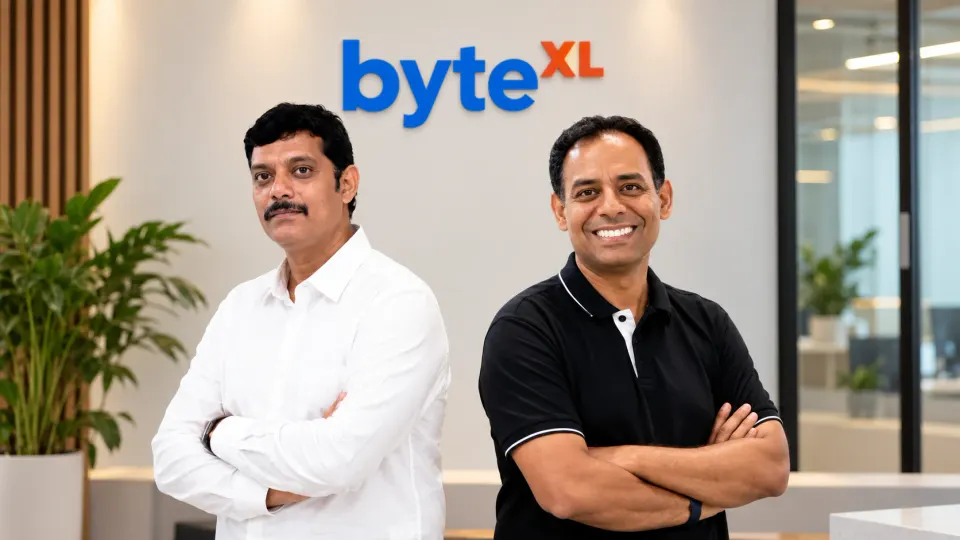
Brothers Karun Tadepalli and Sricharan Tadepalli founded the Hyderabad company in 2019. Karun is chief executive, and Sricharan, who previously worked in engineering delivery at Oracle and Kloud9, is chief strategy officer.
byteXL works with engineering colleges, particularly in Tier 2 and Tier 3 cities, to build industry-aligned technology and AI skills into students' regular degree programmes. Its model works business-to-business through institutions rather than selling courses to individual learners, combining curriculum, hands-on learning, its technology platform and trained educators within college programmes. It also helps colleges automate administrative work such as attendance and teacher-student engagement.
It reaches about 2 lakh students through 40 institutions, and says 7,600 of its graduates were placed in IT and engineering roles last year. Over the next two years it plans to expand to 120 institutions and 5 lakh students across 15 states.
The capital goes into expanding its institutional network, strengthening its AI and technology platform and developing new skilling programmes, including AI-enabled learning and assessment, student analytics and personalised learning tools.
Kalaari partner Sampath P said the model lets byteXL work within the existing college system rather than reinventing it, and pointed to the company's growth and its ability to reach profitability.
It operates in a broad skilling and employability market alongside companies such as Emversity, SmartBridge, iNurture, Board Infinity and Imarticus Learning.
Why It Matters
India produces a very large number of engineering graduates every year, and many of them come from private colleges in smaller cities whose syllabi move slowly and whose faculty have little industry experience. The result is a familiar complaint from employers: graduates who hold the degree but cannot do the job on day one. For years the market's answer was to fix that afterwards, through bootcamps, online courses and paid upskilling sold to students who had finished, or were about to finish, their degrees.
That consumer model had a cost problem. Selling a course to an individual student means paying to find them and persuade them, and often their parents too, one at a time. The collapse of India's consumer edtech boom showed how expensive and how fragile that approach could be. byteXL goes the other way. It sells to the college and builds its curriculum, platform and trained educators into the four-year degree itself, so the students are already in the classroom and the course is already on the timetable.
The appeal to colleges is straightforward. A private engineering college in a Tier 2 city competes for admissions largely on placements, and its own faculty often cannot teach cloud, cybersecurity or AI to industry standard. Bringing in a partner that can, and that runs placement preparation alongside, improves the number every prospective parent asks about. Helping the college automate attendance and engagement makes byteXL part of how the institution runs, not just a vendor of courses.
The appeal to investors is the distribution. Forty institutions reaching two lakh students is an audience a consumer edtech company would have spent heavily to acquire, and here it arrives through a handful of contracts.
The Strategic Read
The placement figure is the number that matters, and it needs a denominator. byteXL says 7,600 of its graduates were placed in IT and engineering roles last year. It has not said how many students graduated through its programmes that year, how many sought jobs, or at what salaries. Placement statistics in Indian engineering education are notoriously hard to read, because a single offer, a low-paid role or a job outside the field can all count. For a company whose whole proposition to colleges is employability, a fuller disclosure would be the strongest marketing it has.
The model also has its own concentration. Forty institutions means forty large customers, each relationship depending on a college's management, its budget and its willingness to keep paying for something built into its programmes. The plan to reach 120 institutions and five lakh students in two years triples the customer base and the delivery load with it. Trained educators placed inside colleges are people, and the quality of a programme depends on them in a way a software platform alone does not.
The larger question is what the students are being trained for. The entry-level work that graduates of these colleges have traditionally moved into, testing, support, maintenance and routine coding, is exactly the work AI tools are changing fastest, and fresher hiring at large IT services companies has been subdued. byteXL's push into AI skills is the obvious response, and much of this funding is aimed at it. The difficulty is speed. A curriculum embedded in a four-year degree moves on an academic calendar, while the tools employers use change by the quarter. A partner that can update what is taught faster than a college could on its own is precisely what byteXL is selling, and it is what it will be judged on.
The cap table explains the patience. Elevar Equity is an impact investor focused on businesses that serve underserved communities, and the Michael & Susan Dell Foundation, which last week led a round in the small-business lender Seeds Fincap, works in India on education, jobs and livelihoods. Both are comfortable with businesses whose value builds through institutional relationships rather than viral growth, and Kalaari, which led the Series A, has come back alongside them.
What sets byteXL apart from other skilling companies is how deeply it sits inside the degree. That depth is both its defence and its exposure: hard to dislodge when outcomes are good, and directly accountable when they are not.
For daily, sharp analysis of the biggest moves in the Indian business and startup ecosystem, follow StartupFox.