



The Story
Zinara has raised ₹3.61 crore, about $380,000, in a pre-seed round led by Inflection Point Ventures. Nine Jewellery, actress Nikita Dutta and other angel investors also participated. Dutta announced her investment last month and described it as her first in a consumer brand.
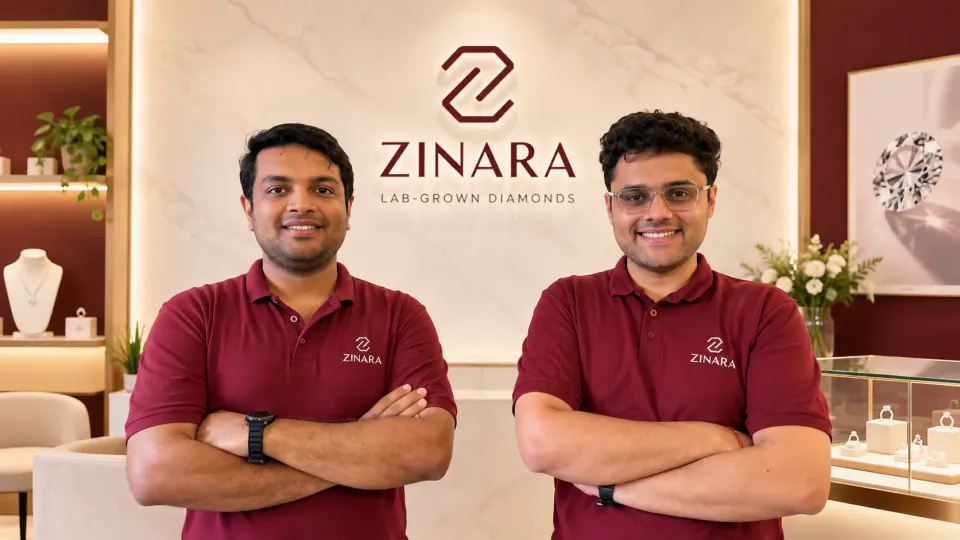
Harshit Abrol and Sumanyu Vyas founded the Delhi NCR company in 2023. Abrol, the chief executive and an IIT Delhi graduate, previously worked at P&G and Apnaklub; Vyas has worked at Blinkit and Classplus.
Zinara makes everyday diamond jewellery using lab-grown diamonds set in 18K gold vermeil, which is sterling silver with a layer of gold. It says its stones are graded and certified by gemological laboratories. Its catalogue runs to more than 400 designs, with rings on its site priced at roughly ₹5,000 to ₹7,500. It sells online across India and offers a lifetime warranty, buyback and exchange. The company says it has crossed ₹1 crore in annual recurring revenue, after what Abrol described as significant growth over the last two quarters.
The money goes into hiring, marketing and supply chain, and into expanding the brand's product range and presence across India.
Inflection Point Ventures says it has invested more than ₹900 crore across over 280 startups.
Why It Matters
Two weeks ago the Bengaluru brand ONYA raised money to sell lab-grown diamonds set in BIS-hallmarked solid gold, through its own stores, at prices aimed at engagement rings. Zinara uses the same kind of stone for a very different product.
The difference is the metal. Gold vermeil is sterling silver coated with gold; the 18K describes the purity of the coating, not the piece. Swap solid gold for plated silver and the cost of the setting falls sharply, which is how a ring with real, certified diamonds can sell for around ₹5,000. That price changes what the product is. It stops being a once-in-a-lifetime purchase made after weeks of thought and becomes something bought for a birthday, an office party or simply a Tuesday.
That is where the opening lies. Lab-grown diamonds have become cheap enough, particularly in the small sizes used in everyday pieces, that the stone is no longer the expensive part of the jewellery. Gold went the other way, rising sharply to record prices in 2025, which pushed many younger buyers toward silver. A brand that pairs an inexpensive real diamond with an inexpensive precious-metal base sits where those two trends meet: diamond jewellery at fashion-jewellery prices, for people who want it to look and feel like fine jewellery rather than costume.
The founders' backgrounds suit a business won online. P&G and Apnaklub on one side, Blinkit and Classplus on the other: consumer marketing and consumer internet growth rather than the jewellery trade. A digital-first brand at this price point lives or dies on how cheaply it can find buyers and how many of them come back.
The Strategic Read
The lifetime warranty is the promise to examine. Vermeil is a coating, and coatings wear. Jewellery sold for everyday use meets soap, sweat, sanitiser and friction every day, and the gold layer on silver thins over time. A lifetime warranty on that, if it covers replating, is a real cost the company carries for as long as customers keep their pieces. Larger silver-based jewellery brands have generally offered plating warranties measured in months rather than lifetimes, which shows how differently Zinara has chosen to price that risk. How it defines what the warranty covers will decide whether it is a selling point or a liability.
The buyback raises the same question another way. In ONYA's case the buyback was backed by solid gold, which holds its value, set with lab-grown stones, whose prices have been falling. Here the metal is mostly silver, worth far less, and the stones are small. A buyback on that is a trust device rather than a store of value, and customers will judge it by the price actually offered rather than the promise.
The catalogue is the operating question. At roughly ₹5,000 to ₹7,500 a piece, ₹1 crore of annual revenue is something like 1,500 pieces a year, spread across more than 400 designs. That is a wide catalogue for the volume, which works if most designs are made in small batches or to order, and becomes expensive if each is stocked. Deep inventory across hundreds of designs is how small jewellery brands run out of cash, and the supply chain spending in this round is presumably aimed at exactly that.
The competitive frame is GIVA more than the lab-grown specialists. GIVA built a large business on silver-based, plated jewellery and now sells lab-grown diamonds through its own label, with far more capital, a store network and an established audience. Zinara's difference has to come from design and from leading with the diamond rather than the silver. Celebrity backing helps with the first problem, getting noticed. It does not solve the second, getting chosen again.
None of that makes ₹3.61 crore the wrong amount. A pre-seed round for a brand already doing ₹1 crore of revenue is enough to learn which designs sell, how often customers come back and what the warranty really costs. Those three numbers will decide the next round.
For daily, sharp analysis of the biggest moves in the Indian business and startup ecosystem, follow StartupFox.