



The Story
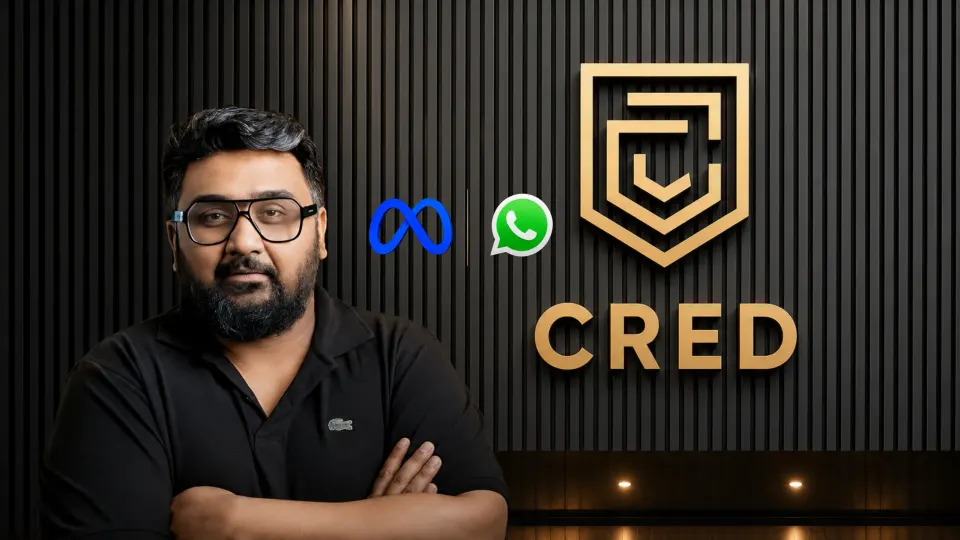
Global technology giant Meta has invested $900 million (approximately ₹8,550 crore) in Bengaluru-based fintech unicorn CRED through a combination of primary and secondary share purchases. The Series H funding round values the company at a post-money valuation of $4.5 billion (₹43,239 crore), securing Meta an approximate 20% minority stake.
However, the massive capital injection serves as the financial anchor for a historic leadership transition. CRED founder Kunal Shah is stepping down from his operating role as chief executive officer to join Meta’s global leadership team, where he will succeed Will Cathcart as the head of WhatsApp. Cathcart, who led the platform for the past seven years, will transition to a new role focused on Meta's artificial intelligence initiatives. Miten Sampat, who has overseen strategy and finance at CRED since 2020, has been appointed interim CEO with immediate effect.
According to statements from Meta CEO Mark Zuckerberg and Chief Product Officer Chris Cox, Shah was recruited for his "builder mentality" to guide the three-billion-user messaging app through its next phase of commercial expansion. At CRED, Shah announced he will step back from daily operations but retain his shareholder status. The funding event also triggers the startup's fifth Employee Stock Ownership Plan (ESOP) buyback programme.
The transaction marks a critical milestone for CRED. Shah noted that the platform, founded in 2018, now serves 1.7 crore monthly active members, processes more than 40% of India's credit card bill payments, and recently achieved its first profitable quarter, scaling to an annualised revenue of roughly $325 million (₹3,200 crore). Both companies explicitly clarified that Meta will not receive access to CRED’s customer data as a result of the strategic investment.
Why It Matters
This transaction is fundamentally an acqui-hire executed at an unprecedented corporate scale. Meta is deploying $900 million to secure a strategic financial position in a premium Indian fintech, but the primary asset it is acquiring is Kunal Shah’s product vision and monetisation expertise.
The core problem Meta is attempting to solve is the commercialisation of WhatsApp. With over three billion global users, WhatsApp is the default communication infrastructure for much of the world, including its largest market, India. Yet, it remains trapped in the "free utility" paradox. It consumes massive server and encryption resources but generates revenue disproportionately lower than Meta's advertising engines on Instagram and Facebook. Previous attempts to embed native financial infrastructure—most notably WhatsApp Pay in India—failed to capture meaningful market share against entrenched domestic incumbents like PhonePe and Google Pay.
Meta is betting that Shah can solve this monetisation puzzle. Shah's entire entrepreneurial track record is built on behavioural economics: aligning incentives to change consumer financial habits. He successfully built a ₹3,200 crore revenue engine by gamifying bill payments for a relatively small but highly affluent user base. Meta requires exactly this capability to seamlessly integrate business messaging, in-app commerce, and AI-driven transactions into WhatsApp without alienating a user base that historically resists platform alterations.
For CRED, the $900 million war chest provides immense capital efficiency. It allows the company to step off the continuous venture fundraising treadmill, offering deep liquidity to early investors and employees while setting a stable financial runway for an eventual initial public offering (IPO) under professional management.
The Strategic Read
The Meta-CRED transaction signals a definitive shift in how global big tech views Indian entrepreneurial talent. Historically, Indian executives ascended to global CEO roles through decades of corporate ladder-climbing within legacy software firms. Meta’s decision to effectively buy into a startup to extract its active founder as a global product leader establishes a new paradigm for cross-border talent acquisition.
The underlying business mechanism driving this deal is the convergence of social distribution and financial checkout. By placing Shah at the helm of WhatsApp, Meta is signalling that the platform's future is no longer just encrypted messaging; it is high-frequency commerce. If Shah can replicate the trust and engagement mechanics he built at CRED inside WhatsApp, Meta can close the loop between product discovery (on Instagram) and frictionless payment (on WhatsApp), capturing the transaction margins that currently escape to third-party payment gateways.
The leverage point in this deal is the explicit data wall. By strictly preventing Meta from accessing CRED’s proprietary financial data, Shah protects the fintech’s core moat: its reputation as a secure, exclusive enclave for India’s top 1% of creditworthy consumers. This ensures that CRED’s enterprise value remains intact and independent of Meta's broader data machinery, avoiding immediate regulatory blowback from the Reserve Bank of India (RBI).
However, the strongest countercase to this strategic alignment is severe culture and product mismatch. CRED was engineered around exclusivity, targeting a highly specific demographic that responds well to premium aesthetics and complex reward structures. WhatsApp is the exact opposite; it is the ultimate mass-market, utilitarian product, relying on absolute simplicity and low-friction access for billions of diverse users. Applying premium, incentive-driven monetisation tactics to a global, varied demographic carries a high risk of user friction and defection to alternate messaging protocols.
Furthermore, CRED faces immense internal execution risk. The company's brand identity, marketing tone, and product philosophy have been entirely synonymous with Shah. Transitioning from a founder-led cult brand to an institutionally managed corporation ahead of a public listing is notoriously difficult. If the platform's product velocity slows under an interim CEO, the $4.5 billion valuation could prove difficult to defend in public markets.
The critical watchpoint over the next 12 months will be WhatsApp's product rollouts under Shah's leadership. Investors and ecosystem observers should monitor whether WhatsApp aggressively launches subscription tiers, advanced merchant tools, or embedded financial features, proving that Shah can translate his domestic fintech playbook to the world's largest communication network.
For daily, sharp analysis of the biggest moves in the Indian business and startup ecosystem, follow StartupFox.