



The Story
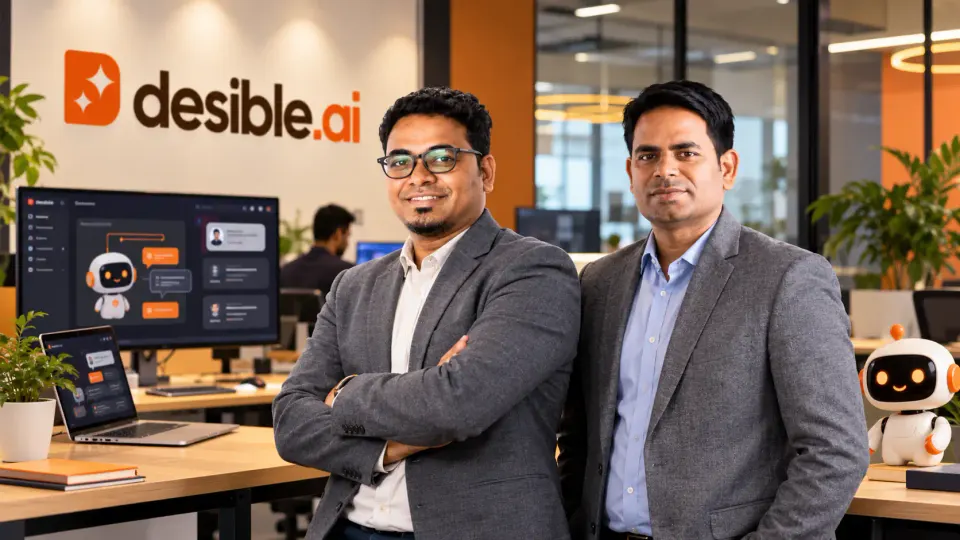
Desible.ai has raised ₹32 crore in a seed plus round led by Prime Venture Partners, with existing investor Invention Engine participating. The money goes into expanding its agentic AI capabilities, strengthening its compliance infrastructure and building more products for banking, financial services and insurance.
Uttam Tiwari and Omkar Raikar founded the Bengaluru company in 2025. Raikar, who leads technology and product, spent more than a decade in machine learning, statistical modelling and enterprise software, including at Crisil and Edelweiss. Tiwari, who leads growth and fundraising, is a former investment banker with a background in enterprise sales. Both previously co-founded and sold edtech startups, Tiwari's to an Indonesian edtech company. Desible.ai came through Invention Engine, an AI accelerator.
The company builds a workflow orchestration platform for banks, NBFCs and insurers that automates customer engagement, servicing, operations and compliance, starting with voice and expanding to WhatsApp, SMS and email. It says it works with more than 40 BFSI institutions and runs more than 25 workflows across revenue, risk and compliance, collections, underwriting, service and claims. Its use cases include collections, lead qualification, renewal management, claims intimation, welcome calling, cross-sell and tele-medical examinations for insurance underwriting. It says the platform handles more than 1 crore customer engagements a month and integrates with existing enterprise systems.
The platform is built around deterministic decision-making, with workflows designed so that disclosures, consent and escalations follow predefined rules and remain auditable. The company holds SOC 2 Type II and ISO 27001 security certifications.
Why It Matters
Indian banks, NBFCs and insurers run on the telephone. A new borrower gets a welcome call. An insurance applicant gets a call to record their medical history, the tele-medical examination that often replaces a physical test. A policy nearing expiry gets a renewal call, a claim gets an intimation call, and an overdue loan gets a collections call, and then another. Behind those calls sit large telecalling operations, often outsourced, working through scripts at volume. It is one of the biggest operating costs in Indian retail finance, and much of it is repetitive enough to automate.
Voice AI has been able to hold a convincing conversation for some time. The reason it has not simply replaced these call centres is that financial services is regulated, and the regulated parts of a call cannot be improvised. A collections call has to stay within permitted hours and avoid anything that reads as harassment. A loan or insurance call has to deliver specific disclosures. Consent has to be captured and recorded. Certain situations, a customer in distress, a dispute, a request to stop calling, have to go to a human. A language model that paraphrases a disclosure, forgets to record consent or talks its way past an escalation trigger is not a quirky bug in this setting. It is a compliance breach, repeated on every call it makes.
That is the problem Desible.ai says it is built around. Its pitch is deterministic decision-making: the conversation can be natural, but the decisions that matter to a regulator follow predefined rules and leave an auditable trail. It is a more modest claim than most agentic AI marketing, and in regulated finance it is the one that counts. A bank does not need an AI agent that is creative. It needs one that behaves identically on the ten-thousandth call and the first, and can prove it.
The Strategic Read
The scale claims are large for a company founded last year, and the biggest of them needs a definition. An engagement could be a dial attempt, a connected call or a resolved case, and in outbound calling the gap between those is wide, because most calls go unanswered. The company's own pitch stresses raising connect rates, which is a reminder that completed conversations are the more useful measure, and that figure has not been published.
Collections is where the stakes are highest. RBI rules restrict recovery calls to between 8 am and 7 pm and prohibit harassment, and aggressive collection has been a recurring concern for the regulator. An AI agent can apply those rules more consistently than a stressed human working to a target, which is a real argument in its favour. It can also make the same mistake ten thousand times before anyone notices, which is the argument for the audit trail. Under RBI's outsourcing rules the lender stays responsible for how its agents behave, so lenders will want firm contractual answers from any vendor before they scale an automated collections operation.
Tele-medical underwriting is the other sensitive use. These calls record an applicant's health history, so an automated version handles health data and shapes a decision about who is insured and on what terms. The consent requirements of the Digital Personal Data Protection Act apply, and an insurer will want to know exactly what the agent asked, how answers were recorded, and whether anything was inferred rather than stated. Deterministic design is the right answer to that, provided it holds under pressure.
Commercially, the main competition is the incumbent rather than other startups. Banks and insurers already pay large outsourced call-centre operations, and voice AI companies such as Gnani.ai sell into the same buyers. Desible's argument is integration plus compliance: plugging into a lender's existing systems and producing records a compliance team can sign off. A lead investor with deep fintech roots fits that argument, because selling to Indian banks is slow and relationship-driven, and an investor who knows the buyer is worth more than the cheque.
The longer question is what happens as the platform spreads from voice into WhatsApp, SMS and email. Each channel adds volume and adds rules. A system that orchestrates every customer touchpoint for a lender becomes infrastructure, which is valuable and hard to replace. It also concentrates risk: when one vendor runs customer contact for dozens of institutions, its rulebook becomes, in practice, part of how those institutions comply.
For daily, sharp analysis of the biggest moves in the Indian business and startup ecosystem, follow StartupFox.