


The Story
ONYA has raised ₹12.5 crore in a pre-Series A round led by Divisa Family Office, with existing investor Zeropearl VC following on. It takes total funding to ₹18 crore after a ₹5.5 crore pre-seed in November 2025, which drew MyGate's founders and UrbanVault founder Amal Mishra among its angel investors.
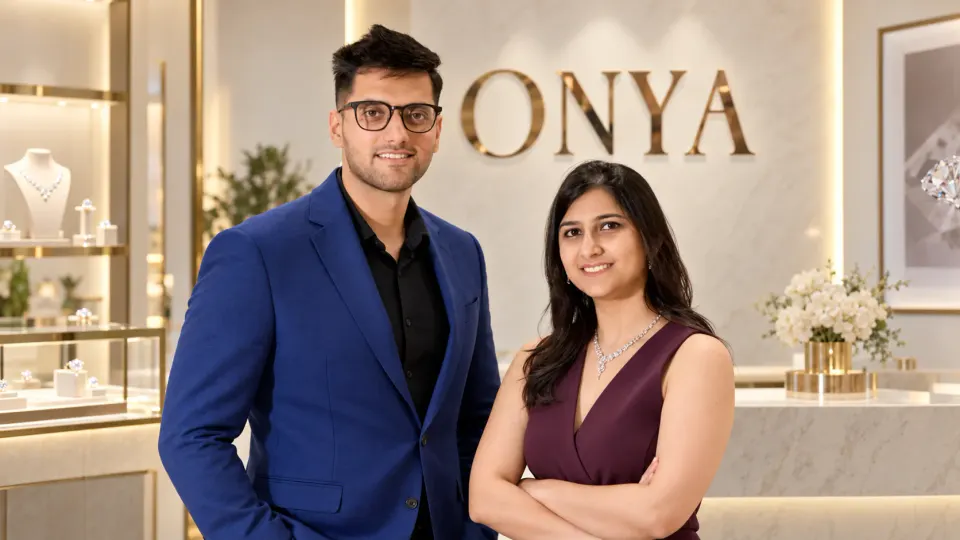
Himani Yadav and Gaurav Choudhary founded the Bengaluru brand in 2024. Yadav spent more than eight years in product and growth roles at Ola, InMobi and MyGate, and started the company after finding the engagement ring she wanted was beyond what she could justify paying. Choudhary was previously director of products at xto10x. The name is short for On You.
ONYA sells IGI-certified lab-grown diamonds set in BIS hallmarked gold, priced at roughly a fifth of comparable natural stones and backed by a lifetime exchange and buyback promise. It holds a patent on its own ring setting, the ONYA Setting, and its flagship ONYA Signature Collection is built around Neoclassical architecture.
The brand is deliberately offline-first. It now runs eight flagship stores, across Bengaluru's high streets, Amanora Gold Souk Mall in Pune and Jubilee Hills in Hyderabad, and reports monthly revenue of ₹3.5 crore. At its pre-seed round ten months ago it had four stores, all in Bengaluru, and ₹2 crore a month.
The money goes towards accelerating the retail footprint, digital customer acquisition, online personalisation and research into product design and manufacturing. It plans to expand through both company-owned stores and franchises.
Capital has been moving quickly into the category. Nine pure-play lab-grown diamond startups raised $26.4 million between them in 2025, against $4.7 million the year before. Aukera raised ₹90 crore in debt in July after a $15 million equity round led by Peak XV Partners, Limelight Lab Grown Diamonds took ₹275 crore in a strategic round, and GIVA, which runs the lab-grown brand Heer, raised ₹530 crore in a Series C.
Why It Matters
The Indian diamond market has a gap in it that is easy to describe and has been hard to fill.
A young couple in Bengaluru wants an engagement ring. The stone they like, in a natural diamond, costs several lakh rupees, which for most people at that stage of life is a meaningful share of a year's savings spent on an object. The alternatives have historically been to buy a much smaller stone, to buy something with a diamond in it that is mostly gold, or to decide the whole thing is not for them. That is the position Himani Yadav found herself in, and the reason ONYA exists at all. Her own engagement ring was a lab-grown diamond before most people in India knew what one was.
A lab-grown stone is chemically and optically identical to a mined one. It has the same hardness, the same refraction, the same appearance under a loupe. The difference is that it was made in a reactor over a few weeks rather than pulled from the ground, and it costs roughly a fifth as much. For someone who wants the ring rather than the provenance, that is not a compromise; it is the same product at a price that does not require a loan.
India is an unusually interesting market for this. It is the country that cuts and polishes the overwhelming majority of the world's diamonds, so the manufacturing skill is already here, and it is also a market where jewellery carries enormous cultural weight and where the audience buying its first serious piece is young, urban and comparatively unattached to the mining story that the natural diamond industry spent seventy years building.
What ONYA appears to have understood better than most is that the product is not the only thing being sold. Yadav came from product and growth roles at Ola, InMobi and MyGate, and Choudhary from xto10x, which is not a jewellery background at all. What that has produced is a brand built around design ownership, a patented setting, a signature collection with an actual reference point, rather than a catalogue of stones at a discount. In a category where the underlying material is becoming a commodity, the design is the only part that cannot be copied on price.
The Strategic Read
The growth figures are the ones to sit with, because they are unusually clean for a young consumer brand.
Ten months ago ONYA had four stores and ₹2 crore of monthly revenue. It now has eight stores and ₹3.5 crore. Revenue per store has therefore gone from about ₹50 lakh a month to roughly ₹44 lakh. That is a slight dilution rather than a collapse, which is the normal and healthy pattern when a retailer doubles its footprint: newer stores take time to mature, and the earlier ones were in the best locations. A company that doubled stores and held revenue per store flat would be more suspicious than one that gave up a little.
It also means the total is not being carried by a single flagship, which is the failure mode in premium retail. And the pre-seed announcement described the first four stores as profitable at store level, which for an eleven-month-old jewellery brand is unusual enough to be the most persuasive thing about this company.
The offline-first choice is the strategic decision underneath all of it, and in this category it is correct. Nobody buys an engagement ring from a photograph. The purchase is expensive, infrequent, emotionally weighted and requires trying the thing on a hand. More than that, lab-grown diamonds carry a specific consumer anxiety that online retail cannot resolve: buyers want reassurance they are not being sold something worthless, and a shop with a person in it who can show the IGI certificate answers that in a way a product page does not. The lifetime exchange and buyback promise is doing the same work, because the unspoken question about lab-grown stones is always resale.
That question is also the category's structural risk, and it is worth naming. Natural diamonds hold value poorly, but lab-grown stones have been falling in price steadily as production capacity grows, and the wholesale cost of the raw material has dropped sharply over the past few years. That is excellent for a brand buying stones and terrible for a customer thinking of jewellery as a store of value, which is how a great many Indian households still think about it. Brands in this category are selling design, certification and emotion rather than an asset, and a buyback promise made today has to be honoured against prices nobody can forecast.
The competitive picture is the other pressure. ONYA has raised ₹18 crore in total. GIVA's Heer sits inside a company that raised ₹530 crore, Limelight has taken ₹275 crore, and Aukera has Peak XV behind it with ₹90 crore of debt on top. In a business where expansion means signing high-street leases and stocking each one with gold and certified stones, working capital is the constraint and ONYA has the smallest balance sheet among the funded players. The franchise route it has flagged is the sensible answer to that, since it puts the store fit-out and part of the inventory on somebody else's books, but it trades control of the customer experience for speed at exactly the moment the brand is still being defined.
For daily, sharp analysis of the biggest moves in the Indian business and startup ecosystem, follow StartupFox.