

The Story
Alive App has raised $1 million in a seed round led by Powerhouse Ventures, with Flipkart Ventures participating. Powerhouse also led the Bengaluru company's ₹6 crore pre-seed in November 2025, making this its second investment.
Vivek Kumar founded the company in 2023. He had spent more than a decade in India's startup ecosystem as a technologist, co-founder of an incubator and accelerator, and later a venture investor, before taking a break in late 2022 and finding that even in Bengaluru, with disposable income to spend, the city's leisure options ran to cafes, pubs and the occasional film.
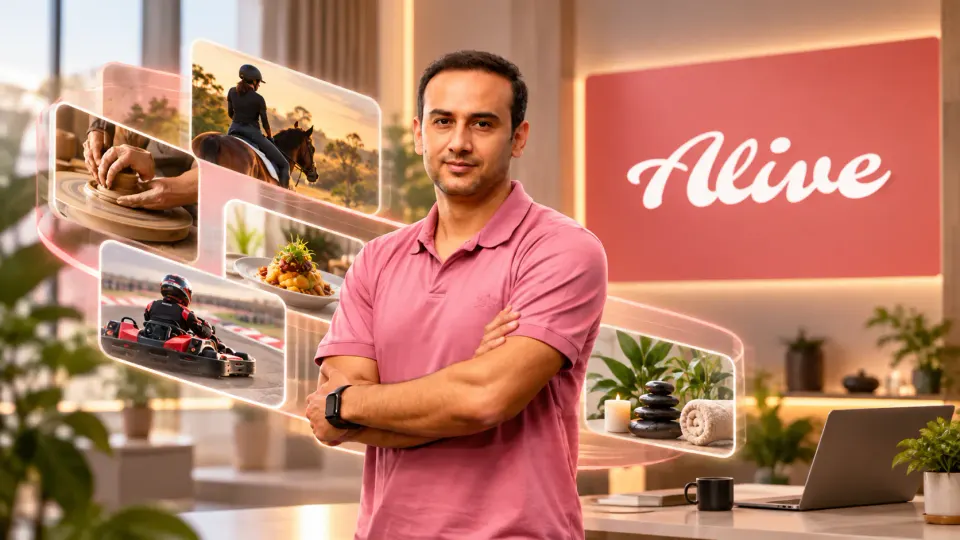
Alive helps users discover and book curated experiences across adventure, food, wellness, art, culture and learning. Rather than only aggregating what already exists, it works with creators and venues to build experiences, taking a cut while retaining control over quality and brand. It started with five pilot experiences at premium venues including Prestige, Embassy and Leela Palace, promoted through WhatsApp groups.
It now operates across Bengaluru, Hyderabad, Mumbai, Chennai, Delhi and Goa, with more than 500 experiences and over 400 creators and partners, adding around 100 new experiences a month.
The company says it recorded its first profitable quarter in Bengaluru, its earliest and largest market. Over the past six months it has added Mumbai, Chennai and Delhi alongside Goa, and says experience supply in the newer cities has grown five times faster than during its initial expansion.
The capital goes towards expanding product and experience supply, as the company works to raise how often urban consumers take part in leisure activities. It is targeting threefold revenue growth over the coming months with a focus on user frequency.
"Over the last year, the biggest validation for us has been seeing how quickly experiences are being adopted as an upgrade to weekend plans in every city we enter," Kumar said, describing the ambition as becoming the default weekend companion for urban India.
Elsewhere in the segment, Bucketlistt raised ₹1.07 crore in pre-seed funding in June for a curated marketplace of verified experiences, and experiential travel brand WanderOn raised ₹54 crore in a Series A this year.
Why It Matters
Vivek Kumar's account of how this started is unusually specific, and it identifies something most people in Indian cities have felt without naming.
He had spent over a decade in the startup ecosystem, as a technologist, then co-founding an incubator and accelerator, then investing. In late 2022 he stopped to decompress, and discovered that in Bengaluru, with time and money to spend, the options for a free weekend were cafes, pubs and occasionally a film. That was it. A city of fifteen million people, an enormous population of young professionals with disposable income, and a leisure menu that could be written on a napkin.
What is missing is not restaurants or bars. It is the layer above them: the pottery studio running a beginners' evening, the supper club, the astronomy night, the sourdough workshop, the guided dive. Those exist in Indian cities but scattered, unmarketed and largely invisible, run by individuals with an Instagram account and no way to reach the people who would gladly pay for them. The demand and the supply are both present and have no reliable way of finding each other.
That gap is why Alive builds rather than only lists. An aggregator collects what exists and hopes it is enough; Alive works with creators to design experiences and keeps control of the standard, which matters in a category where one bad Saturday ends the relationship permanently. Starting with five pilots at Prestige, Embassy and Leela Palace venues, shared into WhatsApp groups, is about as unglamorous a beginning as a consumer company gets, and it is the right one for a product Kumar describes as selling on impulse.
The comparison he draws is to Indian e-commerce a decade ago, and the useful part of it is not the size of the opportunity but the shape. E-commerce did not grow because people suddenly wanted to buy things. It grew because finding and buying them stopped being difficult. Weekends in Indian cities are at the stage where the wanting exists and the finding does not.
The Strategic Read
A profitable quarter in one city is a more interesting disclosure than the round size, and it is worth being precise about what it proves.
It proves the unit works where supply is dense and the brand is known. Bengaluru is Alive's oldest market, with the most experiences, the most creators and three years of word of mouth. Profitability there says the take rate covers the cost of acquiring a customer and servicing a booking once a city has matured. It says nothing yet about Delhi, which is six months old, and the honest reading is that Bengaluru is now paying for the cities that are not.
That is the right way to build this, and it is also why $1 million is a defensible size for the round. Experiences are a local supply business. Every new city means finding creators, curating venues, building enough inventory that a returning user sees something new, and doing it again from zero. Capital does not accelerate that as much as it does in a category with centralised supply, which is presumably what Powerhouse's general partner meant in describing the company as capital-efficient.
The word doing the most work in this announcement is frequency, and it is the entire problem.
Experiences are structurally a low-repeat purchase. A pottery class, a night dive, a supper club: people do them occasionally, and the good ones are memorable precisely because they are not weekly. That gives the category punishing economics, because a platform that acquires a user for a single booking a year has to keep acquiring. Alive's answer is to become the default weekend companion, which requires moving from something people remember once a quarter to something they open on a Thursday. Adding 100 experiences a month is the mechanism: a catalogue that refreshes gives a returning user a reason to look. Whether that converts curiosity into habit is the thing the next year will test, and no frequency or repeat-rate figures have been published.
The other structural question is what stops a creator leaving. Alive builds experiences with creators and takes a cut, which works while it is supplying demand they could not reach themselves. A creator whose supper club fills reliably starts wondering why they are paying commission, and the answer has to be that Alive keeps bringing new customers rather than the same ones. Marketplaces in this shape live or die on that, and curation plus brand control is a better defence than pure listing, because a creator who leaves gives up the standard the platform enforces.
Flipkart Ventures joining is the most commercially interesting part. Flipkart has hundreds of millions of Indian users and no reason to be in experiences unless it sees a distribution fit, and for a company whose main constraint is getting urban consumers to open the app on a weekend, access to that kind of surface is worth more than the cheque.
For daily, sharp analysis of the biggest moves in the Indian business and startup ecosystem, follow StartupFox.