



The Story
Sugar Cosmetics has raised ₹144.5 crore from A91 Partners, which subscribed to the entire issue. The board approved the allotment of 1,12,248 Series D7 compulsorily convertible preference shares at ₹12,871 apiece to A91 Emerging Fund III in a resolution passed on 1 September, and A91 will hold roughly 19.97 percent afterwards. No new investor took part.
Estimates of the post-money valuation vary between about ₹550 crore and ₹755 crore, which places the round somewhere between 75 and 82 percent below the roughly ₹3,000 crore Sugar carried in 2022, when L Catterton led a $50 million Series D.
Early investors are separately looking for the door. Stakes worth up to ₹150 crore are reportedly being shopped, and a consulting firm has been pitching Sugar shares at a fraction of peak valuation with a minimum ticket of around ₹25 crore.
The business has now contracted for two consecutive years. Revenue fell about 20 percent to ₹404 crore in FY25 from ₹505 crore, the first decline since the company was founded, while net loss nearly doubled to ₹135 crore and EBITDA loss more than doubled to ₹116 crore. FY26 revenue has been reported at roughly ₹380 crore, lower again. Cumulative losses across five years run to about ₹375 crore, and Sugar has not recorded a profitable financial year.
A valuation report dated 30 June 2026 and attached to the filings states that the company has shown a sustained and worsening pattern of financial deterioration across the past two financial years.
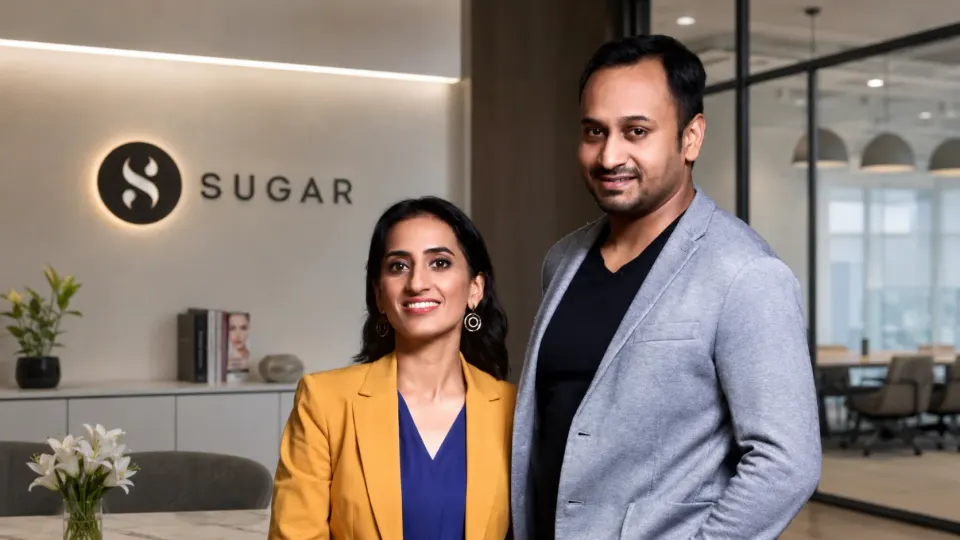
Vineeta Singh and Kaushik Mukherjee, IIM Ahmedabad alumni and a married couple, founded the Mumbai company in 2015. Singh is chief executive and Mukherjee chief operating officer. Sugar sells through its own platform, marketplaces, more than 200 exclusive outlets across 50 cities and around 50,000 retail touchpoints.
Why It Matters
The cause is not mysterious, and it is not the market.
Sugar raised $50 million in 2022 and spent much of it building physical retail: exclusive outlets, distributor relationships, shelf space reaching 550 cities. It is a defensible strategy for a beauty brand, because colour cosmetics genuinely sell better when a customer can swatch a shade, and it is the route Indian consumer brands take when online customer acquisition costs stop making sense.
The problem is what offline retail does to a cost structure. Leases, store staff and distributor commitments are fixed, and they are fixed for years at a time. When revenue fell 20 percent in FY25, none of that fell with it. The company has since reportedly closed 30 to 40 percent of the stores it opened because the per-store economics did not work, and closing a store does not immediately release its lease.
That is why the loss ratio moved as it did. In FY24 Sugar lost about 13 percent of revenue. In FY25 it lost roughly a third of it. A company does not double its losses while its sales shrink unless its costs are structurally committed somewhere it can no longer justify.
The A91 round should be read against that. This is not growth capital, and it is not the repricing of a healthy business. An existing shareholder holding a fifth of the company is funding the entire issue alone because the alternative to funding it is worse.
The Strategic Read
The most informative document here is not the funding announcement. It is the valuation report attached to the filing.
A registered valuer writing that a company has demonstrated sustained and worsening financial deterioration across two financial years is a formal statement made under professional liability, not a journalist's characterisation. That language sits in a document A91 read before writing its cheque. It is the clearest available account of what this round is, and it explains why no new investor is in it.
The secondary market says the same thing from another direction. Early backers shopping stakes worth up to ₹150 crore through a consulting firm, at a fraction of peak, with a ₹25 crore minimum ticket, is a distressed process. Brokers do not run structured sale processes for companies whose shareholders expect to be paid at an IPO. And the price at which that paper actually clears is a more honest valuation than any post-money figure, which is derived arithmetic rather than a transaction.
There is also a gap between what Sugar sought and what it got. It was reportedly looking for ₹100 to 150 crore at ₹1,400 to 1,500 crore in mid-2026, itself already half of peak. It has closed at roughly a third to a half of that valuation. Reports of a severe cash crunch running six months, with the founders settling employee salaries from personal accounts, have not been confirmed by the company or independently verified, but they are consistent with an inside round taken on these terms.
What remains is genuinely valuable, which is why this is a reset rather than an ending. Sugar has ten years of brand equity, distribution across 550 cities that a new entrant cannot replicate quickly, formulations built for Indian skin tones and climate, and a founder recognised nationally. Those assets do not disappear with a down round.
But the arithmetic they now serve is different. Sugar spent a decade proving it could build a brand and the last two years demonstrating it could not yet make one profitable at scale. ₹144.5 crore against ₹135 crore of annual losses buys roughly a year. The task is no longer growth. It is showing that the ₹380 crore it still sells can be sold at a positive margin, and the listing Singh once spoke about is not a near-term question.
For daily, sharp analysis of the biggest moves in the Indian business and startup ecosystem, follow StartupFox.