


The Story
RapidCanvas has raised $29 million in a Series B round led by Vertex Ventures Southeast Asia & India, with Hitachi Ventures joining as a new investor and existing investors Accel, Peak XV Partners, Valley Capital Partners and Titanium Ventures participating. The round takes its total funding to $52.5 million. It follows a $16 million Series A led by Peak XV Partners in December 2024.
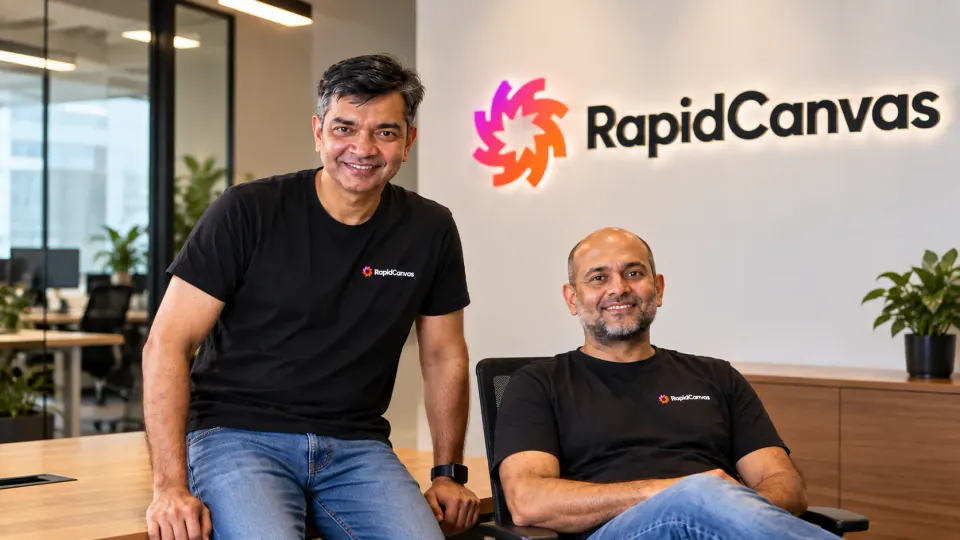
Rahul Pangam and Uttam Phalnikar founded the company in 2021. The two previously built Simility, an AI-based risk management company acquired by PayPal. Pangam, the chief executive, earlier led analyst teams at Google. RapidCanvas is based in Austin, Texas, with teams in India, the United States and Brazil.
RapidCanvas describes itself as a managed AI execution company. Its platform combines AI agents with human expertise to help enterprises build custom AI applications and move them from pilots into production. It has three core products: an Enterprise Context Engine that captures how a business works, a Visual Development Canvas for building custom AI applications, and an Operational Harness for managing them once deployed. Alongside the software, its field AI engineers learn each customer's processes, build applications for that business and remain responsible for their outcomes after deployment.
It targets enterprises with annual revenue of $100 million to $10 billion that have AI budgets but lack the people or expertise to deploy custom applications, across manufacturing, financial services, retail, business services and infrastructure.
The company says its annual recurring revenue has grown eightfold over the past six quarters, and that more than 40 percent of its customers now run several AI use cases in production. In 2026, more than 75 enterprises have made 1.4 million AI-led decisions using applications built on its platform.
The money goes into expanding go-to-market teams, growing a network of private equity and advisory partners that bring its services to their portfolio companies and clients, and hiring field AI engineers in India, the US and Brazil.
"Vibe coding has made it easy to start building with AI. Getting AI into production reliably and safely still remains the biggest gap," Pangam said.
Why It Matters
Most companies have now tried AI. Far fewer have it running. Across enterprises, the past two years have produced a long list of pilots, chatbots and proofs of concept, and a much shorter list of applications that changed how a business actually operates. A widely cited 2025 study by MIT researchers found that the large majority of generative AI pilots delivered no measurable financial return. The models were rarely the problem. The work of connecting them to a company's data, rules and processes, testing them against reality and keeping them running was.
The largest companies can solve that by hiring. Mid-sized firms, the ones with $100 million to $10 billion in revenue that RapidCanvas targets, usually cannot. They have budgets and ambition but no internal AI team, and the consultancies that could build for them are priced for bigger clients. Pangam's framing is blunt: so far, AI's biggest wins have gone to the Fortune 100.
RapidCanvas's answer is to sell the people along with the software. Its field engineers learn a customer's business, build the application and stay accountable for whether it works. The model has a well-known precedent. Palantir built its business by embedding engineers with customers, and the approach, now usually called forward-deployed engineering, has since been adopted by the largest AI labs as they sell into big enterprises. RapidCanvas applies it to companies too small to get that kind of attention from the labs.
The Strategic Read
The eightfold growth in recurring revenue is the headline number. The more revealing one is that more than 40 percent of customers run several use cases in production. Enterprise AI usually stalls after the first project, so customers adding a second and third application is evidence the model does what it claims: turning a pilot into a programme.
The question investors will keep asking is margin. Field engineers are people, and people are the cost that separates a services company from a software one. RapidCanvas's argument is that its platform does progressively more of the work, capturing each customer's context so the next application is faster to build, and that its engineers shift from building systems to supervising them. Palantir followed a version of that path, but it took years before its software margins showed through. RapidCanvas has not disclosed gross margin, and this round funds more engineers, so the balance between people and platform is the thing to watch.
The hiring map is telling. India gives it engineering depth at lower cost. Brazil sits in time zones that overlap with US working hours, which matters for engineers working alongside American customers day to day. And growing through private equity and advisory partners suits the mid-market: a single private equity firm can introduce the company to dozens of portfolio businesses with similar problems and an owner pushing for efficiency.
Hitachi Ventures joining points the same way. Hitachi's industrial customers are the kind of manufacturers and infrastructure operators RapidCanvas serves, and a corporate investor can open doors a purely financial one cannot.
The founders have done a version of this before. Simility sold AI-based fraud and risk tools to businesses before PayPal bought it. Selling AI into risk-averse organisations, where a wrong decision has a real cost, is the most relevant experience they bring to a company whose whole pitch is making AI reliable enough to run in production.
For daily, sharp analysis of the biggest moves in the Indian business and startup ecosystem, follow StartupFox.