


The Story
Even Healthcare has raised $50 million in a Series B round led by existing investor Khosla Ventures, with participation from Alpha Wave. The company says the round triples its valuation from its previous raise and takes its total funding past $120 million. An earlier report in August had put the round at about ₹208 crore.
The money goes into launching five new hospitals in Bengaluru over the next six months.
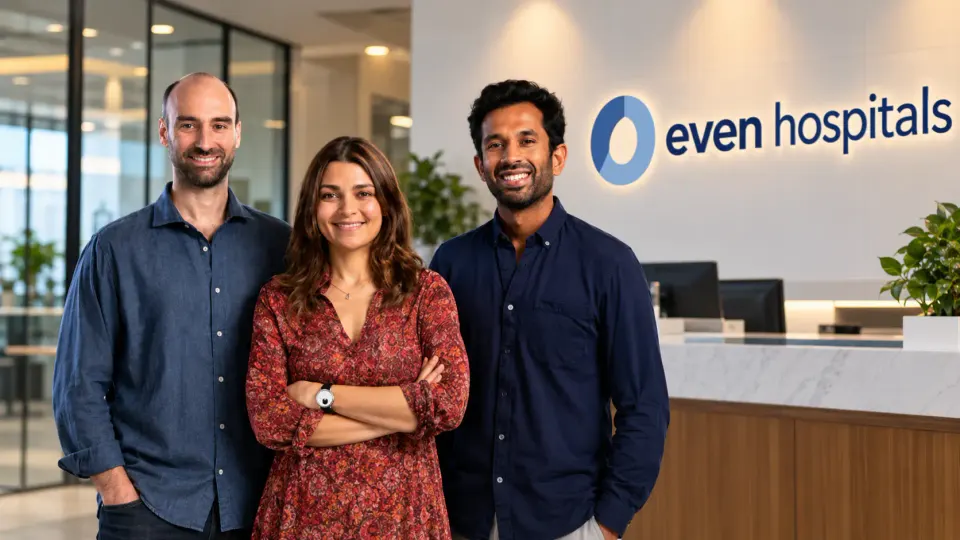
Mayank Banerjee, Matilde Giglio and Alessandro Ialongo founded the Bengaluru company in 2020. Banerjee is chief executive and Giglio chief operating officer; the two previously co-founded the journalism technology company Compass News. Even runs a membership-based model covering primary care, diagnostics and hospital services, with care teams managing patients across consultations, tests, hospitalisation and recovery after discharge, and works with insurance partners on cashless hospitalisation. It says it serves more than 2.5 lakh members across 10 cities.
It began as a membership platform working with partner hospitals and opened its first hospital in Bengaluru in 2025, a 70-bed multi-speciality facility. In January it published results from a tracked cohort, including no unplanned 30-day readmissions across more than 350 surgeries and average hospital stays about 40 percent shorter than comparable settings, and said the hospital had reached operating break-even within six months.
Khosla Ventures led Even's $5 million seed round in 2021 and its $30 million Series A in October 2024. Alpha Wave and Aspada invested $15 million in November 2022, and Lachy Groom and Alpha Wave led a $20 million round in January this year with Sharrp Ventures participating. The company cut about 350 jobs in August.
Even has not yet filed FY26 accounts. In FY25 its revenue rose about fourfold to ₹25.43 crore from ₹6.24 crore, and its loss widened to ₹90.15 crore from ₹72.40 crore.
Other companies building subscription or integrated care models include Superhealth, which pairs subscription consultations and diagnostics with fixed-price procedures, and the cancer care chain Oncare.
Why It Matters
Most Indian hospitals earn money the same way: per bed-day, per test, per procedure. That model pays a hospital more when a patient stays longer, has more scans or comes back after a complication. Nobody designs it to harm patients, but the incentive runs the wrong way, and insurance, which pays the bills at the end, has little say in what happens during treatment.
Even is built on the opposite incentive. Its members pay for a membership that covers their primary care, diagnostics and hospital treatment, so the company's costs fall when members stay healthy, recover quickly and do not need readmission. That is the logic of managed care, the model Kaiser Permanente built in the United States, where one organisation acts as both insurer and provider and profits from outcomes rather than volume. The figures Even publishes are the ones that model rewards: readmissions, length of stay, post-operative infections.
The model only works fully when the company controls the care. A membership that pays partner hospitals still inherits their fee-for-service habits. That is why Even moved from being a membership platform to building its own hospitals, and why this round goes into five more of them. The hospitals are the means of controlling cost and quality, not the business in their own right.
The Strategic Read
The losses put the ambition in context. Even lost ₹90 crore in FY25 on ₹25 crore of revenue, when it was still mostly a membership business without a hospital of its own. FY26 accounts, which will cover the first hospital's opening months, have not been filed. The company cut about 350 jobs in August, before this round closed, which points to a cost reset ahead of the next phase rather than a business running smoothly into it.
Hospitals change the economics in both directions. They are expensive to build and staff, and five at once is a large step for a company that has run one. But they also make the managed-care model real, because a membership is only as cheap to serve as the care behind it. The company's claim that its first hospital reached operating break-even within six months, against what it says is two to three years for many hospitals, is the most important number it has published. Repeating that five times over in six months is what this money is betting on.
Geography is the constraint worth noticing. Even counts more than 2.5 lakh members across 10 cities, but its hospitals are all in Bengaluru. Members elsewhere get the earlier version of the product, care coordinated through partner hospitals, with the incentive problems that come with them. The fully integrated model exists in one city, and Bengaluru's density is what makes it work there. Taking it further means building or controlling hospitals city by city, a capital decision on a much larger scale.
Khosla Ventures leading for a third time is a statement of conviction, and a tripled valuation in a year of layoffs and heavy losses suggests investors are paying for the hospital model's early results rather than the membership business's history. Managed care has worked at scale elsewhere, but it took decades and enormous capital, and India adds a population that pays for much of its healthcare out of pocket and is unused to paying for it in advance. Even's Bengaluru results are a promising start. The test now is whether six hospitals can behave like a system rather than one good hospital.
For daily, sharp analysis of the biggest moves in the Indian business and startup ecosystem, follow StartupFox.