



The Story
DaMENSCH has raised ₹17.40 crore across two tranches at a valuation that has not moved. The board approved the allotment of 887 compulsorily convertible preference shares at ₹1,69,052 each, raising ₹15 crore from existing backer A91 Partners. It separately issued 168 CCPS at ₹1,42,692 each to raise ₹2.40 crore from Tancom Electronics, a Mumbai electronics component manufacturer new to the cap table. The two tranches were priced differently, with Tancom paying roughly 16 percent less per share than A91.
Estimates place the valuation at about ₹600 crore, against a previous mark of ₹582 crore, or $70 million to $75 million. This is the second consecutive flat round: the company raised ₹21.62 crore from existing investors in May 2024, also without an uplift.
A91 remains the largest shareholder at 22.45 percent, followed by Matrix at 12.76 percent, Saama Capital at 11.14 percent and Whiteboard Capital at 9.61 percent. Co-founders Anurag Saboo and Gaurav Pushkar hold 10.87 percent each.
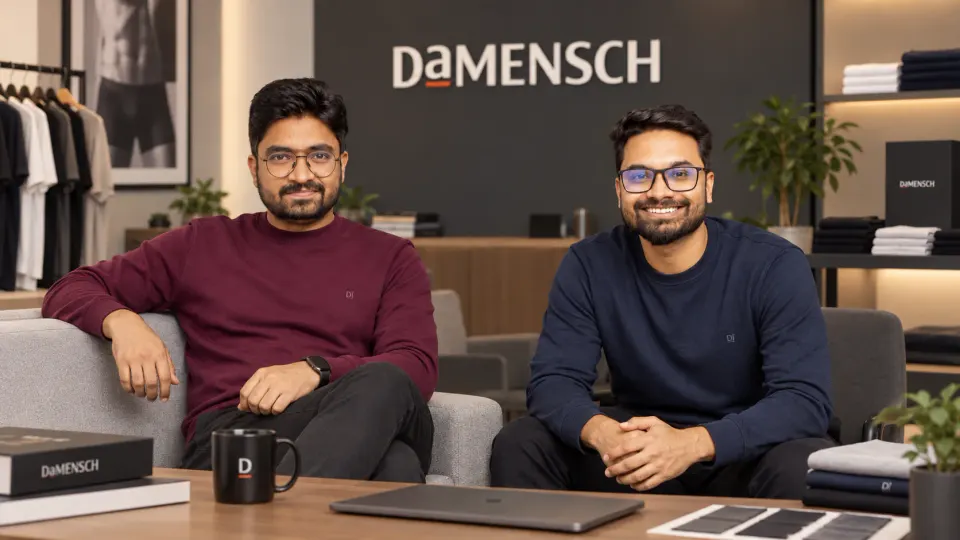
Saboo and Pushkar, both IIT Delhi graduates, founded the company in May 2018. It sells men's innerwear, loungewear and everyday apparel built around fabric engineering rather than fashion, including Deo-Soft odour-cancelling underwear and Neo-Skin bamboo-fibre vests, through its own site and marketplaces including Amazon, Flipkart and Myntra. It has raised over $28 million to date, including a $16.6 million Series B led by A91 in February 2022.
FY26 results have not been filed. In FY25, operating revenue grew 34 percent to ₹118 crore with net loss easing to ₹57 crore from ₹60 crore. Closest competitor XYXX grew 46 percent to ₹187 crore and cut its loss 28 percent to ₹25.5 crore, while the smaller Bummer reached ₹11 crore with losses doubling to ₹4 crore.
Why It Matters
The instinct is to read a flat round as a marketing problem, a brand that stopped growing because it stopped spending. The FY25 numbers say the opposite, and they are worth setting out properly.
DaMENSCH spent ₹27.5 crore on advertising in FY25. XYXX, its closest competitor, spent ₹50 crore, nearly twice as much. DaMENSCH grew 34 percent to ₹118 crore; XYXX grew 46 percent to ₹187 crore. So far this looks like a company that simply bought less growth. But the losses run the other way from what that would imply. DaMENSCH lost ₹57 crore, roughly 48 percent of its revenue. XYXX lost ₹25.5 crore, about 14 percent of its. The company spending less on customers is losing proportionally more than three times as much.
The rest of the cost lines explain it. DaMENSCH spent ₹69.5 crore on raw materials against ₹118 crore of revenue, close to 59 percent. XYXX spent ₹99 crore against ₹187 crore, about 53 percent. On employees, DaMENSCH spent ₹29 crore, a quarter of its revenue, while XYXX spent ₹26 crore, or 14 percent of a much larger base. Its expense-to-revenue ratio of 1.51 against XYXX's 1.16 is the summary of all of it.
That is not a demand problem or an advertising problem. It is gross margin and fixed cost. Fabric engineering, 500-day warranties and bamboo-fibre vests cost more to make, and a company with 200 SKUs across 15 categories carries more overhead per rupee of sales than one with a tighter range. The product story that made DaMENSCH distinctive is also what makes it expensive, and no amount of additional capital fixes that without changing the product or the scale it sells at.
The Strategic Read
Two details in the filing deserve more attention than the flat valuation.
The first is that the round was priced twice. A91 paid ₹1,69,052 per share. Tancom paid ₹1,42,692. That is roughly a 16 percent discount for the incoming investor against the existing one, in the same announcement. Different share classes or different closing dates can explain a gap like that, and nothing in the filing says which. But the direction is worth noticing: the new money came in cheaper than the old money, which is not what happens when a company has options.
The second is currency. The previous mark was ₹582 crore, described at the time as $70 million to $75 million. Today's ₹600 crore converts to roughly $63.5 million. The rupee number is marginally up and the dollar number is down more than ten percent, because the rupee has weakened considerably since the last mark was struck. Every dollar-denominated fund on this cap table is carrying DaMENSCH lower than before, whatever the rupee headline says. Flat is a domestic-currency description of a foreign-currency markdown.
Then there is the pattern. This is the second consecutive round without an uplift. DaMENSCH has not repriced upward since February 2022, which is four and a half years, and it has now raised roughly ₹39 crore across those two flat rounds. That is maintenance capital rather than growth capital, and ₹17.40 crore against a ₹57 crore annual loss is about four months of burn.
The founders' position tells the same story from the register. Saboo and Pushkar hold 10.87 percent each. Combined, the two people who started the company own less than A91 does alone. After $28 million raised and eight years, that is the arithmetic of a business that has needed more capital than it has generated, and each flat round makes the next one harder to price upward.
For daily, sharp analysis of the biggest moves in the Indian business and startup ecosystem, follow StartupFox.