


The Story
Flipkart said on Wednesday, 25 November, that group chief executive Kalyan Krishnamurthy will step down, ending nearly a decade at the head of the Walmart-owned e-commerce company. Chief product and technology officer Balaji Thiagarajan will lead the business with the board in the interim. A permanent successor will be announced in the coming weeks, the company said.
Flipkart did not give a reason for the departure or say what Krishnamurthy will do next. It has not confirmed a last working day either; Bloomberg has reported that he leaves on 4 December. The company has not said whether internal candidates, Thiagarajan among them, are being considered for the permanent role.
Krishnamurthy came to Flipkart from the investor side. He joined Tiger Global, an early backer, in 2011 and represented it on Flipkart's board before moving into the company in 2016. He became chief executive in January 2017 and group chief executive in 2018, the year Walmart bought a stake reported at about 77% for $16 billion. Flipkart says the business grew more than fivefold under his leadership. Chris Nicholas, president and chief executive of Walmart International, said: "Both Flipkart and Walmart are better because of Kalyan."
Thiagarajan, whose 25-year career includes stints at Google, Microsoft, Uber and Yahoo, joined in September 2025 to run Flipkart's OneTech organisation.
The exit follows that of group chief financial officer Sriram Venkataraman, announced in March, the same month Flipkart completed the shift of its domicile from Singapore to India. Flipkart Internet reported an FY26 net loss of ₹8,468 crore on revenue of ₹1,45,880 crore in its consolidated filings.
Why It Matters
Flipkart's chief executive runs the company, but the timetable that shapes the job is largely Walmart's. Walmart owns roughly 80% of the group, according to reports, and that ownership frames every decision a Flipkart chief executive makes.
On its reported FY26 numbers, Flipkart spent about ₹1.06 for every rupee of operating revenue, against ₹1.08 a year earlier. EBITDA loss narrowed 21.5% to ₹5,891 crore, yet net loss fell only 2.1%, because charges below the operating line, including a ₹2,922 crore ESOP cost, absorbed most of the gain. Walmart is reported to want EBITDA profitability before 2027. The Economic Times reported in May that the listing had been put on hold because of volatile markets and a crowded issuance calendar.
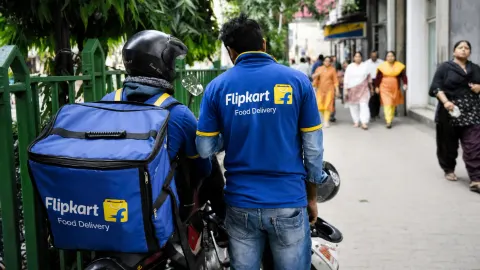
Those demands sit awkwardly with the business Flipkart has been building fastest. Flipkart Minutes, its quick commerce arm, had reached more than 150 cities and close to 1,200 micro-fulfilment centres by September, the company said. A dark store carries rent and inventory from the day it opens and pays back only once order density arrives. A chief executive asked to reach EBITDA breakeven while expanding that network is choosing a burn rate as much as a strategy.
Giving interim charge to the product and technology chief, rather than a commercial or finance executive, keeps the platform running without signalling a direction. That call has been left to whoever Walmart and the board appoint next.
The Strategic Read
The assumption being underwritten is that Flipkart's value at listing rests on the trajectory of its losses rather than on continuity at the top, and that a change of chief executive during a pre-listing period can be absorbed without a discount. Public-market investors usually pay for management stability. Flipkart will have announced the exits of both its group finance chief and its chief executive within a single year, with the top job held on an interim basis.
The moat case does not turn on who runs the company. Flipkart says it has more than 500 million registered users. Its reported FY26 accounts show logistics and shipping revenue of ₹23,059 crore and advertising revenue of ₹9,597 crore, both carrying better margins than the sale of goods and both resting on infrastructure that a new entrant cannot rebuild quickly. Those assets will be in place in January whoever is in the chair.
What does turn on the chief executive is how hard Flipkart pushes quick commerce while chasing an EBITDA target. Reuters pointed to competition from Amazon and from a newer set of quick commerce and online retail players. Flipkart Minutes is the group's response to the second set, and it is the line most likely to be slowed if the incoming leadership is told to put margin first. A slowdown would serve the profitability target and give up ground in the category where shopping habits are still forming.
Krishnamurthy took over in 2017 with a reputation, as Reuters reported at the time, for favouring profitable high-value categories over volume. That approach preceded Walmart's purchase a year later. His successor inherits the same tension under a tighter deadline, and Flipkart has said nothing about what it expects the new chief executive to do differently.
The indicator worth tracking is whether the appointment arrives within the weeks Flipkart has promised, and whether it comes with a listing timeline attached. A name without a timeline would suggest the IPO has moved further out.
For daily, sharp analysis of the biggest moves in the Indian business and startup ecosystem, follow StartupFox.