
 Flipkart
The Story
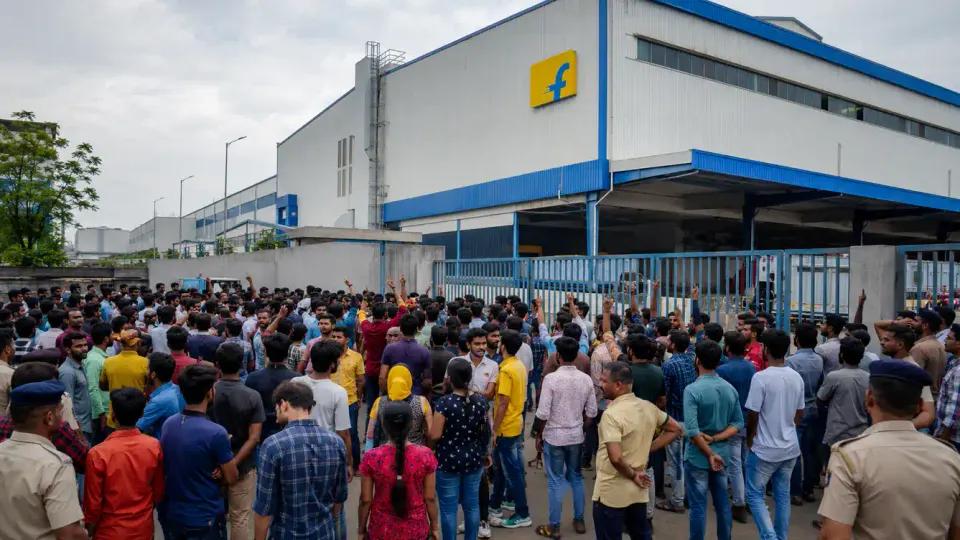
Operations at Flipkart’s FRK fulfilment centre in Farukhnagar face significant disruption following a strike by warehouse employees protesting unannounced structural salary cuts and reduced allowances. The agitation escalated over the weekend, prompting the deployment of local police to maintain order at the facility.
According to protesting workers and local reports, the e-commerce giant has allegedly reduced base salaries for certain warehouse roles from ₹18,000 to ₹13,000. Additionally, the workforce has raised grievances over sudden deductions linked to attendance mis-punches, diminished night-shift allowances, and a broader downgrade in job designations. Workers are demanding an immediate restoration of their previous pay structures, an end to arbitrary wage deductions for technical mis-punches, and the guarantee of minimum one-year contract durations to prevent abrupt terminations.
The Farukhnagar facility operates as a critical logistics node for Flipkart’s supply chain in North India, managing high-volume sorting and dispatch operations. The presence of law enforcement indicates the scale of the unrest, though no severe violence has been officially reported. As of publication, Flipkart has not issued a formal public statement addressing the specific wage reduction claims or the operational impact on delivery timelines in the National Capital Region (NCR) and surrounding markets.
Why It Matters
The unrest at the Farukhnagar fulfilment centre matters because it exposes the direct human consequence of the e-commerce sector's aggressive pivot toward profitability. For years, platforms like Flipkart funded operational expansion and attractive warehouse wages through private capital to build reliable logistics networks capable of servicing Tier-1 and Tier-2 demand. Now, with market leadership established and external capital demanding clearer paths to sustained operating profit, the focus has shifted entirely to unit economics and cost rationalisation.
However, this timing is critical. The market pressure to optimise costs is clashing with an increasingly organised and vocal platform workforce.
The Strategic Read
The unrest at Flipkart’s Farukhnagar facility suggests that the margin-expansion playbook in Indian e-commerce is entering its most difficult phase: extracting efficiency from the physical labour supply chain. This development indicates that the low-hanging fruit of cost optimisation—such as reducing marketing spend, cutting corporate headcount, or rationalising software infrastructure—has largely been harvested. Platforms are now restructuring base wages and allowances at the operational floor, signalling a ruthless focus on lowering the baseline cost of fulfilment.
The underlying business mechanism here is margin improvement through asset and labour utilisation. By enforcing stricter attendance penalties (mis-punches), downgrading roles, and trimming shift allowances, the company is attempting to standardise its labour costs at a lower market rate, likely betting that the current macroeconomic environment and local unemployment levels limit the workers' ability to easily switch to better-paying formal jobs. If Flipkart successfully resets this wage baseline without incurring long-term operational damage or regulatory intervention, the competitive consequence is significant: it establishes a new, lower cost standard for e-commerce warehousing in the region. Competitors, watching closely, may follow suit to maintain parity in fulfilment economics.
For daily, sharp analysis of the biggest moves in the Indian business and startup ecosystem, follow StartupFox.