



The Story
Bharat Semi, a chip design company with teams in India and Santa Clara, California, has raised $24 million (about ₹228 crore) in a seed round led by Info Edge Group, South Park Commons and IndusBridge Ventures. Micromax, Valour Capital and the New York-based syndicate Gaingels also invested, as did angel investors Mukul Agarwal and Karthik Sundar Iyer. The round is all equity.
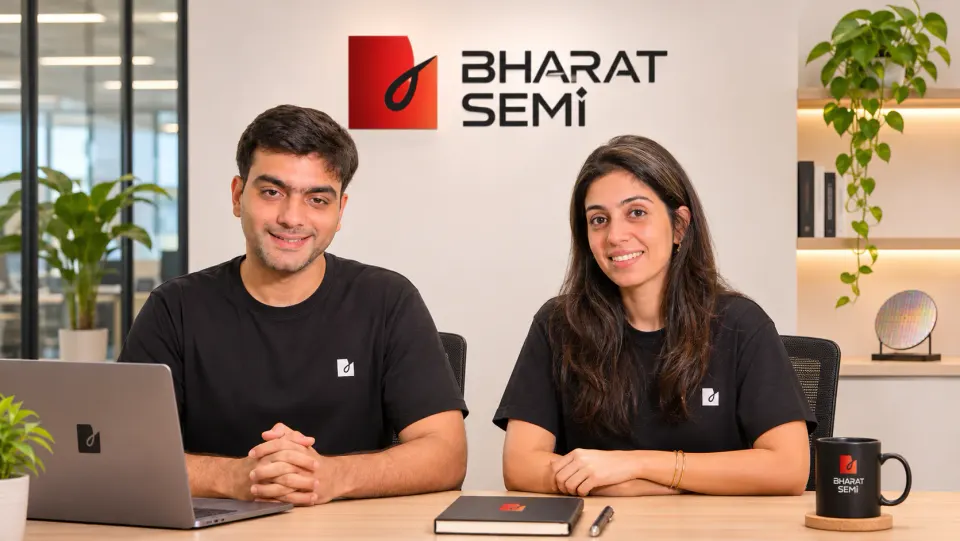
Vrinda Kapoor and Vinayak Dalmia co-founded the company in late 2021. Kapoor is a South Park Commons fellow and has worked on India's semiconductor initiatives with NITI Aayog's Frontier Technology Hub. Dalmia, the managing director, came from strategy work at McKinsey and from private equity. Chief technology officer Boyd Fowler held the same role at image-sensor maker OmniVision.
The product is a programmable image sensor that runs AI models on the same chip that captures the image. Bharat Semi is pre-revenue. Its first-generation sensors are in prototyping, and the company is targeting commercial production in 2027. It says a second generation with more advanced AI will reach prototype by mid-2027 and customers by the end of that year. It also says it has design wins with US defence technology company General Atomics and India's Kaynes Semicon. The company says it employs about 75 people, 10 to 12 of them in Santa Clara, and plans to take the US team to around 20 by mid-2027.
According to the company, the money will pay for more engineers, many of them in the US, and for taking the first sensors to market. It did not disclose a valuation or how the round was split among the three leads. It has not named the foundry that will manufacture its chips, nor said what volumes or terms sit behind either design win.
Why It Matters
A conventional camera module splits the work across separate chips. The image sensor turns light into raw pixel data and hands it to an image signal processor. A system-on-chip then runs the model that decides what the picture shows. Each hand-off pushes heavy data across the circuit board. That traffic costs power and time, and every extra chip adds to the bill of materials.
Bharat Semi's design moves inference onto the sensor, so the chip can pass along a result instead of full frames. The company says this cuts data movement between components by up to 99%. It also says system costs fall by at least 70% against a conventional three-chip setup, and by as much as ten times against standard multi-chip modules. These are design-stage claims, and none has been tested at production volume.
Programmability matters as much as integration. A fixed-function smart sensor is usually built around one product. A sensor that can be reconfigured for different AI models can, in principle, serve an air conditioner that notices an empty room as well as a drone that processes imagery without a costlier processor on board, the two examples the company gives. That range is what a fabless chip company needs. Its fixed costs sit in engineering salaries and the tooling for each chip generation, so margins depend on selling one architecture into as many product categories as possible. The first targets are consumer electronics and surveillance, where power draw and unit cost tend to decide the purchase.
The Strategic Read
Investors are underwriting the view that machines which see will push AI into the sensor itself, rather than into cheaper processors sitting behind ordinary cameras. If that holds, the sensor maker captures value that now goes to the system-on-chip vendor. If it does not, Bharat Semi ends up selling on price in a market where incumbents ship sensors in the billions.
That incumbency is the main risk. Sony leads the image-sensor market, followed by Samsung and OmniVision, and Sony launched a sensor with built-in AI processing in 2020. A startup cannot outspend them on pixel technology, so its case rests on programmability and price in products the incumbents treat as low priority. Hiring OmniVision's former CTO shows the company knows where the bar sits. It does not clear it.
The design wins help, though a design win is not an order. It usually means a customer has picked a part for a product still in development, and revenue follows only if that product ships. The General Atomics win fits the investor line-up, since IndusBridge Ventures is a Mumbai fund that backs defence and dual-use technology. Defence work opens doors but brings long qualification cycles and export rules that consumer electronics do not.
The company's history adds a second thread. In September 2024, Bharat Semi and its group company 3rdiTech were named in an India-US announcement of a compound-semiconductor fab tied to a technology partnership with the US Space Force. The company now says that fab is still in development and looking for Indian partners to build and run it. It describes the project as separate from the sensor business, and this round does not fund it.
Execution is the near-term test. The first-generation chips are still prototypes, and the plan has a second generation reaching customers in the same year commercial production begins. A fabless startup also queues for foundry capacity with little leverage. Seed rounds above $10 million remain uncommon for Indian-founded companies this year, yet $24 million is modest against the cost of taking two chip generations to market. A further raise before meaningful revenue would not be surprising.
For daily, sharp analysis of the biggest moves in the Indian business and startup ecosystem, follow StartupFox.