
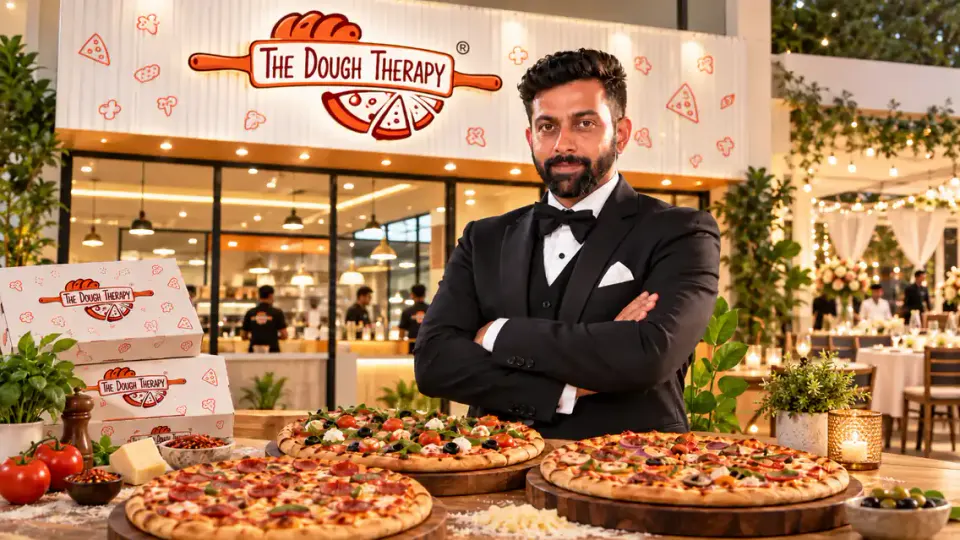

The Story
The Dough Therapy has raised ₹5.25 crore at a valuation of ₹35 crore in a seed round led by Michigan Capital Advisors, formerly known as Melwani Finance, with participation from Equiglobe Investment. It is the company's first institutional funding.
Abhishek Dedhia, Mohit Chheda and Gaurav Majrekar, three friends, founded the Mumbai brand in November 2020. It has grown from a single outlet to 10 across Mumbai and serves more than 30 varieties of gourmet pizza, all vegetarian or vegan.
The company plans to reach 20 outlets within the next 12 months and to enter new cities, using a mix of company-owned outlets, selected dine-in formats and franchise partnerships. It says 60 percent of the money will go into expansion, 15 percent into marketing and 25 percent into supply chain infrastructure, centralised operations and kitchen technology.
The brand says it has built a mix of new and returning customers. It has not disclosed revenue.
"This investment is an important milestone for us because it gives us the opportunity to take that vision to a much larger scale," Dedhia said, describing the next step as moving from building a presence in Mumbai to becoming a multi-market brand.
Why It Matters
Pizza is the most contested category in Indian food delivery, and the market leader sets the terms. Jubilant FoodWorks, which runs Domino's in India, operated more than 3,600 outlets across its brands as of 2024 and reported revenue of about ₹9,500 crore in FY26. Domino's competes on speed, price, coverage and a delivery promise that took decades to build. Pizza Hut, franchise-led chains such as La Pino'z, and cloud kitchen brands crowd in behind it. A 10-outlet brand cannot win any of those contests.
What it can do is sell something the large chains do not. The Dough Therapy's menu is entirely vegetarian and vegan, with more than 30 gourmet varieties, and in Mumbai that is a more significant choice than it sounds. The city has a large vegetarian population, and many vegetarian households prefer to order from kitchens where no meat is handled at all rather than from chains offering vegetarian options alongside chicken and pepperoni. An all-vegetarian kitchen is a trust signal that a mainstream chain cannot easily copy without changing what it is.
The gourmet positioning does the rest. A brand that charges more than the mass chains has to justify it with toppings, dough and variety rather than deals, and returning customers are the evidence that it does. The company says it has built a base of them, though it has not put a number on it.
The founding date is part of the story too. The brand opened in November 2020, when the pandemic had pushed much of the restaurant business onto delivery. Brands that started then were shaped by delivery economics from their first day.
The Strategic Read
The arithmetic of the expansion comes first. Sixty percent of ₹5.25 crore is about ₹3.15 crore. Spread across ten new outlets, that is roughly ₹31.5 lakh each if all were company-owned, which is tight in Mumbai once rent deposits, fit-out and kitchen equipment are paid for, and very tight for a dine-in format. That is why franchising is in the plan. A franchise partner puts up the capital for an outlet, letting the brand double its count with money it does not have, at the cost of handing day-to-day control of the product to someone else.
That is where the other quarter of the round matters. Supply chain, centralised operations and kitchen technology are less visible than new outlets and more important. Restaurant chains rarely fail for lack of locations; they fail when the tenth outlet tastes different from the first, and a gourmet brand charging a premium has less tolerance for that than a mass chain. For a pizza brand the core of consistency is in the name. Centralising dough and sauce production, so every outlet starts from the same base, is how pizza chains hold quality as they grow, and franchised outlets need it more than company-owned ones.
Leaving Mumbai is a different problem. The brand's recognition, its returning customers and its feel for the vegetarian market it serves are all local. A new city starts from zero on all three, and 15 percent of this round, a little under ₹80 lakh, is a modest marketing budget for launching anywhere. The natural candidates are cities with similar vegetarian demand and a population already ordering premium food online, and the first one will show whether the proposition travels.
The valuation is harder to judge, because the company has not disclosed revenue. At ₹35 crore, the round values the business at about ₹3.5 crore per existing outlet, and whether that is cheap or rich depends on what those outlets earn after rent and the commissions food delivery platforms take on every order. Restaurant businesses are ultimately valued on outlet-level profit, and that is the figure the next round will be priced on.
The investors are not among the familiar consumer venture names, and this is a modest first institutional round sized for a specific plan rather than a bet on hypergrowth. For a restaurant brand that is probably the right shape: enough to prove the model at twenty outlets and outside one city before anyone prices it as a national chain.
For daily, sharp analysis of the biggest moves in the Indian business and startup ecosystem, follow StartupFox.