
 Leanwatts
The Story
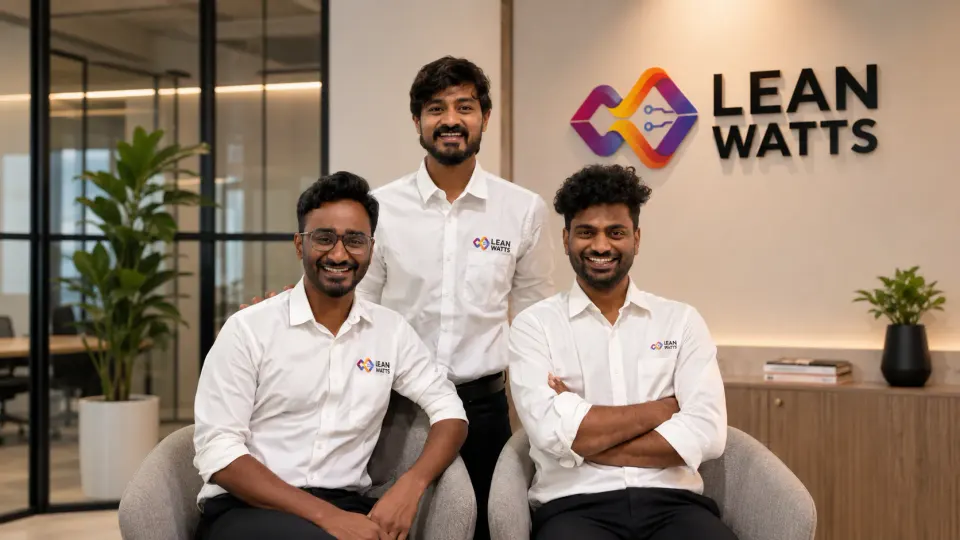
Leanwatts has raised about $2 million, or ₹18.15 crore, in a seed round released across two tranches and led by Trivest Partners, with angel investors Abraham George and Alok Rungta participating.
The Hyderabad company designs and manufactures power electronics for electric vehicles. Its current products are portable and onboard chargers rated between 500 watts and 6.6 kilowatts, sold to makers of electric two-wheelers, L2 and L5 category vehicles, and electric tractors. It runs an automated manufacturing facility in Hyderabad and keeps hardware design, embedded firmware and software, product engineering, validation, testing and quality control in house.
Pradeep Chowdary, Abhilash Reddy and Sujith Kumar founded the company in October 2023. Chowdary and Reddy are BITS Pilani alumni; Kumar studied at NIT Surathkal and IIM Udaipur.
The money goes towards supply chain, localisation, manufacturing capacity, research and development, and testing and validation laboratories. Leanwatts is targeting an annualised revenue run rate of roughly ₹60 crore by March 2027, from scaling its existing EV programmes and moving into new applications. Its roadmap includes public charging equipment, rectifiers, power modules and hybrid inverters.
The company's stated design premise is that hardware built for laboratory conditions does not survive Indian ones. Chargers here contend with high ambient heat, dust, humidity, unstable grid voltage and long daily duty cycles, particularly in three-wheeler and agricultural use.
Named peers include Neenjas Electric, Dynolt and IPEC. Elsewhere in Indian power electronics, Zenergize Technologies has raised $4 million in a pre-Series A round, Enerzolve Smart Technologies $5.1 million, and Dynolt $1.7 million last year.
Why It Matters
There is a useful distinction buried in this round, and it is the difference between the charger on the street and the charger inside the vehicle.
Public charging is the part of the EV transition that attracts capital and coverage, because it is visible and because its unit economics are legible. The onboard charger is neither. It is a sealed box of magnetics, switching devices and firmware bolted inside every electric vehicle sold, and almost nobody outside the industry knows it exists. It is also the more durable business. A public charging network competes on land, uptime and tariffs, continuously. An onboard charger competes once, at design-in, and then ships with every vehicle on that platform for years.
That is the position Leanwatts is buying with $2 million. Component revenue scales with a customer's production volume rather than the supplier's own headcount, which is why ₹60 crore of run rate by March 2027 is arithmetically possible for a company this size, even if it is not easy.
The segment choice looks deliberate as well. L5 three-wheelers and electric tractors are too small and too specific for the large global power electronics suppliers to build custom hardware for, and too demanding to serve with a generic imported module. An e-rickshaw running twelve hours a day in 45-degree heat on unstable single-phase supply is a genuinely different engineering problem, and it is one that rewards being local.
The Strategic Read
The word doing the most work in this announcement is localisation.
India's power electronics supply chain is thin in a specific way. The board, the enclosure, the magnetics and the assembly can all be done here, and Leanwatts already does them. The switching semiconductors cannot. MOSFETs, silicon carbide devices, gate drivers and controllers come overwhelmingly from suppliers in China, Taiwan, the United States and Europe, and no amount of seed capital changes that. Localisation at this cheque size means designing, integrating, testing and manufacturing in India a product whose most expensive components are still imported. That is a real achievement and a real business. It is not supply chain independence, and the two get conflated constantly in this category.
The larger structural risk is that Leanwatts does not control its own revenue. An onboard charger supplier's sales are a derivative of its customers' production volumes. Win a design slot at an electric two-wheeler manufacturer and you ship whatever they ship. India's electric two-wheeler makers have had a volatile three years, with subsidy regimes changing and at least one large player contracting sharply. A ₹60 crore run rate by March 2027 requires customers who are themselves growing on schedule, and none of that sits in Leanwatts' hands.
The competition named in the coverage is also not quite the real competition. Neenjas, Dynolt and IPEC are the visible startup peers, but a procurement head at a two-wheeler manufacturer is choosing between Leanwatts and an imported module that costs less, or an in-house team at a company large enough to build its own. Winning on ruggedness and local support against a cheaper import is a credible pitch. It is also one that has to be made again at every design cycle.
Raising across two tranches is worth noting for what it says about structure. Milestone-gated seed capital is standard in hardware, where money converts into tooling and inventory rather than headcount, and it usually means the second tranche was tied to something the company had to demonstrate first. That it was released is quietly the most encouraging detail here.
For daily, sharp analysis of the biggest moves in the Indian business and startup ecosystem, follow StartupFox.