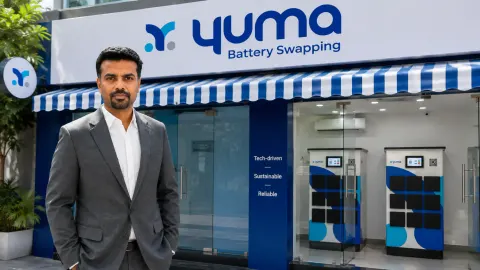


 Battery Smart
The Story
Battery Smart, the EV battery-swapping startup, has raised ₹185.5 crore ($19.5 million) in a Series C funding round led by existing investor Rising Tide Ventures, with participation from Ecosystem Integrity Fund and Blume Ventures. The round was announced on 21 August 2026.
According to the company's regulatory filings with the Registrar of Companies, its board approved the allotment of 34,094 Series C compulsorily convertible preference shares at an issue price of ₹54,407 each. Rising Tide Ventures contributed ₹112 crore ($11.8 million), Ecosystem Integrity Fund ₹49 crore and Blume Ventures ₹25 crore. The capital came in two tranches, of roughly ₹97 crore and ₹88 crore.
Entrackr estimates the round values the company at around ₹4,075 crore ($430 million) post-money. Battery Smart did not officially disclose a valuation, and no valuation should be read as confirmed. Notably, that estimate sits below the roughly $450 million the company was reported to have been valued at during its extended Series B round in mid-2025, which would make this a flat-to-down round rather than a step up.
The round follows a busy financing period. In March 2026, Battery Smart raised ₹66 crore in a pre-Series C round from Acacia Inclusion, Blume Ventures and PC-SBI Kurashi Visionary Fund, followed by $15 million in debt from Mirova in April. The company said the fresh proceeds will support business expansion, capital expenditure, working capital and general corporate purposes.
Founded in 2019 by Pulkit Khurana and Siddharth Sikka, both IIT Kanpur alumni, Battery Smart operates a battery-swapping network for electric two- and three-wheelers. Its battery-as-a-service model lets users, mainly gig-economy drivers, swap batteries rather than bear the high upfront cost of ownership. The company has raised over $211 million to date, with backers including Tiger Global, Blume Ventures and Ecosystem Integrity Fund, and is reported to be preparing to file draft IPO papers around September or October 2026.
Why It Matters
Battery Smart exists to solve a cost problem specific to India's commercial electric fleets. An e-rickshaw or delivery two-wheeler driver earns by the hour, and both the upfront price of a lithium-ion battery and the hours lost waiting for it to charge come straight out of that income. Battery Smart's answer is to separate the battery from the vehicle: the driver buys the vehicle without the battery, then swaps a depleted pack for a charged one at a nearby station in about two minutes.
The revenue mechanism is battery-as-a-service. Battery Smart owns the batteries and the swapping stations, and charges drivers per swap, turning a large one-off capital cost for the driver into a recurring operating cost. For the company, this is the opposite trade: it takes on the capital cost of owning hundreds of thousands of batteries in exchange for an annuity-like revenue stream from a high-frequency, high-utilisation user base that swaps daily.
That makes the cost structure unmistakably that of an infrastructure business. The batteries are the asset and the largest call on capital, which is why nearly every round, including this one, lists capital expenditure and working capital as the use of proceeds. The economics turn on utilisation and battery life: how many revenue-generating swaps each pack delivers before it degrades, against its purchase and eventual replacement cost. Density is what makes it work, because a swapping network is only useful if a charged battery is always close by.
However, the reported revenue growth does not by itself settle the question the model poses. Revenue of ₹358 crore rising 44% shows demand for swapping is real and growing, but the durability of the business rests on battery depreciation and replacement cycles that a top-line figure does not reveal, and those are precisely the costs that determine whether an asset-heavy swapping network can sustain the break-even it has just reached.
The Strategic Read
The market assumption changing behind this round is subtle, because the money is coming in just as the company approaches a public listing, and the terms suggest the market is repricing it on the way. An estimated $430 million post-money against a reported $450 million a year earlier is not a growth financing in the usual sense. It reads as a pre-IPO top-up raised by existing investors at a mark the company can defend to public-market buyers, rather than a fresh external endorsement of a higher price.
That framing matters because the operating story underneath is genuinely improving. Revenue grew 43.8% to ₹358 crore in FY26, and the loss narrowed to ₹23.55 crore from ₹27 crore, with the company reported to have hit operational break-even during the year. A capital-intensive infrastructure business approaching profitability at that revenue scale is a real achievement, and it is the number an IPO prospectus will lead with. The tension is that improving fundamentals and a flat-to-down valuation are pointing in opposite directions, which usually means the earlier private mark was ahead of what public markets will pay for an asset-heavy swapping network.
The model itself is the crux of the equity story. Battery Smart owns the batteries, more than three lakh of them by recent counts, and the swapping stations, then earns recurring service revenue as drivers swap. That is a balance-sheet-heavy way to build an energy network, closer to infrastructure than software, and it scales with capital deployed rather than code shipped. The bet is that density in each city produces utilisation high enough to cover the cost of the batteries, and that owning the physical layer becomes a moat as the two- and three-wheeler EV base grows. Depreciation and battery replacement are the line items that decide whether it works, and neither is visible in a revenue headline.
The competitive and macro risks are real for a company about to be priced daily. Sun Mobility, VoltUp and Mooving chase the same swapping market, and conventional fast-charging keeps improving as the alternative. The largest execution risk is the listing itself: taking an asset-heavy, still loss-making network public at a valuation its own latest private round did not exceed leaves little room for a stumble, and the FY26 break-even claim will have to hold through the June-quarter numbers the draft papers are built on.
For daily, sharp analysis of the biggest moves in the Indian business and startup ecosystem, follow StartupFox.