




The Story
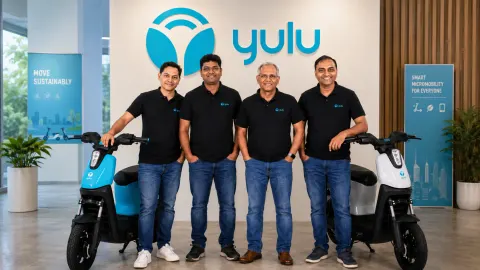
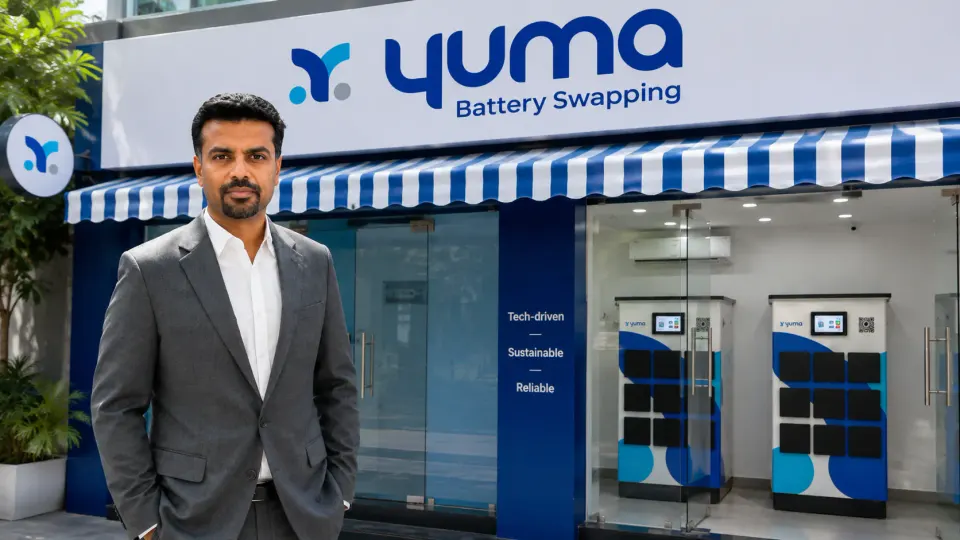
Yuma Energy has raised $35 million from Magna International. The Bengaluru battery-swapping company is not taking on a new backer. Magna already owned 51 percent of it, and this round lifts the Canadian auto supplier's total investment in Yuma to $87 million while increasing that majority stake. Yulu's 49 percent is diluted accordingly. Managing director Muthu Subramanian, who declined to disclose the new split, told TechCrunch that Yulu and Yuma remain Magna's only startup investments in India.
Yuma was formed as a Magna-Yulu joint venture in 2022, initially registered as Yulu Energy, and began operations in February 2023. Magna committed $77 million across the two businesses that year, $52 million of it to the swapping venture and $25 million to Yulu itself.
The company says it has completed more than 60 million swaps through a network of over 100,000 batteries, 2,500 charging units and more than 400 touchpoints across 18 cities, at 99 percent uptime and an average swap time under a minute.
Most of those swaps are Yulu's. Subramanian said 15 to 20 percent of swaps in the latest quarter came from other customers, and that he expects non-Yulu volume to reach about 25 percent within two years. Yuma now serves more than five fleets and has integrated its batteries with over ten vehicle platforms, including Kinetic Green, Motovolt, BGauss and Quantum Energy.
The money goes into network expansion. Yulu raised $93 million earlier this month to grow its own two-wheeler fleet, which Yuma has to keep supplied.
One point of correction: Yuma's acquisition of the Chennai battery maker Grinntech, which some coverage has tied to this announcement, closed in February 2025.
Why It Matters
Calling this a Series A does the story a disservice. An outside investor pricing a company for the first time is one kind of event. A majority owner writing a further cheque into its own subsidiary is another, and the second tells you about conviction rather than about market value.
On conviction, Magna's behaviour is unambiguous. $52 million at formation, $35 million now, $87 million in total, and a stake going up rather than holding flat. For a tier-one auto supplier whose only startup exposure in India is these two companies, that is a concentrated bet on a single thesis: that electrification of Indian two- and three-wheelers runs on swapped batteries rather than plugged-in ones.
The asset base is what the money buys. A hundred thousand batteries, 2,500 charging units, 400 touchpoints. Battery swapping is not a software business with a network effect that arrives free; it is infrastructure, and the capital requirement scales roughly with the size of the fleet it serves. Eighty-seven million dollars for that footprint is not extravagant. It is close to what it costs.
The Grinntech acquisition, eighteen months old now, is the more interesting structural move. Owning battery design and manufacture rather than buying packs changes the unit economics across an asset base this large, and it is the reason Yuma can credibly talk about vertical integration at all. The numbers underneath it moved too: Grinntech's revenue went from ₹3.8 crore in FY24 to ₹15.6 crore in FY25, the year Yuma bought it, though the deal closed in February 2025 so most of that growth came while the company was still independent. It is also the part of the business that most resembles what Magna already knows how to do.
The Strategic Read
The number that matters is 15 to 20 percent.
That is the share of last quarter's swaps that came from customers other than Yulu. Put the other way, four in five swaps still come from the company that co-owns Yuma and has just been diluted. Yuma's own target is 25 percent non-Yulu within two years, which means that even on plan, three-quarters of demand in 2028 comes from a single related party.
It is an awkward structure to sit inside. Yulu is Yuma's largest customer, its minority shareholder and its former parent. Pricing between the two is not observable from outside, so neither Yuma's revenue quality nor its margins can really be assessed by anyone who is not Magna. The dilution also cuts oddly against the customer relationship: Yulu now owns less of the business it depends on for energy, having just raised $93 million to grow a fleet that will need more of Yuma's batteries.
The diversification is real but early. Ten vehicle platforms and five fleets, including Kinetic Green, Motovolt, BGauss and Quantum Energy, is a genuine open-access story. It is also the hard part. Swapping only works if the pack is standardised across manufacturers, and Indian OEMs have every incentive to keep their own form factors and their own captive energy revenue. Whoever wins this market wins it by becoming the standard, and nobody has yet.
The financing structure is the other tell. Battery Smart, the closest comparable, raised ₹124 crore of debt from responsAbility in July. Debt is the right instrument for revenue-generating hardware with a predictable life. Equity from a strategic parent is what you use when the assets are not yet financeable on their own cash flows, or when the parent would rather have control than leverage. Both readings fit here, and Yuma publishes nothing that would settle which.
Sun Mobility and Gogoro are working the same problem with different capital structures. India will support one or two swapping networks at national scale, not five, and the deciding factor is which one reaches standardisation with its balance sheet intact.
For daily, sharp analysis of the biggest moves in the Indian business and startup ecosystem, follow StartupFox.