

The Story
Karta AI has raised $3 million in a seed round led by PeerCapital and Cedar Hill Capital, with Wyser VC, CDM Capital and Seedstars participating. The money goes into strengthening its end-to-end automation and multilingual capabilities, expanding deployments with financial institutions, scaling its engineering and go-to-market teams and developing self-learning capabilities.
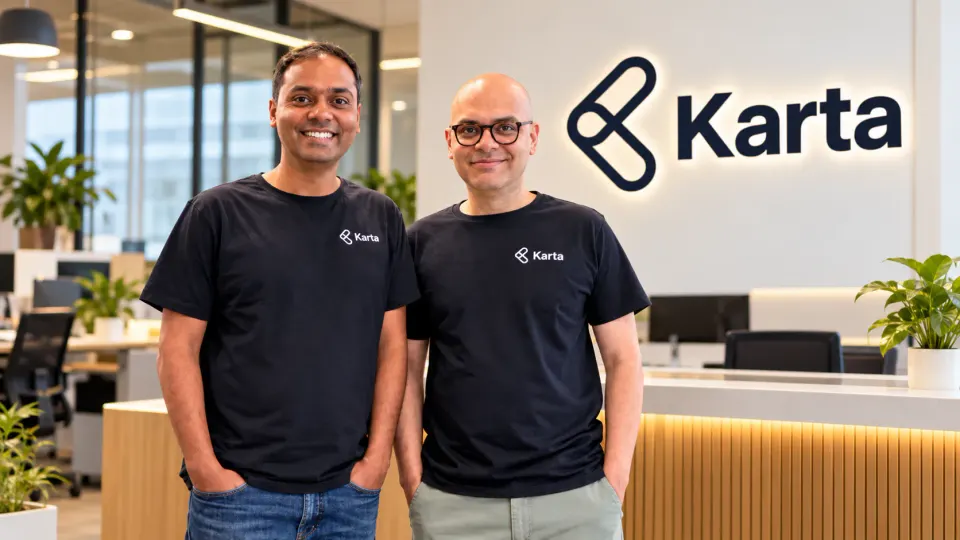
Vijaypal Singh and Abhishek Kushwaha founded the Bengaluru company in 2024 after leaving Razorpay, where they had worked on internal AI automation. Singh is chief executive. Karta AI began with chat-based automation, added voice in August 2025, and now runs a customer communication platform across voice, chat, email and WhatsApp, with voice as its focus.
It builds AI agents that handle inbound customer calls for banks, lenders, fintech companies and insurers. The agents connect to enterprise systems to answer queries and carry out workflows, bringing in a human only when escalation is needed. Instead of handling one question per call, the platform is designed to deal with several requests in a single conversation, and a predictive context engine draws on past interactions handled by both human agents and AI. It concentrates on what the industry calls level-two and level-three queries, which need information from more than one system.
The company says it is live with financial institutions, handles around 2 million customer conversations a month in more than 25 languages, and has 10 to 12 paying customers, including PhonePe, Bajaj and Aavas. Its inbound servicing agent resolves around 70 percent of borrower queries end to end, it says, in cases such as disbursal status, account statements, foreclosure statements and property document release, cutting the cost per query by about half. It uses models from OpenAI and Google's Gemini family alongside open-source models such as Kimi and Gemma.
"Inbound is where financial institutions carry the most cost and where customers feel the most friction," Singh said. "We built Karta AI to resolve the hard calls, the ones that need several systems and more than one answer, and to bring in a human only when it matters."
Over the longer term, the company plans to build reusable, industry-specific capabilities and expand internationally.
Why It Matters
Two weeks ago, Desible.ai raised money for AI agents that make calls on behalf of banks and insurers: collections, renewals, welcome calls. Karta AI works the other side of the line. Its agents answer when the customer calls in, and that is a different problem.
An outbound call follows a script the lender wrote. An inbound call follows whatever the customer brings, and customers rarely call about only one thing. A borrower might want to know whether a loan has been disbursed, ask for a statement and check on the documents for a closed loan, all in the same call. Traditional phone systems handle that badly. An IVR menu takes one request at a time, and a simple voice bot answers frequently asked questions but cannot look up a loan, produce a statement or chase a document. Those calls end up with a human agent who has to move between several systems to resolve them. That is where the cost sits, and it is where Karta AI has chosen to compete.
The examples the company gives are telling. Foreclosure statements and property document release are moments that matter a great deal to customers and are often handled slowly. They also carry regulatory weight: since December 2023, RBI rules have required lenders to return original property documents within 30 days of a loan being fully repaid, and to compensate borrowers ₹5,000 for each day of delay beyond that. An agent that can tell a borrower exactly where their documents are, and move the request forward, is helping solve a problem the lender is obliged to solve anyway.
The founders' background explains the focus. At Razorpay they worked on automating the company's own operations with AI, in a business where support volumes are high and most queries touch several internal systems. Karta AI turns that experience into a product for lenders and insurers.
The Strategic Read
The resolution rate is the headline number, and it needs the context the company itself supplies. Around 70 percent of borrower queries resolved end to end is a strong figure for the complex calls Karta AI targets. The other 30 percent still go to people, and how those calls are handed over matters as much as the automated ones. A customer who explains a problem to an AI and then has to explain it again to a human has had a worse experience than if the AI had never picked up. Passing the full context across is the part of these systems customers notice most.
The scale figures deserve a careful reading too. Two million conversations a month across 10 to 12 paying customers suggests volume is concentrated in a few large accounts, such as a payments company the size of PhonePe. That is normal at this stage, and it is also a risk, because losing or shrinking one big deployment would move the numbers sharply. The company's claim to have won every proof of concept so far is encouraging, with the caveat that young companies choose which pilots they take on.
The model strategy is sensible. Mixing models from OpenAI and Google with open-source ones such as Kimi and Gemma lets the company route each task to the cheapest model that handles it well, and keeps it from depending on a single provider's pricing or availability. Open models also give more control over where data is processed, which matters to financial institutions handling customer information under India's data protection rules.
The competitive field is crowded and well funded. Desible.ai raised ₹32 crore this month, Navana.ai ₹40 crore in a round led by Ronnie Screwvala, Rezolv $12.5 million led by Norwest, and Gnani.ai and Arrowhead are building in the same space. At $3 million, Karta AI's round is modest by comparison. Its argument is focus: inbound servicing, the hardest calls, handled well enough that lenders retire the vendors they already use. With paying customers that include some of India's largest financial companies, it has made a credible start on that argument.
For daily, sharp analysis of the biggest moves in the Indian business and startup ecosystem, follow StartupFox.