

 VaareeHHero EnterpriseCCap Alpha VenturesPPeerCapital
 All In CapitalSSattva VenturesOOTP Ventures
The Story
Vaaree has raised ₹65 crore, about $6.6 million, in a Series A round led by Hero Enterprise and Cap Alpha Ventures, formerly known as Client Associates Alternate Fund. The round was announced on 4 August 2026.
The valuation, the dilution and the split between the two lead investors have not been disclosed, nor has any participation by existing backers in this round.
The capital is earmarked for expanding the fulfilment network to enable faster deliveries, adding fulfilment and quality verification centres in key markets to hold inventory closer to customers, and investing in the company's AI product discovery and home styling technology. Vaaree says it is working towards next-day delivery across major Indian cities.
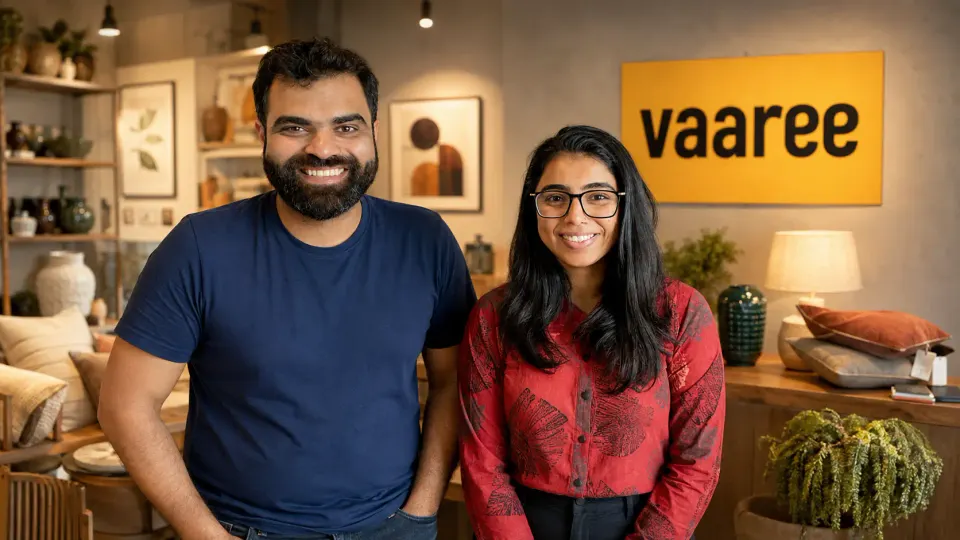
The Bengaluru company was founded in 2022 and operates a curated marketplace for home products across décor, furnishings, bed and bath, kitchen and lighting, listing more than 1.5 lakh products. Its VibeCheck platform recommends products from stated preferences and lets users create moodboards, visualise combinations and shop coordinated looks. It sources directly from export-grade factories under a factory-to-home model.
The announcement names two of the three founders. Vaaree was founded by Garima Luthra, who is chief executive, alongside Varun Vohra and Pranav Arora. Vohra previously co-founded and exited Aknamed, acquired by API Holdings, and Genii, acquired by Practo.
Earlier funding is not mentioned in the announcement. Vaaree raised $4 million in seed funding in November 2023 led by Surge, Peak XV Partners' scale-up programme. Its pre-Series A first closed at ₹20.78 crore, about $2.5 million, in May 2024, led by Capier Investments with Surge, at a post-money valuation estimated from the filing at around ₹180 crore. That round was extended to $4.6 million in July 2025 with PeerCapital leading, alongside Sattva Ventures and the Asian Paints family office. Disclosed funding now stands at roughly $15 million. Other existing investors include All In Capital, Better Capital, OTP Ventures and Kunal Shah.
No valuation has been disclosed for this round, and no gross merchandise value, order volume, average order value or repeat purchase rate has been published.
Why It Matters
Home furnishing in India has historically forced a choice between imported brands priced for a small audience and unbranded goods of unpredictable quality. The factories that make the first category for export markets sit in India already, and Vaaree's model is to buy from them directly and sell domestically, keeping the margin that would otherwise go to an importer or a brand.
That makes curation the product. A marketplace listing 1.5 lakh items has a discovery problem rather than a supply problem, which is what VibeCheck is built to solve: recommend from stated taste, assemble moodboards, sell coordinated sets rather than individual pieces. Basket size, not traffic, is the metric that model is designed to move.
The filed accounts show what that has cost so far. Operating revenue grew from ₹1.91 crore in FY23 to ₹7.06 crore in FY24, close to fourfold. Expenses grew faster, from ₹5.59 crore to ₹25.21 crore, and the net loss widened from ₹3.5 crore to ₹15.79 crore. Advertising and employee costs drove most of that increase, which is the signature of a company buying growth rather than earning it.
The structural question sits in the revenue mix. Nearly 90% of FY24 operating revenue came from services rather than product sales, meaning Vaaree books commission on marketplace transactions rather than the value of goods sold. That keeps the revenue line small relative to what customers actually spend, and it makes the loss ratio look worse than the underlying trade. It also means a rupee of extra warehousing capacity has to be justified by commission, not by gross merchandise value.
What remains unpublished is everything after FY24. Vaaree has filed no FY25 or FY26 accounts in the public record, and has disclosed no average order value, return rate beyond a claimed sub-5% figure, or repeat purchase rate. The catalogue has roughly doubled since July 2025, but catalogue growth measures how many suppliers have signed up, not how much anyone is buying.
The Strategic Read
The market assumption being underwritten is that Indian home décor moves online in the way apparel did, and that it needs a specialist to do it. The category has the right characteristics for that argument: highly fragmented supply, no trusted national brand at mid-market prices, and a purchase where the shopper genuinely does not know what they want until they see it arranged.
Vaaree's answer to the last part is VibeCheck, and the moodboard framing is the right instinct. Nobody buys a cushion cover in isolation; they buy a room. A platform that sells the arrangement rather than the item raises basket size without raising acquisition cost, which is the only lever that reliably fixes marketplace economics.
The problem is that discovery software is the most copyable thing in the stack. Any competitor can ship an AI styling tool within a quarter, and the large horizontal platforms already have the traffic to make one work better. What is not copyable is the supply relationship with two hundred export-grade factories and the fulfilment network being built now, which is presumably why the money is going into warehouses rather than features.
Next-day delivery is where the ambition outruns the cheque. Home goods are bulky, variable in size and expensive to hold, and same-city inventory positioning across major Indian cities is a capital commitment measured in hundreds of crores, not sixty-five. Quick commerce platforms have already begun stocking home categories with far deeper balance sheets behind them.
The investor mix is the quiet signal in this round. A family office and a wealth-management fund replacing venture leads at Series A, with no valuation disclosed and no stated participation from Surge or PeerCapital, describes a different financing environment than the one that funded the seed. Set against FY24 accounts showing a loss more than twice revenue, ₹65 crore reads as capital to prove the unit economics rather than to scale them.
For daily, sharp analysis of the biggest moves in the Indian business and startup ecosystem, follow StartupFox.