




The Story
Pixxel has raised $100 million in a Series C round co-led by Temasek and Seraphim Space, with new investors 360 ONE Asset and IMM Investment joining existing backers Radical Ventures and growX Ventures. The round takes the Bengaluru company's total funding to $195 million, and it is the largest single raise by an Indian spacetech company. Reported figures put the valuation at $450 million to $500 million.
The money goes into expanding beyond hyperspectral imaging. Pixxel plans to build advanced sensing satellites, develop high-resolution optical imaging spacecraft, extend its Honeybee constellation, scale the Aurora Earth intelligence platform and increase manufacturing capacity through its Gigapixxel facility, alongside work on sovereign space systems.
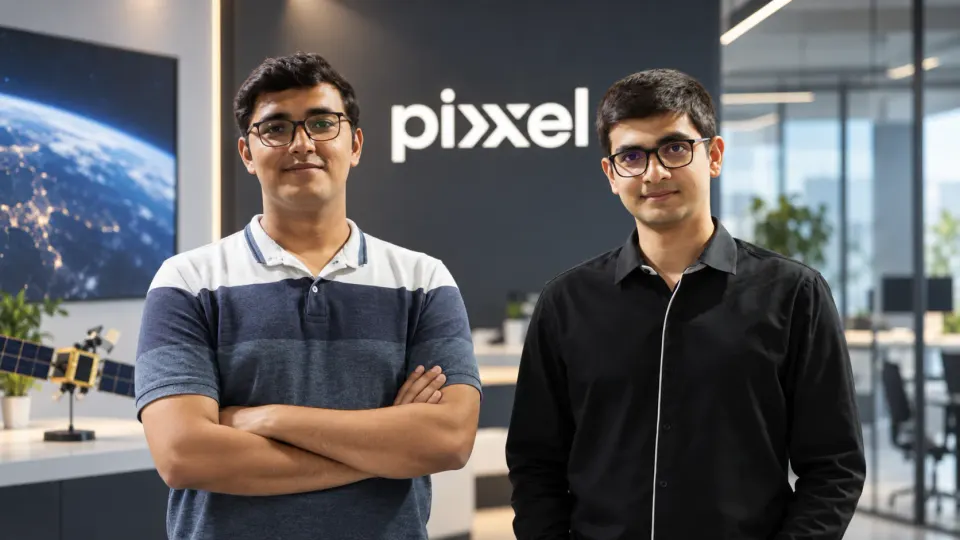
Awais Ahmed and Kshitij Khandelwal founded the company in February 2019 while still undergraduates at BITS Pilani, initially funding it with money borrowed from Ahmed's father. Its six Firefly satellites, all launched during 2025, image at 5-metre resolution across more than 150 spectral bands with a 40 km swath, which the company describes as the sharpest commercial hyperspectral imagery flown.
Pixxel holds a place in NASA's $476 million Commercial SmallSat Data Acquisition programme, running to November 2028, and signed a five-year agreement with the US National Reconnaissance Office in May to integrate hyperspectral data into its remote sensing architecture. In India it has won multiple Ministry of Defence iDEX challenges and was selected to lead the country's first public-private Earth observation constellation, twelve satellites under IN-SPACe.
Its India entity reported operating revenue of ₹39.3 crore in FY25 against ₹30.6 crore the previous year, with net loss widening to ₹30.8 crore from ₹20.4 crore. The company has said a substantial share of revenue sits in overseas subsidiaries not captured in those filings.
The round follows Skyroot Aerospace crossing $1 billion to become India's first spacetech unicorn.
Why It Matters
The interesting thing about Pixxel is not that it takes pictures of Earth. Plenty of companies do. It is what its satellites can see that others cannot.
A conventional Earth observation satellite captures around eight colour bands, enough to tell you a field is green. Hyperspectral sensors capture hundreds of narrow, contiguous bands, which means they read a material's spectral signature rather than its appearance. That is the difference between knowing a field is green and knowing which part of it is nitrogen-deficient, or spotting a methane leak from a pipeline, or identifying the mineral content of a mine tailings pond from orbit. Pixxel's Fireflies do this at 5-metre resolution across more than 150 bands, which is the sharpest anyone has flown commercially.
That capability is why the customer list looks the way it does. NASA took Pixxel into a $476 million data programme as its youngest participant. The National Reconnaissance Office, the agency that runs American spy satellites, signed a five-year agreement. Neither of those buyers is easily impressed, and neither had to choose an Indian-founded company.
The founding detail is worth keeping in view. Ahmed and Khandelwal started this as undergraduates, borrowing money from a parent and living on around ₹10,000 a month while building prototypes. Seven years later they operate a constellation and sell into two American agencies. That path is now the most valuable thing India's deep-tech ecosystem has: proof it can be walked.
The Strategic Read
The valuation is not being set by revenue, and it is worth being clear about the gap.
The India entity booked ₹39.3 crore of operating revenue in FY25 and lost ₹30.8 crore, against ₹30.6 crore and a ₹20.4 crore loss the year before. Set that against a reported $450 million to $500 million and the multiple has no sensible interpretation. The company's answer is that a substantial part of its revenue runs through subsidiaries in the United States, Europe, the Middle East, Southeast Asia and Australia, which the Indian filings do not capture, and that is almost certainly true given where its largest customers sit. But consolidated figures have not been published, so the only revenue anyone outside the company can verify is a number that looks nothing like the price.
What is being priced instead is the contracted pipeline. NASA through 2028, a five-year NRO agreement, iDEX awards, and the IN-SPACe constellation. Those are the collateral, and for an Earth observation company they are better collateral than commercial sales, because government programmes renew and expand while commercial imagery buyers churn on price.
The move beyond hyperspectral deserves more scrutiny than it will get. Pixxel's defensible position is spectral depth: 150-plus bands against the eight on a conventional multispectral satellite. That is a genuine step change and very few operators can match it. High-resolution optical imaging, which the new money also funds, is the opposite kind of market. Planet, Maxar, BlackSky and Satellogic are already there, the product is close to commoditised, and it competes on price and revisit rate rather than on anything proprietary. A company leaves a defensible niche for a crowded one when it concludes the niche is not large enough to support the valuation it has taken. That may well be the right call. It is still a different business.
The structural asset here is the one nobody quite says out loud. Pixxel is a US-India company by construction: the parent is incorporated in Delaware and sits in El Segundo, while the Bengaluru entity does the engineering and manufacturing. In-Q-Tel, the venture arm of the American intelligence community, is on the cap table. That architecture is what lets a company founded in a BITS Pilani dorm hold a five-year contract with an American intelligence agency while simultaneously leading India's sovereign Earth observation constellation and winning Indian defence challenges. Sitting inside two states' intelligence supply chains at once is unusual, and it is a large part of what a sovereign fund like Temasek is underwriting.
It is also the exposure. Companies whose market access depends on how two governments read their ownership are hostage to a relationship they do not control.
For daily, sharp analysis of the biggest moves in the Indian business and startup ecosystem, follow StartupFox.