

The Story
Lickicious has raised ₹19 crore in growth capital through a mix of equity and institutional debt, led by Prath Ventures. The founders of the appliance company Atomberg and several senior industry executives are among its early backers. The split between equity and debt has not been disclosed.
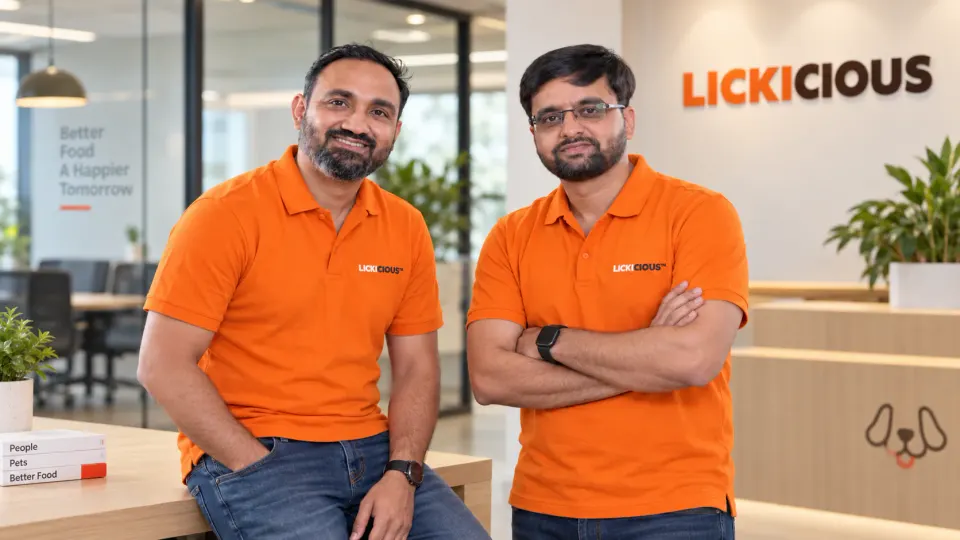
The brand sells dry food, wet food and treats for dogs and cats, and is operated by Nuvexo Wellness Private Limited, a company incorporated in Uttar Pradesh in 2023 with a registered office in Varanasi. Shashwat Sahai and Chandan Jha founded it, and the two make up its board. The range was developed over a year of testing with more than 500 consumers, and the company positions it on palatability, transparent nutrition and quality.
The money goes into capacity, capability and category expansion. Lickicious is building a 60,000 square foot manufacturing and distribution footprint to raise production capacity, improve supply reliability and hold more control over quality. It also plans to spend on research and development, supply chain, brand and commercial functions, and to widen its range across products, formats, species and sales channels as it moves from a digital-first model to an omnichannel one.
The company is targeting ₹100 crore in annual revenue and says it wants to be among India's top three pet food companies within a decade. Filings for Nuvexo Wellness show revenue of under ₹10 crore for the year to March 2025, with paid-up capital of ₹17.8 lakh.
It currently sells through its own channels, Amazon, quick commerce platforms and social, and counts Dogsee Chew, Goofy Tails and Khanal Foods among its nearer competitors.
Why It Matters
Most consumer brands at this stage raise money to buy customers. This one is raising it to build supply, and in pet food that is the correct instinct.
Kibble is heavy, cheap per kilogram and bought again every few weeks. Those three properties together are hostile to pure ecommerce: shipping a 10 kg sack to a customer who pays a few hundred rupees for it destroys the unit economics, and no amount of brand affinity fixes freight. The category is won on availability and cost, which means being in the neighbourhood pet shop and the vet's clinic as much as on a marketplace, and it means controlling what a bag costs to make. That is a manufacturing and distribution business wearing a brand's clothes.
India's pet food market bears this out. The companies with real share are the ones that own plants and route-to-market rather than the ones with the best packaging. Building a 60,000 square foot facility at two years old looks premature against a D2C playbook and entirely rational against this one.
The Atomberg founders on the cap table point the same way. Atomberg took on entrenched Indian appliance makers by owning its engineering and manufacturing rather than outsourcing and outspending. That is a specific view about how an Indian consumer company beats incumbents, and it is money that understands what it is backing.
The Strategic Read
The arithmetic is the part to sit with.
Filings put Nuvexo Wellness under ₹10 crore of revenue for the year to March 2025, with paid-up capital of ₹17.8 lakh. The target is ₹100 crore. That is at least a tenfold climb, funded by ₹19 crore of which an undisclosed portion is debt rather than equity. Debt is a reasonable instrument for a company buying an asset it will own, but it converts a growth plan into a fixed obligation, and those obligations begin before the factory produces anything. No timeline has been attached to the ₹100 crore, which makes it a direction rather than a forecast.
The competitive picture is where the ambition gets difficult. Being among India's top three pet food companies means displacing either Mars, whose Pedigree and Whiskas brands have been in Indian shops for three decades, Nestlé's Purina, or Drools, the domestic player that already did what Lickicious is proposing to do and has a decade's head start on capacity. Godrej has since entered the category too, which means the next competitor for shelf space is a conglomerate with existing distribution into every kirana in the country. None of these lose share to better storytelling. They lose it to someone who matches them on availability and undercuts them on cost per kilogram, which is a manufacturing problem before it is a marketing one.
Distribution is the harder half and it barely features in the announcement. A pet food brand in India has to be in neighbourhood pet shops and veterinary clinics, which means thousands of small accounts, credit terms and a field sales force. That is a different organisation from one selling on Amazon and quick commerce, and it is expensive to build. Chandan Jha has been recruiting for distribution roles, which suggests the company knows this.
What is genuinely encouraging is that nothing here is being spent on the wrong thing. A young brand raising to build supply rather than to buy customers is unusual, and the company says outright that it spends less on advertising in order to put more into the bag. That reads as a business that understands its category rather than one following the D2C script. Whether ₹19 crore is enough to build a factory, staff a distribution business and still fund working capital is the open question, and the likely answer is that this is the first of several rounds.
For daily, sharp analysis of the biggest moves in the Indian business and startup ecosystem, follow StartupFox.