
 Asaya
AsayaThe Story
Asaya, a direct-to-consumer skincare brand, has raised ₹88 crore ($9.2 million) from RPSG Capital, OTP Ventures, Huddle Ventures, Hyperscale Ventures and 72 Ventures at a post-money valuation of ₹400 crore. The round was announced on 24 August 2026.
The round comprised both primary and secondary capital, with some early angel investors selling their stakes. Asaya did not disclose the split between the primary and secondary components, or the equity diluted.
The Bengaluru-based company had previously raised ₹28 crore in a pre-Series A round led by RPSG Capital in September 2025, at a reported post-money valuation of about ₹138 crore. The valuation implied by this round is therefore close to three times that mark in under a year, a steep step up for a business of this revenue scale.
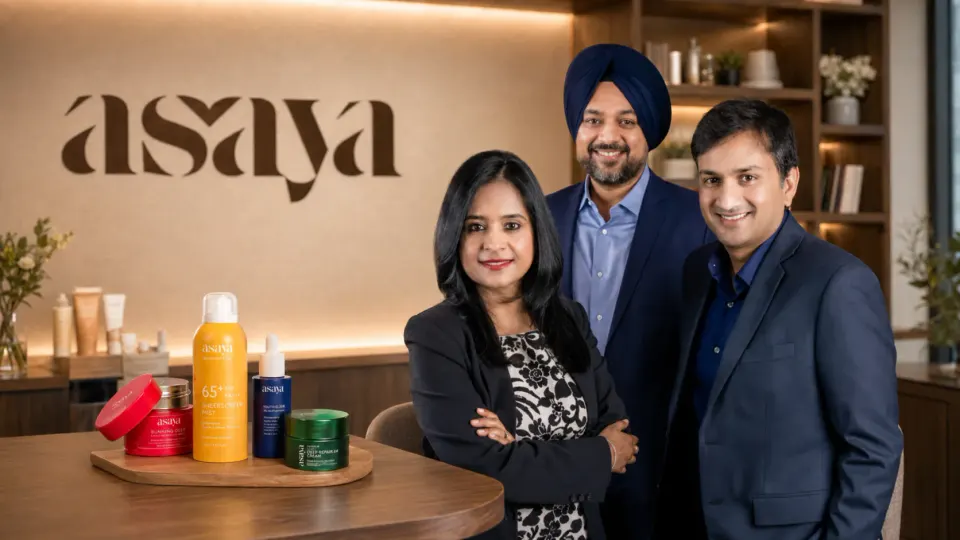
Founded in 2021 by Neeraj Biyani, Eeti Sharma and Mandeep Singh Bhatia, Asaya sells skincare products targeting hyperpigmentation, dehydration and acne, with a portfolio spanning dark-spot correcting serums, even-tone creams, body sprays, cleansers and sunscreens. Biyani, the chief executive, was earlier a co-founder of the beverage brand Paper Boat. The brand follows a D2C model, selling through its own online channels, quick-commerce platforms and select offline retail outlets, and has built its positioning around melanin-rich Indian skin.
At the centre of its pitch is a proprietary, patented molecule called MelaMe, which the company says is designed to address pigmentation and uneven skin tone specifically for Indian skin types. The proceeds will go towards research and development, product expansion, distribution and hiring.
For the financial year ended March 2025, Asaya's operating entity, Wellspring Consumer Private Limited, reported revenue of ₹7.09 crore, per its filings with the Registrar of Companies. The company has publicly targeted ₹35 crore in net revenue for the current fiscal.
Why It Matters
Asaya is built on a demographic argument that mainstream skincare largely ignored: that melanin-rich Indian skin has specific needs, and that hyperpigmentation, uneven tone and related concerns are widespread yet poorly served by products formulated for lighter, Western skin. The brand's whole design is to speak to that buyer directly, rather than treating Indian skin as a variant of a global default.
The product strategy follows from that. Asaya concentrates on pigmentation-led concerns with serums, even-tone creams, cleansers and sunscreens, and anchors the range in MelaMe, a patented molecule it says was developed specifically for Indian skin. The revenue model is direct-to-consumer, selling through its own site, quick-commerce platforms and select offline retail, which lets the brand own pricing, margin and the customer relationship rather than surrendering them to a marketplace or a distributor.
The cost structure of a science-led beauty brand is front-loaded into two places: research and formulation, which is where a patented molecule is expensive to develop but valuable to own, and customer acquisition, which in D2C beauty is relentless and rises as a brand scales. Asaya's stated use of proceeds, R&D, product expansion, distribution and hiring, maps to exactly that shape, funding both the science that is meant to differentiate it and the go-to-market that every D2C brand has to keep paying for.
However, the filed numbers show how early this still is. Revenue of ₹7.09 crore for FY25 is a small base, and while the company reports rapid growth since, the gap between that figure and a ₹400 crore valuation means the investment case rests almost entirely on what the brand and its molecule can become, not on what the accounts currently show.
The Strategic Read
The market assumption changing behind this investment is that specialisation beats breadth in Indian skincare. The last cycle rewarded broad D2C beauty brands that launched dozens of products across categories; Asaya is a bet on the opposite, a brand built around a single, historically underserved concern, hyperpigmentation on melanin-rich skin, and a patented molecule to own it. Investors are paying up for depth in a niche rather than reach across a shelf.
The valuation is where the bet becomes explicit, and where the caution belongs. A ₹400 crore post-money mark against ₹7.09 crore in filed FY25 revenue is a multiple that only makes sense on growth and the promise of MelaMe as defensible IP, not on current economics. The company reports rapid growth and a ₹35 crore revenue target for the year, and if that target is hit the valuation looks less extreme, but a filing-to-valuation gap this wide prices in a future that has not yet been delivered. The near-tripling of the valuation from ₹138 crore to ₹400 crore in under a year is investor conviction, not proven value, and the two do not always converge.
The patented molecule is the crux of whether this holds. If MelaMe is genuinely differentiated IP that competitors cannot easily replicate, Asaya has something most D2C beauty brands lack: a product moat rather than a marketing one. Skincare brands usually compete on formulation claims, influencer reach and repeat purchase, none of which is durable, and a patent that actually delivers on pigmentation for Indian skin would be a real barrier. The evidence for that is the company's own clinical claims, which no independent source has verified, so the moat is asserted rather than demonstrated.
The competitive field is crowded and consolidating. Foxtale, Deconstruct, Conscious Chemist and Pilgrim chase overlapping D2C skincare demand, larger houses like Dabur are buying into the category, as with its RAS Luxury investment, and strategic acquirers are circling science-led brands. The secondary component of this round, letting early angels cash out, is a normal mid-life liquidity event, but it also signals a lengthening path to exit. The largest execution risk is the one the valuation creates: at ₹400 crore, Asaya has to keep compounding fast enough to grow into the price before its next round, in a category where a well-capitalised incumbent can copy a positioning far faster than it can copy a patent, assuming the patent proves as defensible as the pitch claims.
For daily, sharp analysis of the biggest moves in the Indian business and startup ecosystem, follow StartupFox.