





The Story
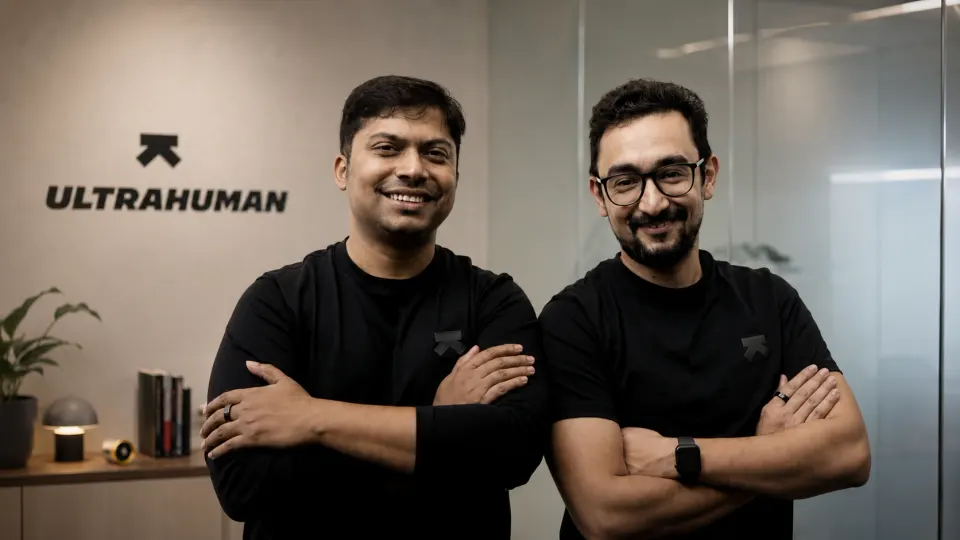
Ultrahuman has raised $70 million in a round led by Qualcomm Ventures, with Labcorp, Alpha Wave, Blume Ventures, Nexus Venture Partners and Alteria among the participants. Regulatory filings reported earlier in the week had put the round at $60 million, so it has closed above what was filed.
Earlier estimates place the post-money valuation at around $363 million, a 65 percent step-up on the Series B. The Bengaluru company had previously raised $35 million in Series B funding and $17.5 million in a Series A in October 2022.
The money goes into product development across sensing, AI, miniaturised electronics, health algorithms, clinical science and research. Ultrahuman says it intends to move from being a wearable health company to what it calls a human-computer interface company built around data from the body. Its platform now spans the Ultrahuman Ring, Blood Vision biomarker testing, the M1 and M2 Live continuous glucose monitors, Ultrahuman Home for environmental data, and the Jade AI system. It has added Pulsomics, an opt-in research platform through which Ring users can join studies on sleep, VO₂ max and glucose metabolism, alongside AFib detection, Cycle and Ovulation Pro, and a cardiovascular fitness age measure.
Mohit Kumar and Vatsal Singhal founded the company. The pair had previously built the logistics startup Runnr, which they sold to Zomato in 2017.
Ultrahuman reported ₹565 crore of revenue and ₹73 crore of profit after tax in FY25, and has projected roughly ₹1,000 crore for FY26. Those FY25 figures cover the twelve months to March 2025, which ended almost seven months before the United States barred its rings from import.
Why It Matters
Read this round against the last eighteen months and it looks less like a growth raise than a vote of confidence in an engineering team that has just survived something.
In August 2025 the International Trade Commission issued exclusion and cease-and-desist orders against Ultrahuman, after Oura asserted a patent covering the layered internal construction of a sensor-filled ring. From 21 October, Ultrahuman rings could not be imported into or sold in the United States, its largest market and roughly half its revenue. RingConn, the other respondent in the case, settled with Oura, took a licence, paid royalties and had its orders rescinded. Ultrahuman did not.
It redesigned the product instead. The banned Ring Air used a two-part housing, a titanium shell over an epoxy inner layer, which is precisely what the patent claims describe. The Ring Pro replaces that with a single continuously formed titanium tube and a snap-in cap. In March 2026, US Customs and Border Protection ruled the redesign falls outside the exclusion order, and the Ring Pro went back on sale in America while appeals continue.
That is roughly six months from losing half your revenue to shipping a hardware workaround that clears customs. It is the most impressive thing this company has done, and it explains why a chipmaker is leading the round. Qualcomm is not buying a wearables brand. It is buying into a team that redesigns miniaturised electronics under legal and commercial pressure, at speed, and gets it right.
The Strategic Read
The numbers everyone will quote are the wrong vintage.
₹565 crore of revenue and ₹73 crore of profit are FY25 figures, covering the twelve months to March 2025. The exclusion order took effect on 21 October 2025. So those results describe a company with unrestricted access to the market supplying about half its sales, a market it then lost for roughly five months of FY26 before the Ring Pro cleared customs in March 2026. FY26 accounts have not been published. Until they are, the profitable-hardware-company story rests on a period that no longer resembles the business.
The ₹1,000 crore FY26 projection was also made before any of this was resolved. Whether it survived a US import ban across the busiest stretch of the year is the single most useful thing anyone could publish about Ultrahuman right now, and it is absent from the funding announcement.
The legal position is better than it was, but not settled. Customs cleared the Ring Pro; it did not invalidate Oura's patent. The exclusion order still stands against the Ring Air, appeals continue, Ultrahuman has countersued in the Delhi High Court over Oura's Ring 4, and the validity of the patent has been under review at the US Patent and Trademark Office. A competitor that has already won once at the ITC has every reason to test the redesign. The Texas facility matters here: rings made in America cannot be excluded from import, because they are not imported.
Two names on the cap table point at where this is going. Labcorp is one of the largest clinical laboratory operators in the world, and Ultrahuman sells blood biomarker testing. That is a distribution and validation relationship dressed as an investment. Alteria is a venture debt firm, which means some portion of this $70 million is borrowed rather than equity, worth remembering whenever the headline number gets repeated.
The human-computer interface framing is a pitch for the next round rather than a description of the current business. Ring plus glucose plus blood plus home environment is a genuinely broader dataset than Oura's. It is also four hardware lines to manufacture, certify and support. Ultrahuman has just proved it can do difficult hardware quickly. Doing four at once, against a litigious market leader, is the harder test.
For daily, sharp analysis of the biggest moves in the Indian business and startup ecosystem, follow StartupFox.