

The Story
Circle has raised ₹25 crore in a seed round led by Nexus Venture Partners, with existing investors Titan Capital and Myntra co-founder Raveen Sastry participating. Delhivery chief operating officer Ajith Pai joined as an angel investor. Titan Capital led the company's ₹3.4 crore pre-seed round in November 2025, also with Sastry.
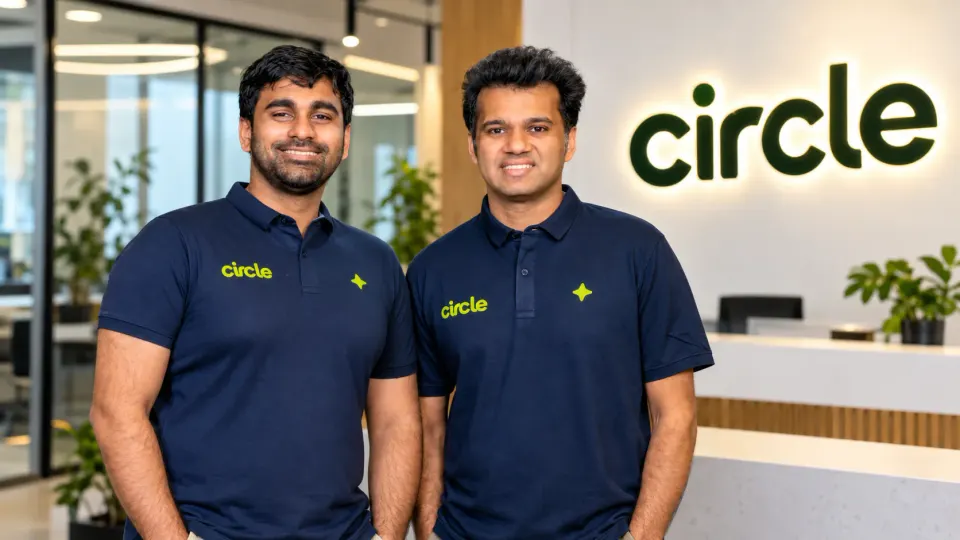
Chirag Kataruka and Ankit Misra founded the Bengaluru company in 2025. The two have been friends for 18 years and have built a startup together before. Circle soft-launched in August 2025.
Circle runs a managed customer-to-customer marketplace for pre-owned goods. It does not own inventory. Instead it handles the parts of a second-hand sale that tend to go wrong between strangers: AI-led verification of listings, including guided pricing, automated condition grading and catalogue matching; doorstep pickup and delivery; and secure payments with transaction protection. Its main categories include electronics, furniture, appliances and home goods.
In about a year it has facilitated around ₹25 crore of pre-owned sales, drawn more than 1 million visitors and generated 100,000 listings, all in Bengaluru. Nearly 40 percent of buyers return within 90 days, according to the company.
The money goes into expanding beyond Bengaluru and into AI-led pricing, discovery and verification, its Trust Hubs and its logistics network.
"Our ambition is to help 100 million Indians buy and sell with confidence on Circle," Kataruka said. Suvir Sujan, a partner at Nexus Venture Partners, said the founders had the potential to fundamentally reshape how India buys and sells pre-owned goods.
Why It Matters
Every Indian city has a vast, informal second-hand economy. People upgrade phones, change jobs and cities, move flats and get rid of furniture, appliances and gadgets that still work. Most of those goods change hands through classifieds and social media marketplaces, which do one thing well: they put a buyer and a seller in touch. Everything after that is left to two strangers. The buyer has to trust the photographs and the description, meet someone they do not know, inspect a laptop or a washing machine without knowing what to look for, and hand over money with no recourse. The seller has to deal with no-shows, haggling and the occasional scam. Many sales that should happen never do.
Circle's bet is that trust is the missing product, and that people will pay for it. It checks the listing, grades the condition, suggests a fair price, collects the item, delivers it and holds the payment until the buyer is satisfied. That turns a classified ad into something closer to an e-commerce order, with the convenience and protection buyers already expect when they buy new.
The size of the opportunity is not in doubt. Titan Capital has put India's pre-owned market at around ₹1.6 lakh crore, and households now buy and replace products faster than ever. The question has always been whether anyone can make a managed model pay.
The Strategic Read
The symmetry in the numbers is the place to start. Circle facilitated about ₹25 crore of sales in its first year and has now raised ₹25 crore. The first figure is the value of goods that changed hands, not Circle's revenue. The company earns a fee on each transaction and has not said how much, so the round is priced on growth and repeat behaviour rather than on what the business currently keeps.
The fee is the crux, because a managed model is expensive to run. Every sale involves a pickup, a check, a delivery and payment handling, often for items worth a few thousand rupees. A phone or a laptop carries that cost comfortably. A used sofa or refrigerator, which needs a vehicle and two people to move, is a different calculation. The economics depend on the mix of what sells, on how many pickups and deliveries a vehicle can complete in a day, and on what share of each sale buyers and sellers will accept as the price of safety.
The repeat figure is the best evidence so far that they accept it. Nearly 40 percent of buyers returning within 90 days suggests the experience is good enough to change behaviour, which is what a trust-led marketplace has to do to justify its cost.
Expansion is where it gets harder. Classifieds scale almost for free, because users do the work. A managed marketplace has to rebuild its operations in each new city: pickup teams, inspection capacity in its Trust Hubs and a delivery network dense enough to keep the cost per item down. That is a logistics problem as much as a software one, which makes Delhivery's chief operating officer a fitting angel, and it is why Bengaluru's density was the right place to prove the model before taking it elsewhere.
The asset-light choice matters too. Refurbishers that buy used goods, repair them and resell them carry inventory and price risk on every item. Circle never owns the goods, which protects its balance sheet. The trade-off is that it cannot control quality the way a refurbisher can, so its verification and grading have to be good enough that buyers trust a stranger's item as much as a refurbished one. That is where the AI investment is aimed, and it is the part of the model that has to hold as volumes grow.
For daily, sharp analysis of the biggest moves in the Indian business and startup ecosystem, follow StartupFox.