
 Third Wave Coffee
The Story
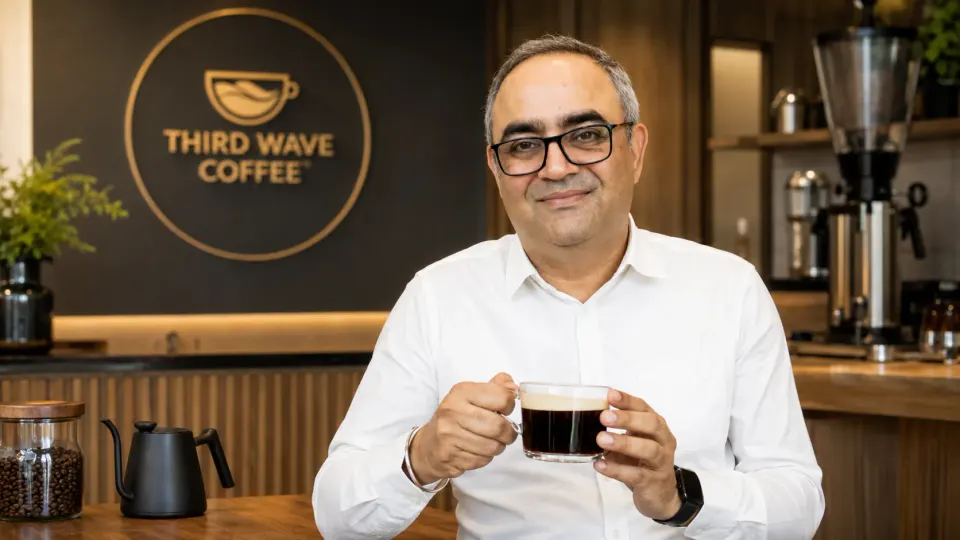
Third Wave Coffee, the Bengaluru-based specialty coffee chain, has raised ₹408 crore ($43 million) in a funding round led by existing investor WestBridge Capital, with most of the capital coming through a primary issuance. The round was announced on 24 August 2026.
Existing investor Creaegis and other angel investors also participated. According to a Mint report, the round values Third Wave Coffee at around ₹2,000 crore ($210 million), up from about ₹1,200 crore ($150 million) at its previous round in 2023. The company did not officially confirm the valuation, and it should not be read as disclosed.
Third Wave Coffee said the capital will support expansion in existing markets, growth into high-potential cities and the acceleration of its Third Rush Desserts segment. It plans to enter nine new cities in the coming months, including Ludhiana, Jalandhar, Amritsar and Lucknow, and to deepen its presence in tier II and tier III cities.
Founded in 2017 by Sushant Goel, Ayush Bathwal and Anirudh Sharma, the company operates cafes and sells packaged products such as coffee beans and cold brew bags, with a presence across Bengaluru, Delhi, Pune, Mumbai and Hyderabad. WestBridge has backed the company since its Series A round and led its $21 million Series B in 2022, while Creaegis led the $35 million Series C in 2023. The latest round takes total funding past $105 million.
The raise follows a difficult stretch and a change at the top. Soon after the 2023 fundraise, Third Wave Coffee laid off around 100 employees, and in early 2024 co-founder and then chief executive Sushant Goel stepped down from the CEO role and moved to the board. Rajat Luthra, former chief executive of KFC India and Nepal, was appointed to replace him. In FY25, the company's operating revenue stood at ₹285 crore and its net loss narrowed to ₹94 crore. It has yet to file its FY26 financials.
Why It Matters
Third Wave Coffee is trying to prove that specialty coffee is a category India will pay for at scale, not just a big-city indulgence. It built its brand on a premium in-cafe experience, single-origin beans, trained baristas, a designed space, and now sells across cafes and packaged retail formats such as coffee beans and cold brew bags. The proposition is that a rising, urban, out-of-home coffee habit is large enough to support a national chain built on quality rather than price.
The economics of that are the economics of a cafe chain, which are unforgiving. Revenue comes cup by cup, and each cafe carries rent, staff, equipment and a roastery supply chain behind it. The path to profit runs through two things: getting each individual cafe to make money on its own operations, and then adding cafes without the head-office and capital cost of expansion swamping those store-level gains. This is why the company's shift under new leadership focused on standardising the menu and tightening operations, the levers that move store-level economics.
The turnaround has visibly changed the trajectory. Bringing in Rajat Luthra from KFC India signalled a move toward disciplined, QSR-style operations, and the results followed: losses narrowed even as revenue grew, and the company now says the large majority of its cafes cover their own operating costs. For a chain that was deepening its losses two years ago, moving most stores to store-level break-even is the single most important operational shift, because it means growth can, in principle, stop compounding the loss.
However, the reported store-level EBITDA positivity does not by itself mean the company makes money. Store-level economics exclude the corporate overhead, marketing and the capital cost of building the next hundred cafes, and it is precisely the expansion this round funds that keeps the company in the red at the group level. The gap between a profitable cafe and a profitable company is the whole question, and it is one no Indian coffee chain has yet answered.
The Strategic Read
The market assumption changing behind this round is that an Indian specialty coffee chain can reach profitability at scale, something no domestic operator, and not even Tata Starbucks after more than a decade, has yet done. Two years ago Third Wave looked like a cautionary tale: losses doubling, layoffs, a founder-CEO stepping aside. This round is a bet by existing investors that the turnaround under Rajat Luthra has changed the trajectory enough to underwrite a valuation that has nearly doubled.
The numbers behind that bet are genuinely better, and the caution belongs on what they still hide. FY25 revenue of ₹285 crore with the loss narrowed to ₹94 crore, achieved largely by standardising the menu and tightening store operations, is real progress from an FY24 loss reported above ₹100 crore. The company says more than 90% of its cafes are now EBITDA-positive at the store level, which is the metric that matters for a chain, because it separates the health of an individual cafe from the cost of building new ones. That claim is management's and unaudited, and store-level EBITDA is not company profitability: it excludes head office, marketing, the roastery and the capital cost of every new cafe, which is exactly where the ₹94 crore loss still lives.
The expansion plan is where the strategy and the risk meet. Adding roughly 100 cafes a year and pushing into tier II and tier III cities like Ludhiana, Jalandhar and Amritsar tests whether premium specialty coffee travels beyond the metros that built the brand. Each new cafe is upfront capital and a fresh bet on local demand, and smaller cities have lower willingness to pay for a ₹300 coffee than Koramangala does. The Third Rush dessert push is the other lever, an attempt to raise average order value and sweat the same rent and staff, but it also pulls the brand toward a QSR model and away from the specialty-coffee positioning that differentiates it.
The competitive frame is crowding at both ends. Tata Starbucks has scale and deep pockets but has not cracked profitability, abCoffee and Blue Tokai attack from the affordable and the premium-retail flanks, and the out-of-home coffee market, while growing fast, is being funded aggressively by everyone at once. The valuation leaves little margin: at a reported ₹2,000 crore against ₹285 crore of revenue, Third Wave is priced as a company that will keep compounding and reach profitability on schedule. Its own history of reinvention is the reason to believe it can, and the reason to remember how quickly the last version of the story unravelled.
For daily, sharp analysis of the biggest moves in the Indian business and startup ecosystem, follow StartupFox.