
 Biryani Bees
The Story
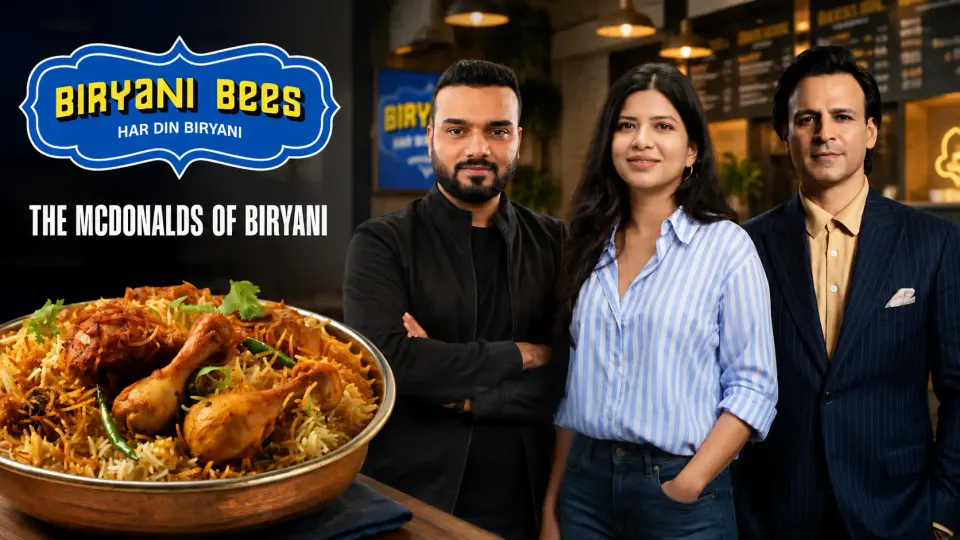
Biryani Bees, a biryani and Indian meals brand incubated by Wolfpack Labs, said it has raised $1 million (about ₹8.7 crore) from the Vivek Oberoi Family Office. The company announced the funding on 27 August 2026.
The round is single-sourced to the company at the time of writing and has not been independently confirmed. Biryani Bees did not disclose a valuation, the equity diluted, or the structure of the investment. Vivek Oberoi, the actor and investor whose family office is backing the round, is an investor in the company rather than a founder.
The company said the capital will be used to expand from its current three outlets in Uttar Pradesh to 10 outlets across Uttar Pradesh, Madhya Pradesh and other Tier 2 markets, strengthen its central kitchen infrastructure, build its operating team, and establish a repeatable expansion playbook. It framed the raise as the foundation for a larger national expansion.
Founded by Nitin Tiwari, with Vaibhav Thomas as co-founder, Biryani Bees operates a central-kitchen-led model that it says allows consistent quality and standardised food across outlets. The company said it is operating at an annual revenue run rate of approximately ₹25 crore while remaining profitable. That figure is company-stated and unaudited; an earlier Wolfpack Labs post in 2024 put the brand's run rate at about ₹18 crore, and the current number could not be independently verified.
In a statement, Vivek Oberoi said India's next wave of consumption would come from Tier 2 and Tier 3 cities, and compared the opportunity to building for Indian food what McDonald's built in quick service. Nitin Tiwari said the company's immediate goal is to reach 10 outlets, prove the model at scale, and build Biryani Bees into a trusted everyday biryani and meals brand. Prerna Gupta, co-founder of Wolfpack Labs, said the incubator had built the brand's identity and packaging to feel national from the outset.
The company said it holds one of the highest market shares for biryani on platforms such as Zomato and Swiggy in the cities where it currently operates. That claim is company-stated. Biryani Bees said that once it reaches 10 outlets and demonstrates scalability across states, it expects to be positioned for a larger institutional funding round.
Why It Matters
Biryani Bees is built on a specific bet about where India's branded-food demand is heading: not the metros, which are saturated with QSR and cloud-kitchen options, but the Tier 2 cities where consumers increasingly want the consistency and trust of a chain at prices that work for an everyday meal. The brand started in Uttar Pradesh, in Prayagraj, and its entire proposition is that a standardised, affordable biryani brand can own that under-served middle.
The operating model is central-kitchen-led. Rather than run each outlet as an independent kitchen, Biryani Bees produces centrally and finishes at its outlets, which is how the company says it keeps taste consistent and unit costs low. Revenue comes from a mix of dine-in and, more importantly, delivery: the brand sells heavily through Zomato and Swiggy, and says biryani's status as the single most-ordered category on those platforms is what gives a focused brand room to capture share quickly in each new city.
The cost structure is the reason the model is interesting and the reason it is hard. A central kitchen concentrates the expensive, quality-critical work in one place and lets outlets stay lean, which improves margins as volume grows through a hub. But that same architecture ties the brand to geography: a kitchen serves a radius, and expansion into a new state means either a new central kitchen, with its own fixed cost, or delivery distances that work against the freshness biryani depends on. This is why the funding is aimed squarely at central kitchen infrastructure and a repeatable playbook rather than just storefronts.
However, the reported profitability and run rate cannot be independently verified. The company says it is profitable at three outlets on a roughly ₹25 crore run rate, but those figures are company-stated and unaudited, and an earlier Wolfpack Labs post cited a lower ₹18 crore. Whether the model works is not settled by a single city's performance, and the numbers that would settle it are not yet on any public record.
The Strategic Read
The market assumption behind this raise is that standardised, central-kitchen biryani can become a branded QSR category in Tier 2 India, the way burgers and pizza did in the metros. The pitch, repeated by both the founder and the investor, is explicit: build the "McDonald's of biryani." It is an appealing analogy, and it is worth examining rather than repeating, because the economics of biryani differ from the economics that made QSR chains scale.
The central-kitchen model is the strongest part of the thesis. Producing at a hub and finishing at outlets can hold taste consistent, cut per-store labour and improve unit economics, which is exactly the discipline that separates a chain from a collection of good local restaurants. Biryani Bees says this architecture already delivers profitability at three outlets, and if that holds, it is a more credible foundation than the cash-burning expansion many food startups pursue. The claim is company-stated and unaudited, and profitability at three owned outlets in one city is a very different test from profitability across states, where a central kitchen either has to be replicated per region, adding fixed cost, or stretched across longer delivery distances, which erodes the freshness that is biryani's whole appeal.
The scale of the round is the fact worth sitting with. A $1 million cheque, roughly ₹8.7 crore, against a plan to more than triple the outlet count is modest, and it signals this is an early proof-of-concept raise, not growth capital. The company is candid that a larger institutional round is meant to follow once 10 outlets prove the model. That sequencing is sensible, but it also means the current announcement is a bet on a bet: the money funds the evidence that would justify the real capital, and everything rests on those next seven outlets replicating the first three. The delivery-share claim, one of the highest biryani shares on Zomato and Swiggy in its cities, is the most encouraging signal of genuine demand, but platform share in a handful of UP cities before wider expansion says little about whether the brand travels.
The competitive backdrop is unforgiving, and it is where the McDonald's comparison strains. Biryani is the most-ordered food category on Indian delivery platforms, which is why it is crowded: Rebel Foods' Behrouz and The Biryani Life operate at national scale from cloud kitchens, Biryani By Kilo was large enough to be acquired by Devyani International, and regional chains hold deep loyalty. A Tier 2-first, dine-in-plus-delivery brand is a differentiated wedge, but it is entering a category where far better-capitalised players already run the central-kitchen playbook. The largest execution risk is the one every regional food brand faces at this stage: the model that is profitable and beloved in Prayagraj has to prove it is not a local phenomenon before the institutional capital it is counting on will arrive.
For daily, sharp analysis of the biggest moves in the Indian business and startup ecosystem, follow StartupFox.