


The Story
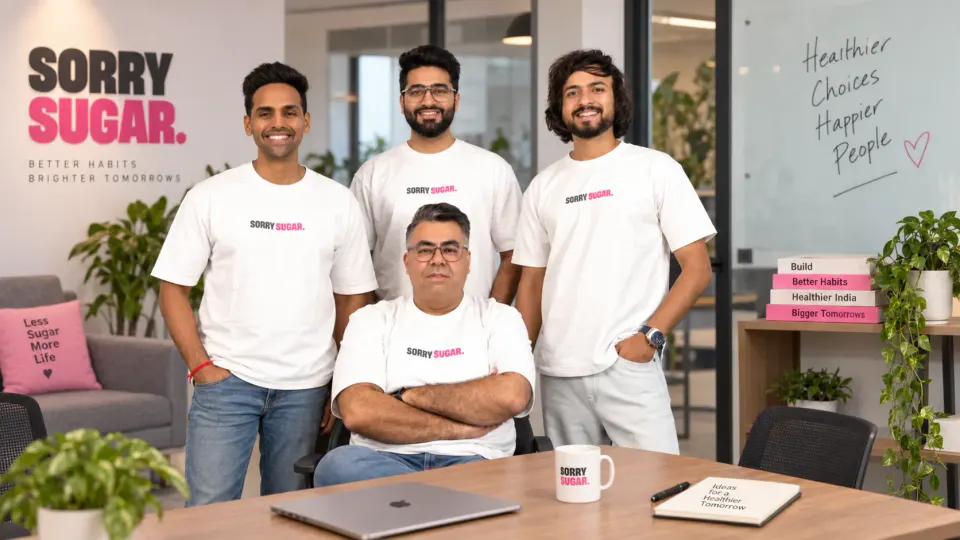
Sorry Sugar has raised $1 million in a seed round co-led by the Dhanuka family and Amishi London, the luxury accessories brand. Both are private and family investors rather than institutional venture funds. The money goes towards online and offline expansion across North India and new product launches.
Deepak Pathak, Kunal Verma, Shashank Sherawat and Saiyam Malik founded the Gurugram company this year. It was incubated by Palash Arneja, founder of BlaBliBlu, together with Wolfpack Labs, the venture studio led by Bella Vita founder Aakash Anand and Prerna Gupta.
The brand sells café-style coffee drinks with no added sugar, sweetened with monk fruit and formulated with added fibre, positioned around zero glycemic impact. The range runs to Hazel Almond Latte, Silk Chocolate Mocha, Sea Salt Caramel, French Vanilla Cloud and Butter Gooey Toffee. It also sells a ₹399 trial pack of five flavours, the value of which is fully redeemable against a larger purchase.
The company says it generated more than ₹1 crore in revenue in its first month and runs three stores across Gurugram and Delhi. It is targeting an annual run rate above ₹60 crore by the end of the current financial year, expanding across direct-to-consumer, quick commerce and offline retail, and plans a range of zero-added-sugar gelato.
The round lands in an active patch for Indian functional and clean-label beverages. Peping, which sells prebiotic fizzy drinks and probiotic shots, raised ₹2.5 crore from IAN Angel Fund in March. Swizzle raised ₹2 crore in December. TABP Snacks and Beverages raised $3 million to build manufacturing and distribution.
Why It Matters
A brand founded this year claiming more than ₹1 crore of revenue in its first month sounds implausible until you find the detail the funding announcement leaves out: Sorry Sugar was not built from a standing start. It was incubated by Palash Arneja, who founded BlaBliBlu, alongside Wolfpack Labs, the Gurugram venture studio Aakash Anand launched in 2024 with ₹50 crore of his own money and Prerna Gupta as founding partner.
That changes the reading entirely. A studio brand arrives with the things that normally take a consumer company two years to assemble: contract manufacturers already qualified, packaging suppliers already negotiated, a marketing team that has run this playbook on other brands, and relationships with the quick commerce platforms that decide whether anyone ever sees the product. Anand scaled Bella Vita into India's largest homegrown perfume brand, around ₹1,200 crore of annual revenue within four years, before selling it to Ananta Capital.
He has also done beverages before. Bevzilla, an instant coffee brand, sat alongside Bella Vita in his IDAM House of Brands portfolio. So Sorry Sugar is not a studio experimenting in an unfamiliar category. It is the same operator returning to coffee with a different proposition, which is a considerably better reason to take the early numbers seriously than the numbers themselves provide.
The category choice is sound. Coffee is the one Indian beverage occasion where consumers already accept a premium price, and sugar is the one ingredient regulators, schools and doctors have spent two years telling people to cut. A zero-sugar coffee sold at café-style prices asks the customer to give up nothing they were not already paying for.
And monk fruit, whatever it costs, solves the problem that has capped stevia drinks in India. Stevia carries a bitter finish that formulators spend enormous effort masking. Monk fruit does not. In a product whose entire proposition is that it tastes like the sugared version, that difference is the product.
The Strategic Read
The ₹1 crore first month is the number everyone will repeat, and it is worth taking apart.
In consumer goods, revenue in an early month can mean two quite different things. Sell-out is what consumers actually bought. Sell-in is what the brand shipped to retailers, distributors and quick commerce warehouses, which books as revenue on dispatch whether or not anyone drinks it. A brand with three stores and a few months of history reporting ₹1 crore is far more likely to be describing the second. That is not improper, it is how the trade works, but it measures distribution reach rather than demand.
The trial pack complicates it further. ₹399 for five flavours, fully redeemable against a larger pack, means a portion of that revenue is effectively a credit the company has already promised to honour. Money received now, product owed later. In a first month built substantially on trial, the gap between cash collected and revenue earned can be wide.
Then the ₹60 crore run rate by the end of this financial year, from a company that did not exist in April. Reaching it requires roughly ₹5 crore a month within months, which in a category sold on quick commerce means buying growth through discounting and platform placement. That is achievable with a studio's marketing machinery. Whether it is achievable at a positive contribution margin is the question $1 million does not answer, and no unit economics have been shared.
Monk fruit is the other thing to watch. It is a genuine differentiator, since it avoids the aftertaste that has held back stevia-sweetened drinks in India. It is also markedly more expensive than stevia or sucralose, and Indian formulation consultancies list its regulatory position among the items beverage brands need to validate, where the older sweeteners sit on settled ground. For a brand whose entire proposition rests on the sweetener, both the input cost and the compliance work sit on the critical path.
What the company has got right is timing. Indian regulators and schools have spent the past two years pushing sugar consumption down the agenda, front-of-pack labelling is tightening, and coffee is the one beverage occasion where Indian consumers have shown they will pay a premium. A zero-sugar café-style coffee is a better bet than a zero-sugar cola, because the customer is already paying ₹200 for the experience rather than ₹20 for the drink.
For daily, sharp analysis of the biggest moves in the Indian business and startup ecosystem, follow StartupFox.