

The Story
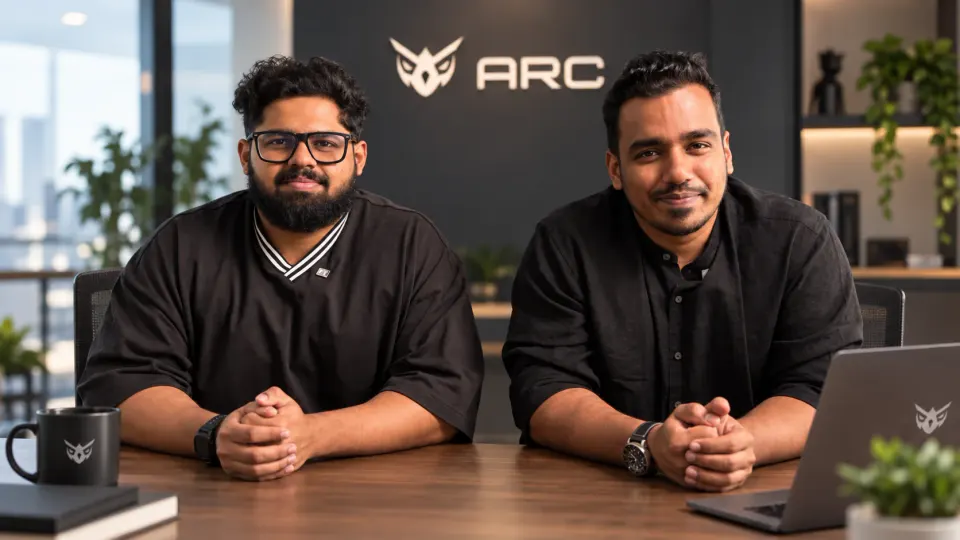
ARC has raised ₹10.5 crore, about $1.1 million, in a pre-seed round co-led by Chimera VC and MIXI Global Investments, the venture arm of the Japanese company behind Monster Strike. Dhruv Vohra, a director at Meta in Asia Pacific, invested in a personal capacity.
The Bengaluru company, the consumer gaming brand of Zenalli Innovative Technologies, is building the ARC X1, a handheld games console aimed at India and other emerging markets. Jobin Joseph and Kaustubh K. Jadhav founded it, and the device has been in development for over a year.
The X1 runs on ARM architecture powered by Qualcomm, with which ARC announced a partnership last week. It runs OWL OS, a fork of the Android Open Source Project rebuilt around a controller-first interface with system-level performance optimisation, which the company says supports Android gaming, PC-game compatibility and cloud gaming. The device is targeted below $300, roughly ₹25,000 to ₹30,000, and is assembled at two facilities in Bengaluru and Chennai.
The founders evaluated x86 architectures, including AMD's, before settling on ARM, on the reasoning that performance-per-watt rather than peak power is what makes a handheld affordable, portable and comfortable during long sessions.
ARC has passed 50,000 waitlist sign-ups and is running a public beta in which selected members test controls, comfort, battery life, frame rates and game compatibility ahead of commercial launch. The founders have pointed to roughly 2.5 lakh gaming handhelds, largely Steam Deck units and Nintendo Switch consoles, being imported into India in a single year through grey-market channels as evidence of unmet demand.
The money funds hardware engineering, product validation, manufacturing and supply-chain readiness, development of OWL OS and the software platform, and expansion of the team, go-to-market capability and partnerships.
Why It Matters
The number that justifies this company is not in the funding announcement. It is that roughly 2.5 lakh gaming handhelds were imported into India in a single year.
Those were Steam Decks and Nintendo Switches, bought through grey-market channels by people willing to pay import duty and dealer margin for hardware designed for Western infrastructure, Western prices and Western game libraries. Nobody does that casually. It is the clearest possible statement that a market exists which no manufacturer has bothered to serve directly, and it is the gap Joseph and Jadhav set out to close.
The economics of why nobody served it are worth understanding. A Steam Deck or ROG Ally runs an x86 processor, which is what lets it play PC games natively. Those chips are expensive and power-hungry, which forces a larger battery and active cooling, which adds weight and cost. Land that in India with import duty on top and you are past ₹50,000 before buying a game. ARC's answer was to rule out x86 entirely and build on ARM with Qualcomm, trading peak performance for performance-per-watt, and to assemble domestically in Bengaluru and Chennai so the duty never applies. That is how a handheld reaches ₹25,000.
The other choice is the operating system, and it is more interesting than it sounds. OWL OS is an Android fork, but the company's framing is that this is not Android put inside a gaming device, it is an operating system rebuilt around how people actually play: controller-first, not touch-first. Anyone who has clipped a phone into a plastic gamepad knows what problem that solves. Android was designed for a touchscreen in one hand, and everything about navigating it with sticks and triggers is an afterthought. Fixing that is unglamorous, genuinely useful, and a reasonable thing to spend a pre-seed on.
The Strategic Read
Three phrases are carrying most of the weight here, and they describe three different companies.
Android gaming on an ARM handheld is straightforward. The games are already compiled for this architecture, and the work is a controller-first interface and thermal tuning, which is what OWL OS appears to be. Cloud gaming is not really a device problem at all; it is a network problem, and Indian broadband and mobile latency decide whether it works, not ARC. PC-game compatibility is the hard one. PC games are x86 binaries. Running them on ARM means either an x86-to-ARM translation layer with a meaningful performance cost, or persuading developers to ship native ARM Android builds, or quietly meaning cloud streaming. Those are wildly different engineering commitments, and nothing published so far says which one ARC is doing.
That matters because the architecture decision that makes the price possible is the same one that makes the software promise hard. x86 handhelds run PC games natively, which is why the Steam Deck can do what it does, and their processors are also why those machines cost upwards of ₹50,000 before a single game. ARM at good performance-per-watt is how you reach ₹25,000. ARC has chosen the affordable path and inherited the compatibility problem that comes with it.
Then the money. One point one million dollars to design consumer hardware, qualify a supply chain, tool for injection moulding, obtain Indian certification, and build an operating system, simultaneously. Hardware does not compress the way software does: tooling costs what it costs, certification takes the time it takes, and component orders need deposits. This is engineering-sample and validation money. There will be another, much larger round before anything ships at volume, and the size of this one is a reasonable guide to how far away that is.
What is genuinely strong is the demand evidence, and it is not the waitlist. Fifty thousand sign-ups are free, and free sign-ups measure curiosity. The 2.5 lakh handhelds imported into India in a year are people who paid import duty and grey-market margins for a device built for somebody else's market. That is revealed preference, and it is the number an investor should have been shown.
The assembly decision follows from it. Building in Bengaluru and Chennai is not a patriotic gesture; it is the mechanism by which a locally made handheld undercuts an imported Switch on price without being a worse machine. Whether ARC can hold ₹25,000 once certification, distribution margin and warranty support are loaded in is the question this round exists to answer.
For daily, sharp analysis of the biggest moves in the Indian business and startup ecosystem, follow StartupFox.