


The Story
Fundly.ai has raised $4 million in a round led by existing investors Accel and Multiply Ventures, with former RBL Bank executive director Rajeev Ahuja and other angel investors participating. It has separately raised about $0.9 million in venture debt. No new institutional investor led the round.
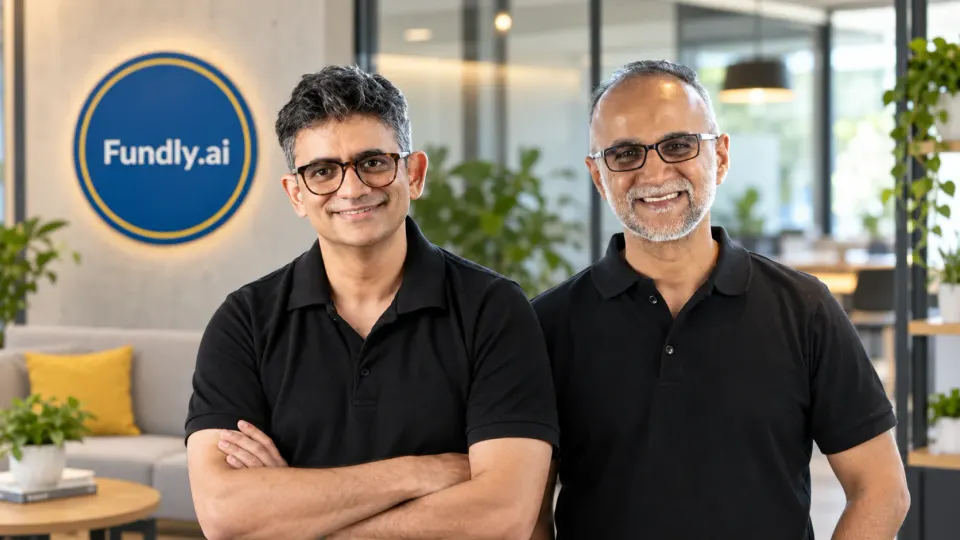
The Mumbai company builds technology for India's pharmaceutical distribution chain. Amit Chawla and Shreeram Ramanathan founded it in 2021, both having worked at the lender InCred, and bootstrapped it for two years before raising a $3 million seed in 2023, also led by Accel with Multiply Ventures.
It started as a supply-chain financing platform and has since expanded into three lines: B2B commerce, payments and settlement infrastructure, and embedded credit. The intention is to bring procurement, payments and working capital onto a single platform, so a pharmacy or stockist can order stock, settle invoices and draw credit in the same place. The new capital goes towards expanding those digital commerce, payments and credit offerings.
At the time of its seed round the company had disbursed ₹140 crore, about $17.1 million, to more than 2,000 retailers and over 30 distributors across nine cities. Tamil Nadu accounted for roughly 55 percent of its business then, Maharashtra 30 to 35 percent and Andhra Pradesh the rest. It has not published updated figures.
Company records show headcount at around 65 as of August 2025, down roughly a fifth from a year earlier.
Why It Matters
The interesting thing about Fundly is the direction it has travelled, because it is the opposite of the usual one.
Most B2B commerce platforms start by moving goods and add credit later, because lending lifts take rate and locks customers in. Fundly started as a lender and moved into commerce. Chawla and Ramanathan came out of InCred, so credit was the thing they knew, and supply-chain financing for pharmacies was the obvious application of it.
The problem with lending alone is that you cannot see very much. Underwriting a small pharmacy from bank statements and GST filings tells you what it earned, not what it bought, from whom, how often, or whether its stock is turning. That information sits in the order book, and the order book sits with the distributor. So a lender that wants better credit decisions eventually has to own the transaction, which is what moving into B2B commerce and payments does. It is the harder route, since running a commerce business is operationally heavier than running a loan book, and it is the sounder one.
India's pharmacy trade is a reasonable place to attempt it. Hundreds of thousands of small retailers buy on 30 to 60 day credit from stockists, margins are thin, working capital is permanently tight, and almost none of it is digitised. That combination of fragmentation and cash-flow stress is exactly what embedded credit is for.
The Strategic Read
The shape of the round is the part to read carefully.
Both leads are existing investors. Accel led the 2023 seed and leads this one; Multiply Ventures was in that round too. Three years on, the company has raised $4 million against a $3 million seed, with no new institutional name at the table. Alongside that, headcount fell about a fifth in the year to August 2025, to roughly 65 people. A company that reduced its team and then raised a similar amount from the same backers is consolidating rather than accelerating, and the round is better read as runway to prove the commerce and payments lines than as capital to scale them.
The $0.9 million of venture debt is worth separating out. For a business that lends, debt is not overhead, it is inventory. Money borrowed at one rate and lent at another is how the credit book grows, so part of this raise funds the balance sheet rather than the company. It also means the effective equity cushion is $4 million, not $4.9 million.
Geographic concentration is the structural risk and it has not been updated since 2023. Tamil Nadu was 55 percent of the business then. Pharma distribution in India is a state-level trade: licensing sits with state drug controllers, stockist networks are regional, and credit terms are set by relationships built over decades. A platform that works in Chennai does not port to Kolkata by adding a server. Every new state is a fresh distribution business, which is expensive and slow, and it is precisely the cost that $4 million has to cover.
There is also a category-specific caution worth stating. B2B commerce in pharmaceuticals is unusually easy to inflate, because trades between distributors can be circular and gross merchandise value can be generated without much underlying demand. Anyone assessing a platform in this sector should be asking about net revenue and margin rather than volume flowing through the system, and Fundly has published neither.
What works in its favour is that the credit book gives it something most B2B marketplaces lack: a reason to know its customers properly. It has been underwriting these retailers since 2021, which is real information about who pays and who does not.
For daily, sharp analysis of the biggest moves in the Indian business and startup ecosystem, follow StartupFox.