


The Story
Navana.ai has raised ₹40 crore, about $4.2 million, in a Series A round led by Ronnie Screwvala, with Antler India, Sharad Sanghi, Sandeep Singhal and Paula Mariwala also participating. The company had raised roughly $1.5 million in total before this, including ₹7 crore led by Antler India in July 2025, so the round is close to three times everything it had taken until now.
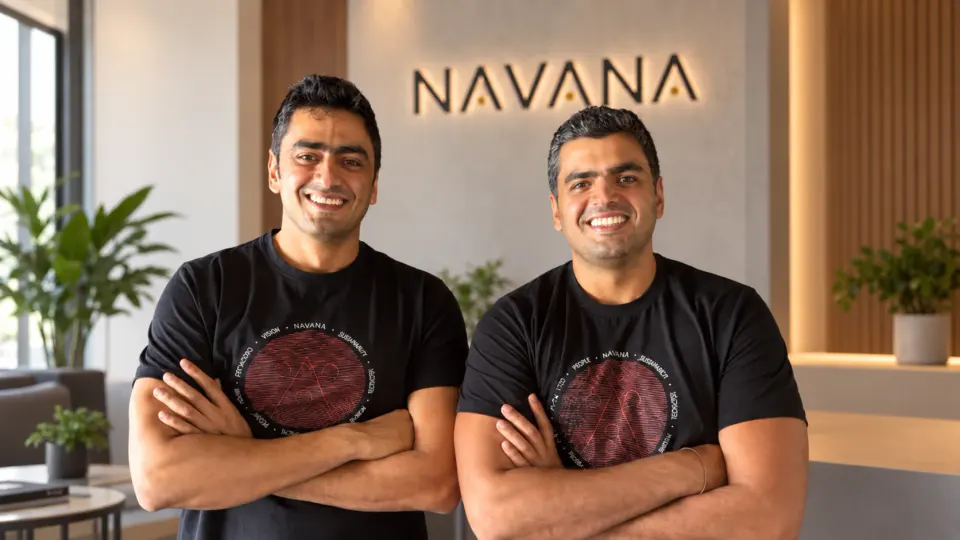
Brothers Raoul and Jai Nanavati founded the company in 2018. Both hold MBAs from Cornell Tech, where they built litOS, a custom Android operating system for low-literacy users that won $80,000 in a university competition and became the precursor to this business. Raoul is chief executive and previously ran a mobile gaming studio; Jai is chief technology officer and worked as an enterprise software engineer. The company operates from Mumbai and Bengaluru.
Its Bodhi speech models cover 12 Indian languages and 45 dialects and are built to handle background noise, overlapping speech, code-switching and regional accents. The product line spans a speech recognition API, a low-code platform for building voice agents, and a contact centre intelligence layer, offered on-premise for institutions that need to keep data inside their own systems.
Navana says it has processed more than 100 million voice minutes for financial services clients including Bajaj Finserv, Protean, Ujjivan Small Finance Bank, Jana Small Finance Bank and Grihum Housing Finance. Its best-documented deployment is Hello Ujjivan, a voice-led banking app built with Ujjivan Small Finance Bank, which reached 725,000 downloads in its first year with 99 percent of users being women.
The company has worked with IISc Bengaluru, IIT Madras, Microsoft Research and the Gates Foundation, including on RESPIN, a 10,000-hour speech corpus spanning 45 dialects. The new money goes towards BFSI deployments, speech model development and an AI contact centre and automated evaluation platform.
Why It Matters
The interesting decision here is architectural, and it is a business choice dressed as a technical one.
Almost every voice AI company sells an API. You send audio to a cloud endpoint and get text or a response back. That model is fast to build, cheap to run and scales without friction, and it is unavailable to a large part of the Indian financial system. A regulated lender recording customer calls is handling personal financial data under data residency rules, and sending that audio to somebody else's servers is a compliance question its risk committee will not sign off quickly. Navana deploys on-premise instead, inside the institution's own infrastructure.
That is a worse business in most respects. On-premise means longer sales cycles, per-customer engineering, thinner margins and slower growth than an API. What it buys is access to buyers nobody else can serve. Bajaj Finserv, Ujjivan, Jana and Grihum are customers precisely because the alternative was not a cheaper vendor but no vendor at all.
The founding story fits the same shape. Raoul and Jai Nanavati built litOS at Cornell Tech, an Android operating system for people who struggle with text-heavy interfaces, and won $80,000 for it. Eight years later the commercial expression of that idea is Hello Ujjivan, where 725,000 people downloaded a voice-led banking app in its first year and 99 percent of them were women. Whatever else is arguable about this round, the problem the founders set out to solve and the product they now sell are recognisably the same one.
The Strategic Read
Two things in this announcement need qualifying before they travel further.
The first is the benchmark. Navana says Bodhi recorded the highest accuracy across Indian voice AI platforms on real-world speech. That exercise was run internally. A company grading its own model against competitors it selected, on samples it chose, is not the same as an independent evaluation, and the word gets dropped every time the claim is repeated. It may well be accurate. It is not evidence.
The second is where the dialect coverage came from. RESPIN is a 10,000-hour corpus spanning 45 dialects, built with IISc Bengaluru, Microsoft Research and the Gates Foundation as an open project. Navana contributed to it and trained on it, which is a genuine credential. But an open corpus is open to everyone, including Sarvam, AI4Bharat and any global lab that wants Indian dialect coverage. The data underneath the moat is shared. What is proprietary is the model, the tuning against real call audio, and the deployment. Those are real advantages, and they are narrower ones than 45 dialects sounds.
The round's shape says something too. Four point two million dollars is small for an AI Series A in 2026, and it is led by an individual rather than a fund, with a pre-seed and seed firm following on. Eight years in, this is Navana's first substantial cheque. Read generously, that is a company that stayed small until it had real enterprise contracts. Read plainly, no institutional fund led a Series A in the most heavily funded category in the market.
What genuinely works in its favour is the customer list. Bajaj Finserv, two small finance banks and a housing financier are not experimental buyers, and Hello Ujjivan is a working deployment with hundreds of thousands of users rather than a pilot. In a category full of demos, that is the harder thing to have.
For daily, sharp analysis of the biggest moves in the Indian business and startup ecosystem, follow StartupFox.