



The Story
Mochatrade has raised about $5.5 million. A seed round led by CoinFund, with Coinbase Ventures and Zero Knowledge Ventures among the participants, makes up most of it; reports put the total at $5.56 million including an earlier $690,000 pre-seed round from Y Combinator and Pioneer Fund. The company went through Y Combinator's Spring 2026 batch.
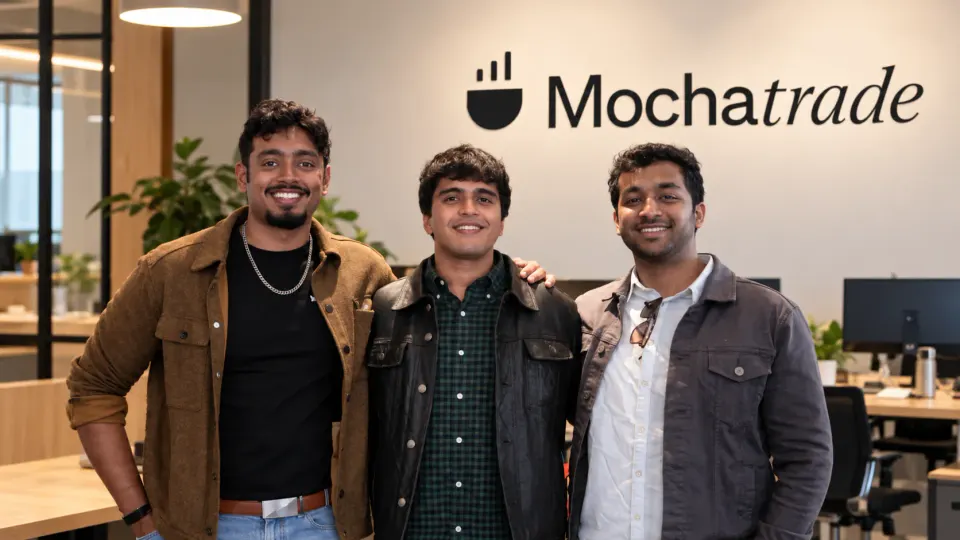
Utkarsh Sinha, Parth Maheshwari and Chetan Manda founded the company this year. All three are IIT graduates. Sinha, the chief executive, previously founded the crypto wallet Martian, which passed two million installs before it was acquired, and Manda, the chief product officer, was a product director at Sprinklr. Maheshwari is chief technology officer. Mochatrade is based in New York and operates in India through ALSD Technologies Private Limited.
The platform is built for Indian traders. It combines UPI funding and rupee balances with perpetual futures linked to US stocks, indices and commodities. Users deposit through UPI, see their margins and profits and losses in rupees, and go long or short on contracts that track the prices of companies such as Nvidia, Tesla and Apple without opening a US brokerage account. The contracts have no expiry, and users do not own the underlying shares or receive dividends. The platform lists more than 50 US stock contracts along with indices, commodities and some crypto assets, offers leverage of up to 50 times, and, according to its own materials, runs on the blockchain-based derivatives exchange Hyperliquid. Leverage lets traders take bigger positions with less money and magnifies losses in the same proportion.
Its Indian entity is registered with the Financial Intelligence Unit India as a virtual digital asset service provider and as a reporting entity under anti-money-laundering rules.
The company says its waitlist has passed 25,000 sign-ups. It is in beta and has not announced a date for its public launch. It plans to add contracts linked to selected pre-IPO companies, US stock options and social trading features, subject to applicable laws and regulatory approvals.
The money goes into its trading engine and risk infrastructure, and into reaching more active Indian traders.
Why It Matters
India has the world's most active retail derivatives market. The National Stock Exchange is the largest derivatives exchange in the world by number of contracts traded, driven overwhelmingly by individuals trading index options. That appetite is the market Mochatrade is built for, and it offers two things domestic platforms cannot easily provide: American stocks, and trading around the clock.
For an Indian trader who wants leveraged exposure to Nvidia or Tesla, the obstacles are real. Buying US shares means opening an overseas brokerage account and sending money abroad under the Reserve Bank's Liberalised Remittance Scheme, which does not allow remittances for margin trading. Leveraged positions on foreign stocks are therefore largely out of reach through regulated domestic channels. Mochatrade's answer is to make the product crypto-native. Its contracts are perpetual futures, an instrument that grew up on crypto exchanges, and its Indian entity is registered as a virtual digital asset service provider, which is what allows rupee funding through UPI.
That structure is the heart of the story, and it cuts both ways. For traders, it removes the friction of cross-border accounts and puts US markets on a familiar trading screen. For regulators, it raises a question India has not yet answered: whether leveraged contracts that track US share prices belong in the virtual digital asset category at all, or are securities derivatives by another name. Registration with the Financial Intelligence Unit is an anti-money-laundering requirement, not a licence from the market regulator to offer derivatives. Y Combinator's partners have stressed the team's commitment to regulated pathways, and the company says new products such as options will wait for approval. The legal treatment of its core product is what everything else depends on.
The Strategic Read
The consumer question is one India's market regulator has already answered at home. SEBI's 2024 study found that 93 percent of individual futures and options traders lost money between FY22 and FY24, with combined losses of more than ₹1.8 lakh crore, and it responded by raising contract sizes, cutting weekly expiries and tightening margin rules, all designed to make leveraged speculation harder for small traders. A platform offering up to 50 times leverage on US stocks, funded through UPI and open around the clock, gives the same traders a way around that friction. At 50 times leverage, a 2 percent move against a position wipes out the margin behind it, and stocks such as Tesla and Nvidia often move more than that in a single day.
Tax is a cost traders may not expect. Gains on virtual digital assets in India are taxed at a flat 30 percent, losses cannot be set off against gains, and 1 percent is deducted at source on transfers. For an active trader whose results swing between wins and losses, being unable to net them can push the effective tax far above the headline rate.
For the investors, the bet is clear. CoinFund and Coinbase Ventures are backing the convergence of crypto infrastructure and traditional assets, and perpetual contracts on equities are one of the fastest-moving parts of it. India's large, derivatives-hungry retail base is the biggest single market for such a product, and the founders have built and sold a crypto consumer product before. Y Combinator reportedly even paid its own investment in USDC, a dollar stablecoin.
The waitlist shows demand exists. What Mochatrade has not yet shown is a public launch, a regulatory position that holds up under scrutiny, and risk controls that protect users from a product capable of erasing a deposit in one trading session. The new money is earmarked for that risk infrastructure, which is the right priority. How Indian regulators view the product will matter far more than how fast the waitlist grows.
For daily, sharp analysis of the biggest moves in the Indian business and startup ecosystem, follow StartupFox.