





The Story
Blacksmith has raised $45 million in a Series B round led by Peak XV Partners at a valuation of $550 million. Existing investors Y Combinator and GV participated. The round was announced on 12 August 2026.
The financing was completed in March 2026, five months before it was made public. It takes total funding to $58.5 million across a $3.5 million seed, a $10 million Series A announced in September 2025 and this round. The Series A carried a $60 million valuation, so the company has been marked up roughly nine times in under a year.
The dilution and the split between the participating investors have not been disclosed.
Blacksmith says most of the capital will go towards compute. It manages hundreds of thousands of cores and plans to grow that footprint by an order of magnitude in the coming months. The company is also hiring engineers in New York and San Francisco.
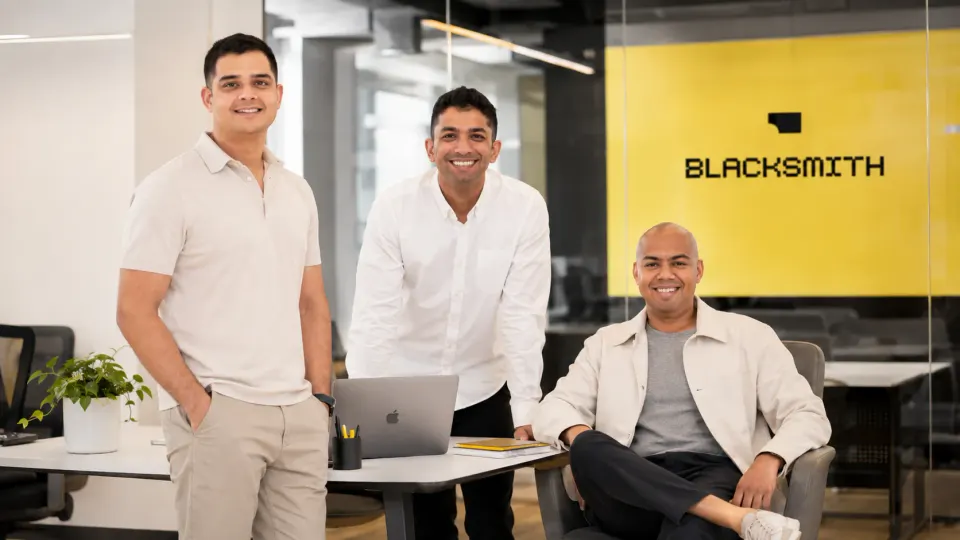
The San Francisco company was founded in 2024 by Aditya Jayaprakash, who is chief executive, alongside Aayush Shah and Aditya Maru, and was part of Y Combinator's Winter 2024 batch. It runs a cloud built specifically for continuous integration, executing GitHub Actions workloads on dedicated compute with caching and storage tuned for the task. Migration requires a one-line change to a workflow file, and the company claims workflows run up to twice as fast at half the cost.
It has since added codesmith, a cloud coding agent that diagnoses failed code checks, fixes them automatically and works inside the validation loop rather than only writing new code.
Blacksmith says more than 6,000 companies now use the platform, including Supabase, Clerk, Ashby and Mercury, against roughly 800 at the Series A last September. It also reports that the number of CI jobs running on its infrastructure has grown between 5% and 10% week on week since the start of 2026.
Jayaprakash told TechCrunch the company reached $10 million in annualised revenue with ten employees, and that revenue has since grown to tens of millions of dollars with a team of thirty. Those figures come from the company and have not been independently verified. One account of the round puts the customer base at 5,000 rather than 6,000.
Why It Matters
Continuous integration is the step where code gets built, tested and checked before it can be merged. It has always been slow, and for most engineering teams it was slow at a tolerable frequency, because a human could only write so many pull requests in a week.
Coding agents removed that ceiling. A developer running Claude Code or Codex produces several times the volume of changes, and every one of those changes still has to be validated. The bottleneck moved from writing software to checking it, which is Jayaprakash's argument for why the category exists at all: writing code got dramatically easier and validating it did not.
Blacksmith's answer is unglamorous and specific. General-purpose cloud instances are not built for CI, so the company runs GitHub Actions workloads on dedicated machines with caching and storage tuned for exactly that pattern. The switching cost is a single line in a workflow file, which is the lowest-friction migration in enterprise software and explains how the customer count went from roughly 800 to more than 6,000 in eleven months.
The cost structure is where this differs from most software companies at this valuation. Blacksmith is buying and running compute, so gross margin is bounded by hardware and utilisation rather than approaching the 80% a SaaS business would expect. That is why most of a $45 million round goes into cores rather than headcount, and why growing the fleet tenfold is presented as the plan rather than a consequence.
What the company has disclosed on revenue is unusually specific for a private business: $10 million annualised with ten people, now tens of millions with thirty. What it has not disclosed is gross margin, net revenue retention, or how much of the customer base sits on free or trial usage. On an infrastructure business, those are the numbers that determine whether scale compounds or simply consumes capital.
The Strategic Read
The market assumption being underwritten is that AI writing code creates a durable, growing tax on validating it, and that the tax gets paid to whoever runs the infrastructure rather than to whoever writes the agent. If every coding assistant multiplies pull requests, the picks-and-shovels position sits under all of them and benefits regardless of which model wins.
The growth data supports the premise. CI jobs compounding at 5% to 10% a week is not a marketing figure but a measure of load, and load on this kind of infrastructure is difficult to fake. It is also the cleanest available evidence that agent-generated code is actually reaching production pipelines rather than staying in demos.
The uncomfortable part is where Blacksmith sits. Its product runs GitHub Actions workflows faster than GitHub does, which means the company's entire wedge is the performance gap in a Microsoft-owned product. Microsoft has every incentive to close that gap, owns the platform, the runner specification and the developer relationship, and has been shipping AI tooling aggressively. A one-line migration works in both directions.
Competing on speed and price against the platform owner is a position that works until it does not. What would make it durable is codesmith, because an agent that diagnoses and fixes CI failures is a product rather than a substitution, and it is harder for a platform to replicate than faster hardware. That is the more interesting half of the company and the less proven one.
The valuation prices the optimistic reading. At $550 million against revenue in the tens of millions, the multiple assumes the CI volume curve holds and that margins on a compute business behave better than compute businesses usually do. Both are plausible. Neither is established, and the round was struck in March, before the last five months of that curve were known.
For daily, sharp analysis of the biggest moves in the Indian business and startup ecosystem, follow StartupFox.