

The Story
Chapter Home has raised ₹63 crore through a mix of equity and debt from Bessemer Venture Partners, Stride Ventures, Tanmay Bhat and a group of family offices. The round values the home and kitchen consumer brand company at close to ₹1,000 crore.
The capital will go towards product development, entry into new categories, technology, brand building and distribution. The company is also working on setting up its first physical retail touchpoints.
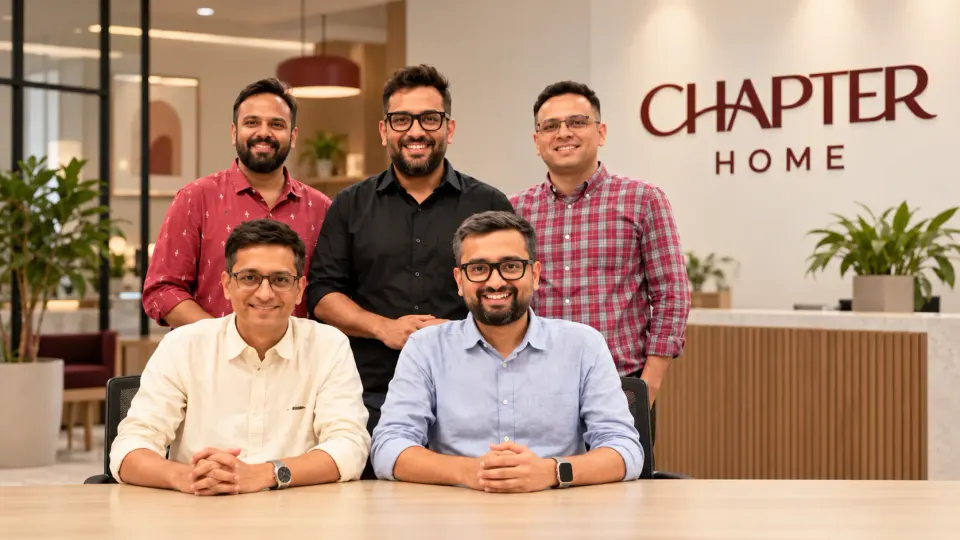
Founded in 2025 by Nitin Chugh, Akarsh Bharadwaj, Shrey Mittal, Dhiraj Jain and Dheeraj Goyal, Chapter Home is building consumer brands across bed and table linen, cookware, home décor and small kitchen appliances. The five were part of the founding and leadership team at PharmEasy before starting the company.
Chapter Home runs its brands on a shared platform covering sourcing, supply chain, content, technology and distribution. It says it uses AI for product cataloguing, content creation, demand forecasting, product assortment, customer targeting and retention.
Home furnishings is the first category live, through HOKIPO, an online home furnishing brand. The company plans to expand into other home and kitchen categories and sell through online marketplaces, quick commerce platforms, its direct-to-consumer channel and offline retail stores.
Why It Matters
What is being funded here is a roll-up, and the people running it have run one before.
A house of brands is a consolidation play with a shared back end. You assemble categories, put them on common sourcing, logistics and technology, and argue the platform is worth more than the sum of the labels. Chapter Home describes exactly this: bed linen, cookware, décor and small appliances, on one platform for sourcing, supply chain, content and distribution.
PharmEasy was India's most aggressive consumer internet roll-up of the last cycle, acquiring Medlife, Thyrocare and Aknamed among others. It also became the cautionary example, marked down sharply from its peak valuation before a heavily discounted rights issue. The founding and leadership team that built it is now applying the same structural idea to home and kitchen.
That cuts both ways and it would be lazy to call it either. These are operators who have integrated acquisitions at scale and have seen precisely how the model breaks. Equally, the Indian house-of-brands cohort that followed PharmEasy, including Mensa and GlobalBees, has largely struggled to show that the shared platform creates value the individual brands could not.
Which makes the valuation the thing to watch rather than the thesis. Close to ₹1,000 crore for a company founded last year with one brand trading is a price set on the team and the structure, not on the business. The round is also part debt, with Stride Ventures in it, so the equity cheque underwriting that number is smaller than ₹63 crore.
The question is not whether these founders can build a brand. It is whether four of them on one platform are worth more than four of them apart.
The Strategic Read
The channel list in the announcement is the part that has actually changed since the last attempt at this model.
Chapter Home plans to sell through marketplaces, quick commerce, its own site and physical stores. Quick commerce is the addition, and for home and kitchen goods it is a material one. A cookware set or a bedsheet bought on a ten-minute platform is a different purchase from one chosen after an hour of browsing, and it rewards a narrow, well-stocked assortment over a long tail. Brands built for that shelf look different from brands built for a marketplace listing page.
That is where the AI claims matter, if they are real. Demand forecasting and assortment decisions are the difference between profitable and ruinous in a business holding physical inventory across multiple categories. The previous generation of house-of-brands companies failed less on marketing than on working capital tied up in the wrong stock.
The physical retail plan is the harder commitment. Home and kitchen is a category people still like to touch, and competitors from Home Centre to Nestasia have store estates built over years. A first-year company funding its first stores from a ₹63 crore round is taking on fixed costs in a format where scale arrives slowly.
The useful signal will come when the second and third brands launch. One brand on a shared platform is a brand. Four is a thesis.
For daily, sharp analysis of the biggest moves in the Indian business and startup ecosystem, follow StartupFox.