


The Story
Marmalade has raised ₹6 crore in an early-stage round made up entirely of individuals rather than funds. The investors come from the spirits trade and from consumer businesses: Ashok Chokalingam, chief operating officer and master distiller at Amrut Distilleries; Robert Sellares of the Don Q Rum founding family; Ishank Gupta, formerly a director at AB InBev and founder of Humyn Labs; Sujeet Mitra and Ganesh Iyer, founding partners at H5 Investments and Malt Society Arabia; and HomeLane founders Srikanth Iyer and Tanuj Choudhry. Lohum founder Rajat Varma is also listed as a backer on the company's site.
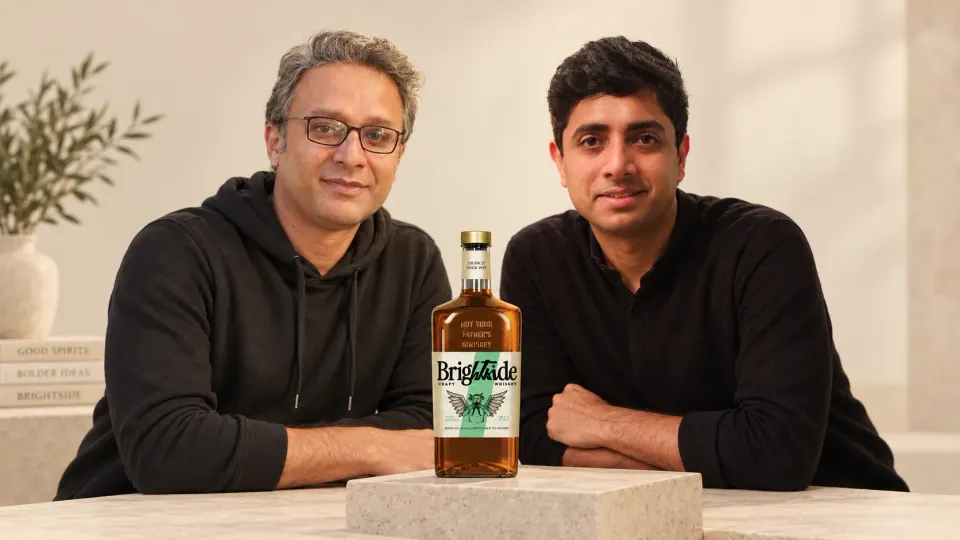
Udit Mediratta and Surojit Bhattacharya founded the New Delhi company in 2025. Its first brand, Brightside Craft Whiskey, launched in Pune in January 2026, positioned as "Not Your Father's Whiskey" and built to remove the burn, bitterness and aftertaste that make whiskey an acquired taste. It blends malts and grain spirits with botanicals, and was developed with Amrut Distilleries and Chokalingam. The bottle carries a built-in pour meter that shows how much has been drunk and a peel-to-reveal label the company calls a category first.
It retails at ₹1,750 for 750ml in Maharashtra, aimed at a ₹1,500 to ₹2,200 band the company argues is thinly served.
The trading numbers are more specific than the funding announcement suggests. In its first 90 days in Pune, Marmalade sold 18,600 bottles for ₹66.5 lakh of revenue, reached over 85 percent distribution coverage, and said more than 70 percent of the third month's sales came from repeat buyers.
The company says it is on track for ₹5 crore in annualised revenue run rate in September and is targeting ₹15 crore by December, which it describes as threefold growth in under four months across two cities. The money funds distribution, brand building and sales and operations, with Mumbai and the wider Maharashtra market the immediate focus.
Elsewhere in Indian craft spirits, Feline Spirits recently raised ₹5.2 crore in a pre-Series A led by Inflection Point Ventures, Cherrapunji Craft Gin maker Raincheck Earth Co. raised $1.2 million, and Nuvola Spirits, behind Mikiamo Limoncello, took ₹1.57 crore.
Why It Matters
The product thesis is narrow, unfashionable and probably right.
Whiskey is an acquired taste, and the industry has treated that as a feature. The burn, the bitterness, the long aftertaste, the idea that you should learn to appreciate it: all of that is baked into how the category markets itself, and into a brand language of heritage, seriousness and inherited masculinity. It works on people who already drink whiskey. It is a poor pitch to someone who tried it once at 22, disliked it, and switched to something else. Marmalade's argument is that those people did not reject spirits, they rejected the pain curve, and that removing it is a product problem rather than a communications one.
Blending botanicals into malt and grain spirit to soften the finish is a real attempt at that, and it is the kind of thing an established distiller would be reluctant to do to its own flagship. Doing it with Amrut, through the man who runs Amrut's distilling, gets a new brand a formulation credibility it could not have bought and a production partner it did not have to build.
The packaging is worth more than it appears too. A pour meter on the bottle and a peel-to-reveal label are small things, but shelf differentiation in a Maharashtra wine shop is a genuine constraint: hundreds of bottles, no salesperson, no tasting, and a shopper deciding in seconds. A bottle that looks unlike everything around it is doing the job that advertising cannot, in a country where alcohol advertising is largely prohibited.
That last point is the one that shapes everything about this business. India bans direct alcohol advertising, so brands are built through packaging, bar presence, word of mouth and retail visibility rather than through media spend. It is why ₹6 crore going to distribution and trade activation rather than marketing is the correct allocation, and why the repeat-purchase figure matters more here than it would in almost any other consumer category.
The Strategic Read
Three things in the framing need adjusting, and the first two are about what the numbers mean.
Start with the per-bottle economics, because they are the most useful figure available and they come from the company's own disclosure. Eighteen thousand six hundred bottles generating ₹66.5 lakh works out at roughly ₹358 a bottle. The consumer pays ₹1,750. The difference is not margin lost to inefficiency; it is the structure of the Indian alcohol trade, where state excise duty, wholesale and retail margins absorb the great majority of the shelf price. Every rupee of brand-level revenue therefore requires about five rupees of consumer spending, which is why spirits brands need volume rather than pricing power, and why ₹5 crore of run rate is a smaller business in bottles than it sounds.
Then the ARR figures, which are doing two different things. An annualised run rate multiplies one period out across twelve months. ₹5 crore in September means roughly ₹42 lakh of sales that month. The ₹15 crore December target implies about ₹1.25 crore in December, and December is the single biggest month in the Indian drinking calendar. Annualising it is the most flattering basis a seasonal business can choose. The threefold growth is real in the sense that Mumbai is a much larger market than Pune, but a September-to-December comparison in alcohol is comparing an ordinary month with the peak.
The third correction is geographic. "Two cities" is accurate and slightly misleading, because Pune and Mumbai are both in Maharashtra. Alcohol in India is regulated state by state: separate excise policy, separate label registration, separate price approval, separate distribution structure, and in several states a government monopoly on wholesale. Adding Mumbai means adding a market, not a regulatory jurisdiction. The genuinely hard expansion, the second state, has not been attempted yet, and it is where most promising Indian spirits brands stall.
What works in Marmalade's favour is more interesting than the growth arithmetic. Eighty-five percent distribution coverage in ninety days is fast for a first-time brand with no trade relationships, and repeat purchase above 70 percent in month three is the number that matters most in spirits, because the category is bought habitually or not at all. A smoother whiskey that people come back to is a product finding its market, not a launch spike.
The Chokalingam relationship deserves stating plainly. He formulated the whiskey, runs the distillery that makes it, and has now invested in the brand that sells it. That is a concentration of roles, and in this instance it reads as alignment rather than a problem: contract distilling in India routinely leaves small brands at the back of someone else's production queue, and an investor with operational control of the plant is unlikely to deprioritise his own holding. It also transfers real credibility, since Amrut made the first Indian single malt and is the reason the category is taken seriously abroad.
The open question is what Marmalade owns. It does not own a distillery, and its differentiation rests on a recipe developed by someone else's master blender, packaging features that are copyable, and a brand position that United Spirits or Pernod Ricard could occupy with a line extension and a marketing budget. The answer, if there is one, is speed and distribution depth before the incumbents notice. ₹6 crore buys one state's worth of that.
For daily, sharp analysis of the biggest moves in the Indian business and startup ecosystem, follow StartupFox.