

The Story
The auto-rickshaw driver in Gurugram has drawn attention online after saying that he left a ₹25,000-a-month supervisor position and now earns approximately ₹40,000–₹45,000 by driving an auto.
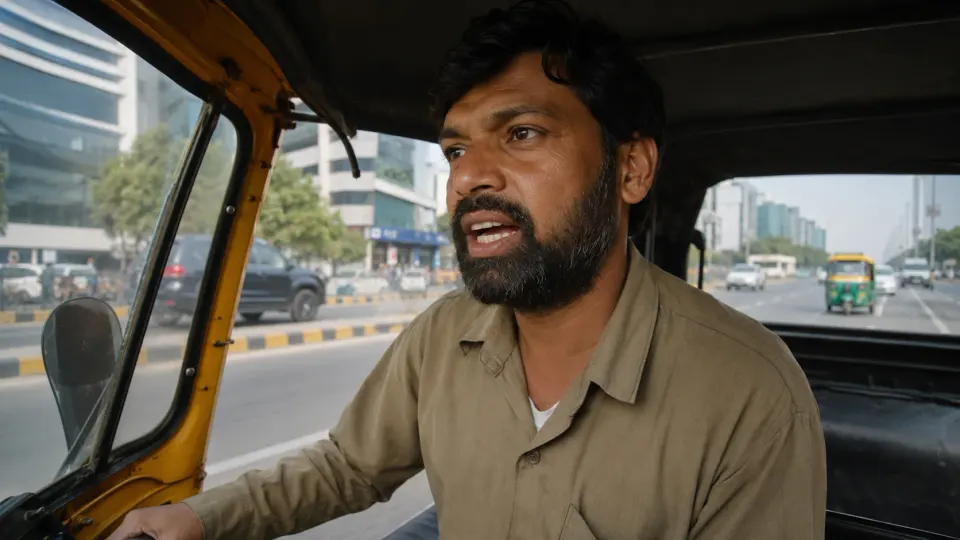
The account emerged from a video recorded by Akash Gupta, co-founder and chief executive of electric-mobility company Zypp Electric, during an auto-rickshaw journey. Gupta asked the driver about his work, previous employment, daily income and family.
The driver said he had earlier worked as a supervisor at a company in Gurgaon, earning around ₹25,000 per month. He subsequently left the position and began driving an auto. In the conversation, he described his present monthly income as approximately ₹40,000–₹45,000.
Captions and subsequent media reports attached additional numbers to the account. Some said the driver generated ₹1,500–₹2,000 a day and ₹50,000–₹60,000 a month before expenses, with around ₹40,000 remaining after costs. Another report transcribed the daily range as ₹500–₹2,000. These figures are not fully consistent, making it important to distinguish his reported gross collections from net earnings and household savings.
The driver said he works for roughly eight to nine hours a day. His routine reportedly involves driving from the morning until the afternoon, returning home for lunch and rest, and then resuming work from around 4 pm until 9 pm.
He also said he has three children studying in his village. Although he was unable to pursue substantial education himself, he said income from driving is helping him finance their schooling.
The video was widely framed as evidence of how independent or “gig” work can offer better earnings and greater flexibility than conventional employment. However, there is no confirmation that the driver receives rides through a digital platform. He may more accurately be classified as a self-employed transport operator unless his use of an app-based aggregator is established.
The driver’s identity, former employer, salary records, vehicle ownership, operating costs and monthly income have not been independently verified. The story should therefore be presented as one individual’s account, not as evidence of what auto drivers generally earn in Gurugram.
Why It Matters
The story resonates because it challenges the assumption that formal employment necessarily produces greater financial security or upward mobility than self-employment.
For the driver, the apparent advantage is straightforward: his labour is connected more directly to daily demand. A salaried supervisor receives a fixed monthly amount regardless of whether the employer’s workload or revenue increases. An auto driver can potentially raise collections by working during high-demand periods, selecting productive locations and extending working hours.
He may also have greater control over his schedule. The ability to divide the day into two shifts, return home during the afternoon and decide when to stop has economic value, even when it does not appear on an income statement.
But the comparison circulating online is incomplete. A ₹25,000 salary is an employee’s compensation. An auto driver’s daily collections are business revenue before fuel, maintenance, repairs, permit costs, insurance, financing payments, platform commissions and vehicle depreciation.
The position also transfers commercial risk from the employer to the worker. A salaried employee may continue receiving income when demand weakens, the vehicle requires repairs or illness prevents work. A self-employed driver usually earns only when both the worker and vehicle are operating.
Formal employment may additionally provide benefits such as provident-fund contributions, paid leave, medical insurance or gratuity, although this depends on the employer and employment arrangement. Those benefits must be valued before concluding that ₹45,000 in self-employment income is almost twice as attractive as a ₹25,000 salary.
The commercially important point is not that everyone should leave low-paying employment to drive an auto. It is that weak salary progression can make self-employment financially rational for workers who possess an income-producing asset, operate in a dense market and can manage the accompanying risk.
The Strategic Read
The market assumption changing here is that workers need an employer to organise demand and convert their time into income.
Urban transport markets allow an individual with access to a vehicle to sell services directly to hundreds of potential customers. Digital payments, navigation tools and, where used, ride-hailing platforms further reduce the infrastructure required to operate independently.
This gives the worker something he did not control in his supervisor role: the commercial output of additional effort. In employment, working harder does not necessarily change the monthly salary. In self-employment, an additional productive hour can generate another fare, provided sufficient passenger demand exists.
The attraction is therefore not only the reported ₹40,000–₹45,000. It is the combination of income potential, schedule control and reduced dependence on a manager for promotions or increments.
The worker’s new leverage, however, comes from accepting costs previously carried by an employer. He must maintain the productive asset, absorb periods without passengers and manage daily cash flow. His earnings can be affected by fuel prices, local competition, traffic restrictions, permit rules and unexpected repairs.
Vehicle ownership is the decisive missing detail. A driver who owns an unencumbered auto has fundamentally different economics from one paying daily rent or a monthly loan instalment. The former retains more of every fare; the latter must first generate enough revenue to cover a fixed asset cost before earning personal income.
This is also why the viral claim should not be converted into a general argument about the gig economy. The driver appears to serve customers directly, while many platform workers depend on an intermediary that controls pricing, customer allocation, incentives and commissions. An independent auto driver may have more pricing and route autonomy than an app-based delivery worker, even though both are casually described as gig workers.
The strongest execution risk for the driver’s model is income interruption. A serious repair, health problem or regulatory disruption can simultaneously remove revenue and create an additional expense. Maintaining emergency savings and appropriate insurance is therefore part of the business model, not an optional personal-finance decision.
The strongest risk for employers is different. When entry-level and supervisory salaries fail to rise alongside urban living costs, productive employees begin comparing employment against entrepreneurship, transport work, delivery work and other cash-generating alternatives. Employers then lose workers even when the alternative occupation carries more risk, because the employee sees too little upside in remaining.
The metric required to test this story is net income after every operating and ownership cost—not daily collections. Over the next six to twelve months, evidence would require the driver’s fuel expenses, maintenance, vehicle payments, working days, downtime, insurance and household withdrawals. Without those figures, the reported pay rise remains plausible but commercially unproven.
For daily, sharp analysis of the biggest moves in the Indian business and startup ecosystem, follow StartupFox.