
 Tamba Solutions
The Story
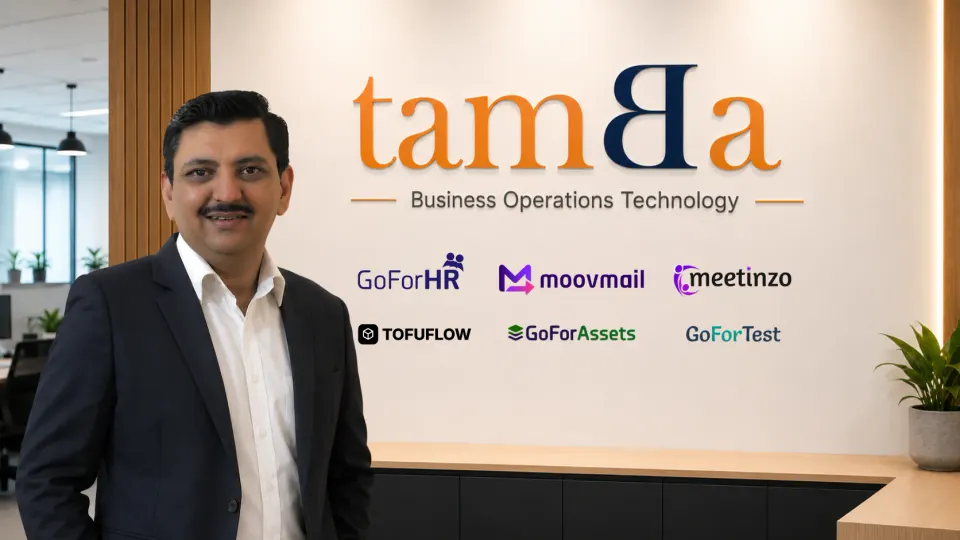
K.P. Tiwari is the founder of Tamba Solutions, a business software company whose products handle HR, corporate email, workflow, asset tracking, visitor management and assessment for other organisations.
Before starting it, by his own account, he headed the Business Applications Business Unit at Team Computers, one of India's long-standing systems integrators, having moved through technical, managerial and non-technical leadership positions as that organisation grew. It is a path — engineer to manager to business unit head — that tends to produce people who understand not only how software gets built, but why an implementation succeeds or fails inside a company that did not ask for it.
Tamba's portfolio now runs to six products. GoForHR is the flagship, a cloud HRMS covering employee records, recruitment, attendance, leave, performance management, expense claims, payroll, the exit process and task management, on web and mobile. Meetinzo is a visitor management system. TofuFlow, GoForAssets and GoForTest cover workflow, asset management and assessment. Alongside the products, the company does application and mobile development, cloud and datacentre migration, hosting and data dashboards.
The newest initiative is MoovMail, a corporate email platform built in India. The pitch is direct: companies currently paying per seat for Google Workspace or Microsoft 365 can move to a domestically built alternative at lower cost, with their mail data staying in the country. The migration story is aimed squarely at organisations already running Gmail or Outlook at scale.
Tiwari's stated philosophy is that technology should not complicate a business but make it simpler and more process-driven, and that good software should reduce an organisation's dependency on particular individuals by turning what they know into a structured, repeatable process.
Why It Matters
The idea worth taking seriously here is the one about dependency.
Most small and mid-sized Indian companies do not run on systems. They run on people who remember things. One person knows how leave approvals actually work, another knows which vendor to call, a third holds the payroll logic in a spreadsheet on their own laptop. Everything functions until that person is on holiday, or resigns, and then it does not. This is the most common operational failure in a growing business, and almost none of it appears in a software requirements document.
Building products against that problem is a specific choice. An HRMS that merely digitises leave forms sells on convenience. One that encodes who approves what, in what order, with what record, sells on continuity. The second is harder to build and harder to explain, and it is what Tiwari is describing when he talks about structured, scalable processes.
The career shape supports the claim. Someone who spent years inside a systems integrator, watching implementations land in real companies, sees the same failure on repeat: the software works, the process around it does not, and six months later everyone is back on spreadsheets and WhatsApp. Choosing to build products rather than keep implementing other people's is a reasonable response to seeing that often enough.
MoovMail applies the same instinct to a different kind of dependency. Corporate email is the one system a company cannot switch off, which is exactly why its per-seat pricing rarely gets questioned. An Indian mid-market company running a few hundred mailboxes on Google Workspace or Microsoft 365 is paying in dollars for a commodity, with its data sitting under another country's jurisdiction. Building a domestic alternative is not a technically glamorous project. It is a cost and control argument, and for CFOs and compliance teams that is the more persuasive one.
Technology should not complicate business. It should make business simpler, smarter and more process-driven. — K.P. Tiwari, Founder, Tamba Solutions
The Strategic Read
The number worth noticing is not the size of the portfolio. It is the ratio.
Six products in production, built and supported by a team that has stayed deliberately small. That is unusual leverage, and there is only one way to achieve it: shared infrastructure. One identity layer, one workflow engine, one notification system, and six front doors onto it. This is precisely how a services company with reusable components turns itself into a product business, and GoForHR sitting at the centre with the others clustered around it suggests that is what happened here. The company is now hiring against that base, which is the more interesting moment. Adding engineers to a platform that already works is a different proposition from adding them to find out whether it does.
The honest caution is that HR, corporate email, workflow, asset management, visitor handling and assessment are six problem domains with six buyer personas and six roadmaps. Breadth costs focus. The question a prospective customer should ask directly is which product gets engineering attention next quarter, and the answer ought to be specific.
The categories are crowded, and Tamba is not pretending otherwise. Indian HRMS alone contains Keka, greytHR and Darwinbox, most of them better capitalised, and corporate email has incumbents with enormous distribution. Competing on feature count in either is not the play.
Competing on price, on data staying in India, and on a willingness to shape software around how a particular company already works is the play. That is the natural advantage of a founder who came up through systems integration, running a team small enough to answer the phone and now expanding to build against a roadmap.
Which is probably the right reading of Tamba. Not a company trying to outscale its category, but one that has turned recurring services work into software it owns, and is now finding out how far that goes.
For daily, sharp analysis of the biggest moves in the Indian business and startup ecosystem, follow StartupFox.