
 Airtel Payments Bank
The Story
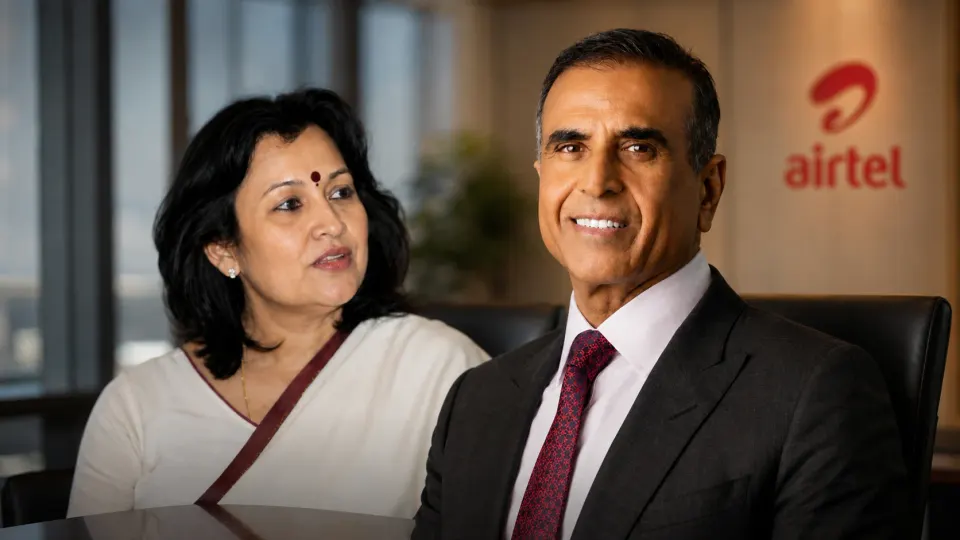
Sunil Bharti Mittal will conclude his tenure as Non-Executive Chairman of Airtel Payments Bank and step down from the board with effect from 30 September 2026. Shabnam Sinha will take over as Chairperson for a three-year term beginning 1 October. The bank disclosed the transition in an exchange filing on 17 August 2026.
Sinha's appointment has already been made by the board and approved by the Reserve Bank of India. It is not pending regulatory clearance.
She currently serves as an Independent Director on the bank's board, where she chairs the Special Committee of the Board for Monitoring Frauds and sits on the Risk Management and IT committees. The bank says she has more than three decades of leadership and board experience across development finance, financial services, public policy and institutional transformation, including a period at the World Bank advising governments and institutions across Asia, Africa and Europe on governance, risk management and operational effectiveness.
Mittal, founder and chairman of Bharti Enterprises, was appointed Non-Executive Chairman in April 2016. Airtel Payments Bank began operations in November 2016, one of eleven entities granted in-principle approval by the RBI to set up a payments bank, with a committed initial investment of ₹3,000 crore. Kotak Mahindra Bank holds a minority stake.
The bank reports more than 121 million monthly active users and nearly 30 million bank account customers through the Airtel Thanks app, with a network of over 500,000 banking points reaching around three in four villages in India. It describes itself as India's largest payments bank by revenue and the country's second-largest mobile bank and UPI Autopay player. Those positioning claims come from the bank.
No successor arrangement beyond the chair has been announced, and the bank has not indicated any change to its executive leadership.
This is the second Bharti group chairmanship to change hands this year. In March 2026 Mittal informed the board of Airtel Africa of his intention to retire as chairman following its July annual general meeting, with non-executive director Gopal Vittal succeeding him and Mittal's son Shravin Bharti Mittal appointed deputy chair.
Why It Matters
A payments bank is a restricted licence. It can take deposits up to a capped amount per customer, issue debit cards and move money, but it cannot lend. That single prohibition determines everything about how the business earns: without an interest spread, revenue has to come from transaction fees, commissions on third-party products and float income on deposits it must park in government securities.
That is why distribution is the whole asset. Airtel Payments Bank's 500,000 banking points are largely retailers already selling Airtel recharge, which turns a telecom distribution network into a banking one at close to no incremental cost. Reaching three in four villages is a number no conventional bank could build economically, because the branch maths never works at rural transaction sizes.
Most of the eleven entities that received in-principle payments bank approval in 2015 either surrendered the licence or never launched. The ones that survived did so by attaching the bank to an existing distribution machine, which is what Airtel and Paytm both did, and by treating small-ticket volume rather than balance size as the objective.
The chair change matters more at this kind of institution than the title suggests. A non-executive chairman of a payments bank is a governance role rather than an operating one, and Sinha's board record is specifically in that territory: fraud monitoring, risk and IT. At an institution processing very high volumes of very small transactions across half a million semi-formal outlets, fraud control is not a compliance function, it is the operating risk.
What the announcement does not address is the constraint everyone in the category faces. The bank has not disclosed current revenue, profitability or deposit balances alongside this transition, and the lending prohibition that shapes its economics is unchanged by any board appointment.
The Strategic Read
Read alongside March's announcement at Airtel Africa, this looks less like one retirement than a sequence. Mittal has now handed over two group chairmanships inside six months, in both cases to people already inside the institution, and in the African case with his son moving into the deputy chair. A founder detaching from board seats while the next layer settles is the recognisable shape of succession being staged rather than announced.
The choice of successor says something about where the bank thinks its risk sits. Sinha is not a telecom executive or a payments operator; her background is development finance, public policy and the World Bank, and her board work here has been on fraud, risk and technology. Elevating that profile to the chair at a bank whose distinguishing feature is half a million semi-formal outlets in rural India is a governance decision, and a defensible one.
It is also a bank operating under close regulatory attention. The RBI cancelled Paytm Payments Bank's operations in 2024 over compliance failures, an event that reset how the regulator is understood to view the category. Against that backdrop, a chair whose credentials are in institutional governance rather than growth is the safer signal to send, and the RBI's prior approval of the appointment is part of the message.
The strategic question the transition does not answer is what the bank becomes. Payments banks cannot lend, which caps the value of even a very large customer base, and the obvious routes out, a small finance bank licence or deeper distribution of third-party credit and insurance, both require regulatory and commercial moves the company has not signalled.
Mittal built the distribution. Whether it can be turned into a durable earnings base is the problem he is handing over, and nothing in this announcement indicates how it will be solved.
For daily, sharp analysis of the biggest moves in the Indian business and startup ecosystem, follow StartupFox.