


The Story
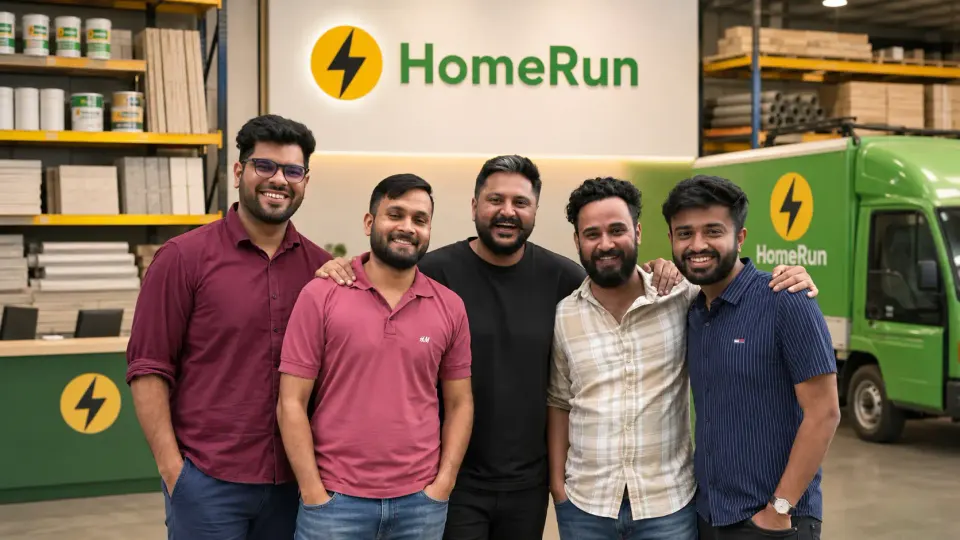
HomeRun, a Bengaluru-based quick commerce startup for construction and interior materials, has raised $12 million in a Series A+ funding round led by Nexus Venture Partners. Existing investors Sorin Investments, Titan Capital, Sparrow Capital and Consumer Collective by Atrium participated in the round, which was announced by founder Pukhraj Grewal on 6 August 2026.
The company has not disclosed the post-money valuation, the equity dilution the round represents, its cash runway on the fresh capital, or whether the money will be released in tranches. In March 2026, Inc42 reported that HomeRun was in talks to raise around ₹100 crore at a post-money valuation of ₹450 crore to ₹500 crore. The round has now closed at roughly ₹115 crore, above that reported target, but the actual valuation on close has not been confirmed by the company or its investors.
The round follows HomeRun's ₹60 crore ($6.6 million) Series A in February 2026, led by Sorin Investments with participation from Titan Capital Winners Fund, Sparrow Capital, Consumer Collective by Atrium and Helios Holdings. Helios does not appear in the participant list disclosed for the current round. Before that, HomeRun's ₹9 crore seed round in November 2025 was led by Titan Capital and Sparrow Capital, with cheques from Anupam Mittal, Abhishek Goyal of Tracxn and Inuka Capital's Raj Sheth and Gautam Shewakramani.
The Series A+ takes HomeRun's total disclosed capital to roughly $19.6 million across a nine-month window. The company says it will deploy the fresh capital to enter new cities, deepen its supply chain, and expand its technology and product portfolio.
Why It Matters
HomeRun addresses a persistent inefficiency in India's construction supply chain. Contractors, site managers and homeowners source cement, tiles, plywood, wires, paints and hardware from fragmented neighbourhood markets where pricing is opaque, quality inconsistent and delivery windows unpredictable. A last-minute cement shortage or a mismatched batch of tiles can idle labour and stall a site for days. HomeRun's proposition is a set of Bengaluru dark stores that fulfil orders inside sixty to ninety minutes across a claimed 105 pincodes, with an all-electric delivery fleet and roughly 2,000 SKUs sourced through authorised dealers.
The company reported an average order value of about ₹7,000 and 200 to 250 orders a day at its Series A close in February 2026. It has separately said its GMV annualised rate crossed ₹35 crore in November 2025 and was on track for ₹50 crore by January 2026. Today's raise adds a claim of more than 100,000 fulfilled orders and 8X growth over the past year, though the unit that growth is measured against — orders, GMV or revenue — has not been specified.
The unit economics differ sharply from grocery quick commerce. A bag of Birla Super OPC 53 Grade cement weighs fifty kilograms; plywood boards and Polycab wire runs are bulk cargo. Fulfilment costs per order are structurally higher than what a Blinkit or a Zepto absorbs, and the reported ₹7,000 AOV does not on its own establish that the model is contribution-positive once dark-store rent, inventory holding and heavy last-mile logistics are counted.
The Strategic Read
The market assumption changing behind this investment is that India's fragmented construction materials trade — a category dominated by neighbourhood hardware stores, unorganised distributors and cement-brand exclusive dealers — can be pulled onto a hyperlocal delivery platform the way grocery, pharmacy and quick fashion have been. Nexus Venture Partners, which closed its eighth fund at $700 million in 2025, has been actively deploying that capital into consumer and enterprise categories in India and the United States. HomeRun becomes the firm's bet on the category expanding from digital-first B2B marketplaces like Infra.Market and JSW One MSME into app-driven rapid fulfilment for contractors and homeowners.
The bet has three parts. First, that authorised-dealer sourcing and transparent pricing lock in higher-frequency, higher-loyalty customers than the neighbourhood alternative. Second, that a dense dark-store network amortises the heavy per-order logistics cost as order volume grows and delivery routes densify. Third, that a category driven by real construction milestones is less discretionary than grocery, so demand holds through consumer cycles.
Evidence for the first is the claimed ₹7,000 AOV and stated repeat behaviour, though a disclosed repeat rate has not accompanied the announcement. Evidence for the second and third has to be built city by city, and HomeRun is still one-city, five-dark-store, and eleven employees on Tracxn's most recent public snapshot. The category is also filling up. Fixxly closed a $5.5 million seed from Accel, Fireside Ventures and Lightspeed India Partners in late July with a September launch planned, and Infra.Market and JSW One MSME hold deep balance sheets in adjacent B2B segments.
Founder Pukhraj Grewal comes to the round with continuity of construction-market insight rather than a clean slate. He founded ProjectHero, a labour marketplace backed by Ankur Capital and Omidyar Network India, in 2021; HomeRun was launched under that entity in December 2024 as ProjectHero's own labour operations wound down, then formally spun into Homerun Retail Private Limited in July 2025. Sorin and Nexus are underwriting a pivoted thesis. The sharper execution risk is the capital-to-footprint gap: HomeRun has banked roughly $18.6 million across two priced rounds in six months against a single-city operation, which compresses the window to prove that construction quick commerce becomes a category rather than a Bengaluru experiment.
For daily, sharp analysis of the biggest moves in the Indian business and startup ecosystem, follow StartupFox.