



The Story
wudhomes has raised ₹2.5 crore in a pre-seed round led by ajvc, the fund founded by Aviral Bhatnagar. Seekho co-founders Rohit Choudhary, Keertay Agarwal and Yash Banwani also invested, alongside other angel investors.
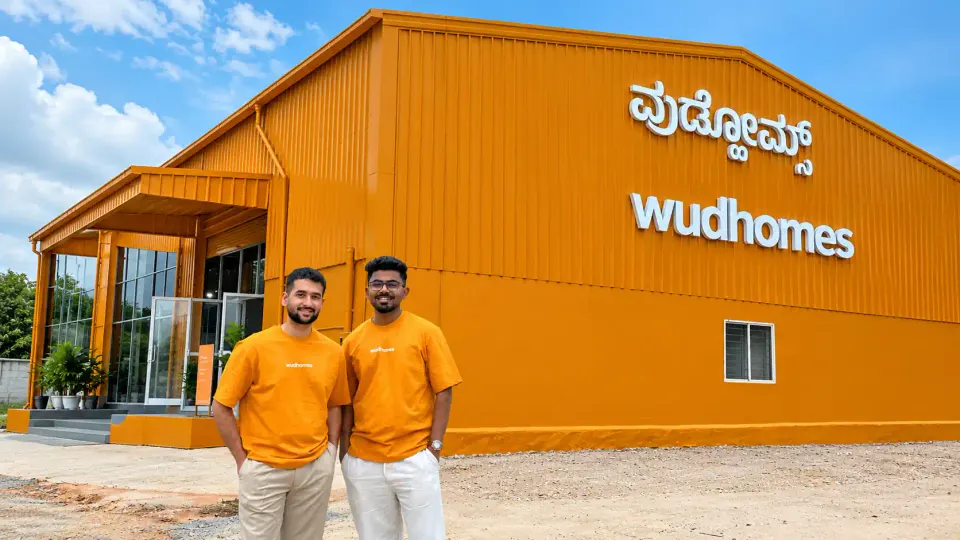
Vasu Arneja and Aditya Singh founded the Bengaluru company in 2025. It makes custom-built living room furniture, including sofas, accent chairs, coffee tables and side tables, with three-seater sofas listed on its website at between ₹22,900 and ₹44,900. Customers can visit its factory in Dommasandra to see materials and customise designs.
Furniture is its starting category. The company describes its broader aim as simplifying the whole process of furnishing a home, connecting inspiration, product discovery, curation, personalisation and fulfilment. It has built an in-house platform for discovering, curating, customising and visualising furniture, opened its first store on Sarjapur Road in Bengaluru, and introduced home visits in which consultants assess a customer's space and help them choose. It says it has furnished more than 200 homes in recent months.
The money goes into building a vertically integrated supply chain, developing its technology, strengthening the retail experience and expanding operations.
"Today, customers have to navigate multiple platforms, stores and vendors to bring their homes together," Arneja said. Singh described the gap between knowing how you want your home to look and actually making it happen as the one the company wants to close.
The company has not disclosed its valuation or revenue.
Why It Matters
Furnishing a new flat in an Indian city is a project with too many moving parts. The ideas come from Instagram and Pinterest. The sofa comes from one place, the coffee table from another and the side chairs from a third, and none of them were chosen with the room's actual dimensions in mind. A local carpenter can build to size but needs a clear brief; a branded store sells finished pieces that may not fit. Budgets drift, deliveries arrive weeks apart, and the room rarely ends up looking like the picture that started it.
That is the gap wudhomes is aimed at, and its answer is to own as much of the chain as it can: inspiration and visualisation in software, advice through a store and home visits, and the product through its own factory. Making to order means it can build to the customer's space and fabric choice without holding finished stock, which is the main advantage a custom manufacturer has over a furniture retailer.
The location makes sense. Sarjapur Road runs through one of Bengaluru's busiest technology corridors, lined with new apartment complexes full of first-time owners furnishing empty flats. They are the customers most likely to want help pulling a room together, and the factory sits close enough to serve them quickly.
The Strategic Read
Start with the round. ajvc's standard pre-seed cheque is ₹1.5 crore, and this round is ₹2.5 crore, with Seekho's three co-founders and other angels alongside. wudhomes is the eighth ajvc company to appear on these pages, and the second this month in which the round went beyond the fund's usual ticket.
The model is ambitious for the money. A factory, a store, a home-visit team and in-house software are four separate cost centres, each of which other companies have built with far larger rounds. ₹2.5 crore buys a proof of concept in one city: enough to show that the joined-up journey converts better than the fragmented one, not enough to scale it. The next round will need evidence that each furnished home earns more than it costs to win and to deliver.
That is where furniture's economics bite. People buy sofas rarely, and a brand that sells one sofa per household has to recover its acquisition cost on a single order, with bulky deliveries, damage risk and returns that are expensive to reverse. Custom manufacturing makes returns harder still, because a sofa built to one room's measurements is hard to resell. The answer wudhomes points to is the whole home. If the same customer buys the sofa, the chairs, the tables and eventually the rest of the room, the cost of winning them is spread over a much larger bill. Counting two hundred homes furnished, rather than two hundred sofas sold, suggests that is already how it thinks about the customer.
The category's history is worth remembering. India's furniture market is large and still dominated by local carpenters and unorganised dealers, and better-funded attempts to organise it have found the going hard. Urban Ladder spent years and substantial venture money building online furniture retail before Reliance Retail bought it in 2020 for about ₹182 crore, and Pepperfry has needed repeated rounds of capital. Logistics, damage and low purchase frequency defeated scale more often than demand did.
What wudhomes is doing differently is starting physical, local and made-to-order rather than online and national. That is slower and less glamorous, and it avoids the warehouse and long-haul logistics burden that weighed on earlier players. Whether it can stay integrated as it grows, without the factory, the store and the software each turning into a business that needs its own funding, is the question its next two hundred homes will begin to answer.
For daily, sharp analysis of the biggest moves in the Indian business and startup ecosystem, follow StartupFox.