



The Story
Arivihan has raised $10 million in a Series A round co-led by existing investors Accel and Prosus Ventures, with a further $200,000 from existing GSF angel investors. It takes total funding past $15 million. Reporting puts the round at about $10.2 million, and Entrackr previously estimated the company's valuation had risen 3.3 times to around $60 million.
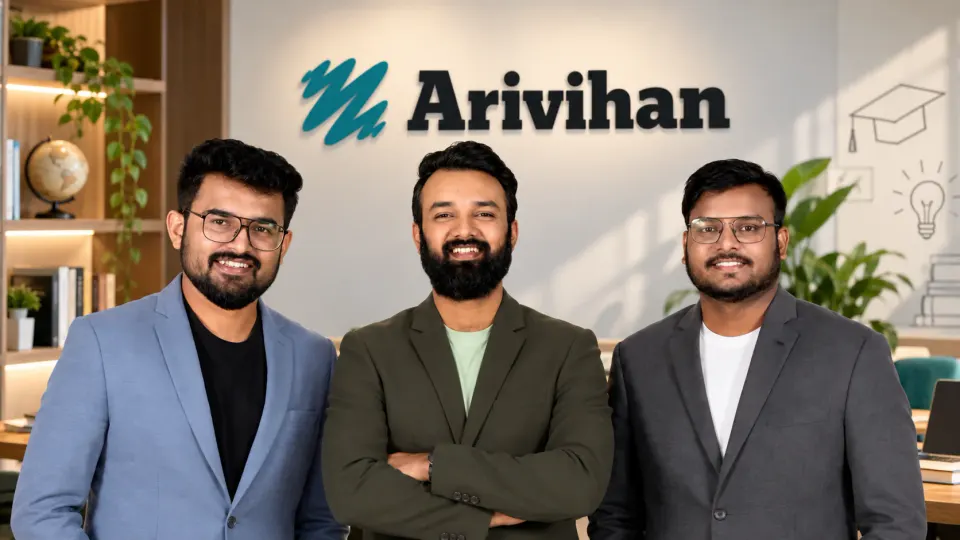
Ritesh Singh Chandel and Sonu Kumar Prashant, both IIT Roorkee alumni, founded the company in 2022 with mathematics educator Rushabh Kothari. Chandel and Kothari grew up in Indore, where coaching centres sat on every street corner and quality teaching still stayed out of reach.
The platform is fully automated. It delivers interactive video lessons, instant doubt resolution and AI-driven study plans that adapt to a student's performance, without live teachers on a timetable. It currently serves State Board, CBSE and NEET students, with a primary focus on Class 12 learners, and operates across Madhya Pradesh, Uttar Pradesh, Rajasthan, Bihar and Chhattisgarh. Around 80 percent of its subscribers come from tier-three cities and rural India.
"Edtech so far has made content cheaper," Chandel said, arguing the opportunity is to make personalised, high-quality learning available regardless of where a student lives or which language they learn in. He has previously described regional languages as a problem that can only be solved with AI at scale.
The capital funds expansion into new states and deeper presence in Madhya Pradesh, Uttar Pradesh, Rajasthan and Bihar, a broader CBSE offering, more vernacular language capability, AI research, performance marketing, on-ground distribution, hiring and new crash courses.
The company began with Class 12 state board students in Madhya Pradesh before adding NEET. It raised $4.17 million in a pre-Series A led by Prosus and Accel in July 2025, and was part of Accel's Atoms accelerator, receiving seed funding through it in March 2024.
Arivihan has not yet filed FY26 accounts. In FY25 its operating revenue rose almost 14.8 times to ₹3.14 crore from ₹21.29 lakh, against a loss of ₹4.45 crore.
Why It Matters
Indian coaching has a supply problem that money cannot fix, and it is the reason this company exists.
There are not enough good teachers, and the ones who exist concentrate where the money is. A strong physics teacher in Kota or Delhi earns many times what the same person would earn in Satna or Chhindwara, so that is where they go, and the students left behind get whoever remains. Chandel and Kothari grew up in Indore watching coaching centres on every street corner while quality teaching stayed out of reach, which is a specific and unusual observation: the problem in small-city India is rarely the absence of coaching centres. It is that the ones there are not very good, and the good ones are somewhere else.
Online learning was supposed to solve this by broadcasting the best teacher to everybody. It half-worked. A recorded lecture from a Kota teacher reaches a student in Bihar, but a recording cannot tell when a student is lost, cannot answer a question at eleven at night, and cannot explain the same idea a second way when the first way did not land. The live-class model that followed solved the interaction problem and reintroduced the cost problem, because a teacher on a timetable is expensive and the fees have to reflect it.
There is also the language question, which most national platforms treat as a translation exercise and which is nothing of the sort. A student who studies in Hindi and gets stuck does not want a dubbed video. They want to ask a question in the language they think in and be understood. Building that for every regional variation with human teachers is economically impossible, which is why nobody has done it, and it is the specific gap Chandel points to when he says regional languages can only be solved with AI at scale.
That is the wager. Not that AI can teach better than a good teacher, which it cannot, but that it can teach acceptably in a place where a good teacher was never going to be available, at a price a family in a district town can pay. For most of the students Arivihan serves, the comparison is not against Kota. It is against nothing.
The Strategic Read
The financials are small enough to state plainly. Revenue of ₹3.14 crore in FY25 against a loss of ₹4.45 crore, and a round of roughly ₹98 crore at a reported valuation near $60 million. That is a price of something like thirty times last year's revenue, on a business that lost more than it earned.
The growth rate is what justifies it, and 14.8 times is a genuine number rather than a rounding artefact, though it comes off a base of ₹21 lakh, which is close to nothing. FY26 accounts have not been filed and will be the ones that matter. The relevant question is not whether the multiple is high, which it obviously is, but whether a company selling into this segment can hold its margin as it grows, and that depends almost entirely on the automation claim holding.
Which is the part worth examining. Removing live teachers removes the cost that has defeated every previous attempt to serve this market, because a teacher's time does not get cheaper with scale. If the platform genuinely teaches without human delivery, the marginal cost of the ten-thousandth student is close to the marginal cost of the thousandth, and a company can price at levels that work in a district town while still making money. Chandel has said the model puts the company on a path to profitability for exactly this reason.
If it does not quite work, the failure will show up as support costs rather than as a product problem. A confused sixteen-year-old whose question the system cannot answer needs a person, and the number of those moments per thousand students is the metric that decides whether this is software economics or services economics wearing software clothes. Nobody outside the company knows that figure.
The distribution plan contains the other tension. The round funds performance marketing and on-ground distribution together, and those pull in opposite directions. Digital acquisition is what makes the unit economics work. On-ground distribution, meaning people in towns signing students up, is what actually converts parents who have never bought an app subscription and want to see somebody accountable before paying. Chandel has said parents buy trust rather than features, which is right, and trust in this market has historically been built by a person in the local market. Every rupee of that is a cost that does not scale the way the product does.
What is genuinely well-chosen is the ground. State board Class 12 in Madhya Pradesh is not a market anyone was fighting over. The large edtech companies chased JEE, NEET and CBSE, where the paying capacity is concentrated and the content is reusable nationally. State boards are fragmented by syllabus and language, which makes them expensive to serve and easy to ignore, and that is precisely why the students there have been offered almost nothing. A company that solves the vernacular problem once has a defensible position in a segment where scale was previously impossible, and it explains why Accel and Prosus have now backed the company three times.
For daily, sharp analysis of the biggest moves in the Indian business and startup ecosystem, follow StartupFox.