
 Ola Electric
The Story
Ola Electric's board has approved a rights issue of partly paid-up equity shares to raise up to ₹1,000 crore, the company said in a regulatory filing after its meeting on 28 September.
Of the proceeds, about ₹350 crore is earmarked for debt repayment and ₹400 crore for organic growth, with the balance for general corporate purposes. The shares carry a face value of ₹10. The record date, issue period and issue price will be determined later, and the issue is subject to regulatory and statutory approvals.
A further board meeting is scheduled for 5 October, or after the company receives in-principle approval from the stock exchanges, to consider matters related to the issue.
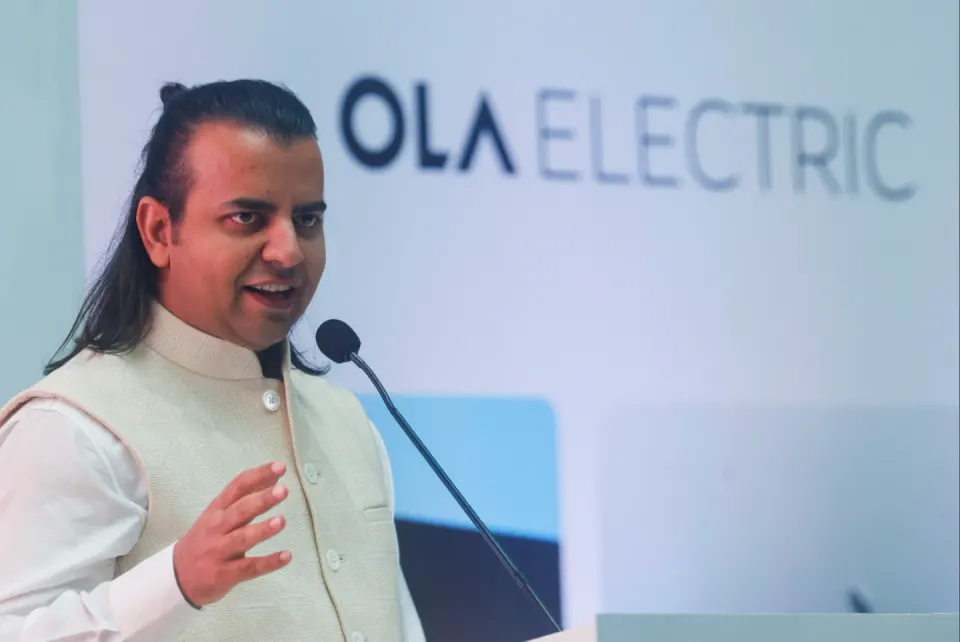
According to the draft letter of offer, chairman and managing director Bhavish Aggarwal has confirmed he will subscribe to his rights entitlement, with any renunciation limited to the promoter group or specified investors. The promoter group holds around 32.97 per cent. People tracking the process said Aggarwal may fund his participation by pledging part of his holding.
The rights issue follows a qualified institutional placement in June that raised ₹780 crore, above an initial ₹500 crore target. Both draw on a board approval from October 2025 to raise up to ₹1,500 crore through equity or convertible securities.
The company reported negative operating cash flow of ₹215 crore for the June quarter. It said in February that restructuring had lowered the automotive business's adjusted operating EBITDA breakeven to around 15,000 vehicles a month.
Ola Electric listed in August 2024. In December it sold shares worth about ₹324 crore at the promoter level to repay a loan of around ₹260 crore and release all pledged shares.
Why It Matters
The instrument tells you more than the amount does.
A qualified institutional placement sells shares to institutions that choose to buy. A rights issue offers them to everyone who already owns the stock, usually at a discount, and leaves existing holders with a decision: put in more money or accept dilution. Ola did the first in June, raising ₹780 crore. Three months later it is doing the second.
Companies generally prefer a QIP. It is faster, it does not require every shareholder to act, and it does not put the question to retail investors who may not have the cash. Turning to a rights issue so soon after one suggests the institutional route has been used about as far as it will go for now.
Which is why the promoter commitment is doing real work in the announcement. Bhavish Aggarwal confirming he will subscribe, with renunciation limited to the promoter group, is meant to signal that the people closest to the business are putting money in rather than being diluted.
The detail that complicates that reading is how he may fund it. Pledging shares to subscribe to a rights issue means borrowing against the stock to buy more of the stock. It is a genuine commitment of capital, and it is also leverage layered onto a holding in a company that is not yet profitable. Aggarwal spent December selling roughly ₹324 crore of shares specifically to clear a promoter loan and release every pledged share.
The Strategic Read
The breakeven figure is the number that makes sense of everything else.
Ola said in February that restructuring had brought the automotive business to adjusted operating EBITDA breakeven at around 15,000 vehicles a month. That is a specific, checkable target, and it is the reason the company keeps raising.
Set it against the market it is selling into. Electric two-wheeler registrations fell 16.2 per cent month on month in August to 1.72 lakh units, a second consecutive decline, after the government halved the purchase incentive to ₹2,500 per kWh capped at ₹5,000 a vehicle. Across the first half of the year, TVS, Bajaj, Hero and Ather absorbed 95.6 per cent of all incremental registrations. Ola's own registrations fell 44.1 per cent year on year and its share went from 18.6 per cent to 6.8 per cent.
A company that needs 15,000 units a month to stop losing money at the operating line is trying to hit that target in a contracting market where four incumbents are taking essentially all the growth.
That is the context in which ₹350 crore of debt repayment reads as sensible rather than defensive. Reducing interest cost lowers the volume required to break even, which is a more reliable lever than winning share back from TVS and Bajaj.
It also sharpens the comparison with Ultraviolette, which committed ₹779 crore this month to a Hosur plant scaled for 250,000 vehicles a year, funded from reserves and cash flows with limited debt and phased over five years. One company is building capacity ahead of demand with its own money. The other is raising money to reach the volume at which its existing capacity stops losing it.
For daily, sharp analysis of the biggest moves in the Indian business and startup ecosystem, follow StartupFox.