



The Story
Swish has raised $24 million in a round led by Bertelsmann India Investments, with existing backers Accel, Bain Capital Ventures and Hara Global participating. It takes total funding to roughly $78 million and values the company at about $175 million post-money, against $139 million when it last raised in March.
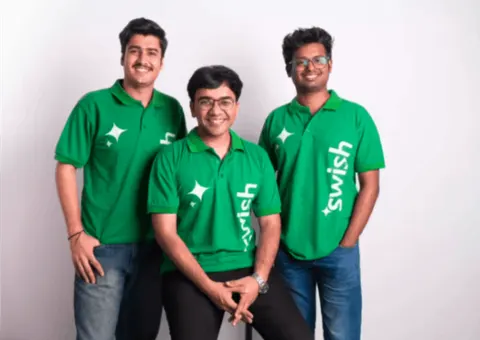
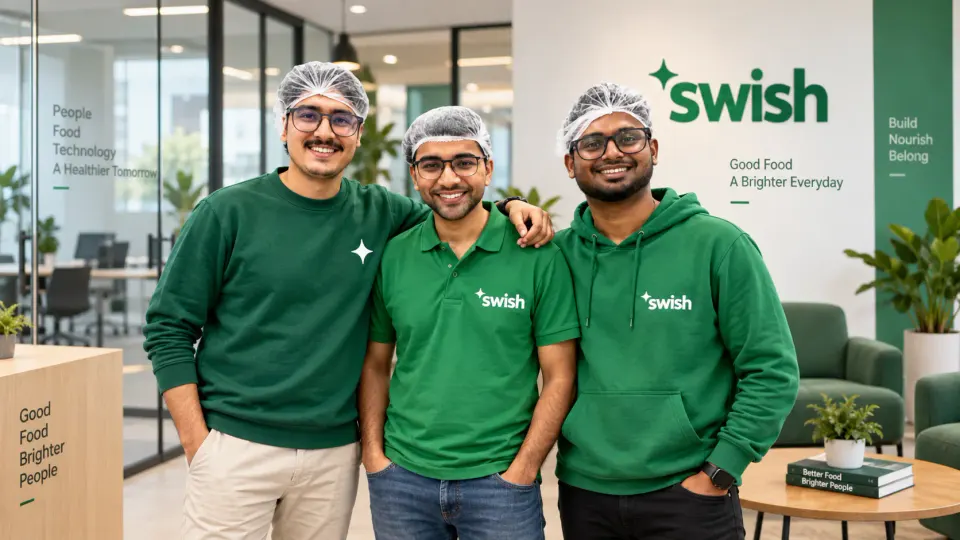
Aniket Shah, Ujjwal Sukheja and Saran S founded the Bengaluru company in 2024, and all three were named to Forbes India's 30 Under 30 the following year. It began with a single kitchen in HSR Layout after the founders timed a coffee and croissant from a test kitchen to a friend's door in eight minutes.
Swish owns the whole chain rather than aggregating restaurants. It runs neighbourhood kitchens with dedicated prep, cooking and assembly stations, its own ordering platform and its own delivery fleet, operating within a one to two kilometre radius so that food barely travels. It now covers Bengaluru, Gurugram, Noida, Delhi and Ghaziabad, across roughly 50 pincodes.
The company says monthly orders have passed a million, having tripled since March, with more than 80 percent of deliveries arriving within 15 minutes. Its menu has grown to over 250 SKUs across more than 20 categories, and lunch and dinner now account for a larger share of orders than snacks and late-night meals. Average order value runs between ₹200 and ₹250.
The money goes into expanding the kitchen network, supply chain infrastructure and capacity, with more cities planned and a target of more than 1,000 kitchens over five years.
Swish reported ₹4 crore of revenue and ₹19 crore of total losses across an eight-month FY25, a period covering its launch when it ran a handful of kitchens in one city. FY26 accounts have not been filed.
Previous rounds were a $2 million seed led by Accel in November 2024, a $14 million Series A led by Hara Global in March 2025, and a $38 million Series B led by Hara Global and Bain Capital Ventures in March 2026.
Why It Matters
The insight Swish was built on is narrower than ten-minute delivery, and better.
Quick commerce trained Indian consumers to expect groceries in ten minutes while prepared food stayed stuck at forty. That gap created a specific behaviour the founders noticed in the data: people abandoning food orders during craving hours, late afternoon and late night, not because they did not want the roll or the cold coffee but because forty minutes is longer than the craving lasts. Hunger that was not planned for does not wait.
That is a different market from the one food delivery has been optimised around. Aggregators are built for the planned, higher-value meal, the family dinner ordered at eight. The unserved surface is smaller, more frequent and more impulsive: breakfast, tea, snacks, a solo lunch at a desk. Those orders were not being lost to a competitor. They were not being placed at all.
Serving them required rebuilding the kitchen rather than the fleet, which is the decision that defines the company. A restaurant cooking to order cannot hit ten minutes regardless of how fast the rider is. So Swish built neighbourhood kitchens with separate prep, cooking and assembly stations, sited inside dense clusters, delivering within one to two kilometres. The food barely travels, which is also why it arrives in a condition worth eating.
The founding test was suitably unglamorous. Before raising anything, the three timed a coffee and a croissant from a small HSR Layout kitchen to a friend's door. Eight minutes. Everything since has been an attempt to do that a million times a month, which is a considerably harder proposition, and the fact that they are second-time founders after a crypto venture that did not work is probably not incidental to how carefully they tested the premise first.
The Strategic Read
The competitive framing around this round is the wrong way round.
Blinkit's Bistro, Zepto Cafe and Swiggy's Bolt get listed as the threats bearing down on Swish. In practice the larger platforms have been scaling back or shutting their rapid food experiments over the past year, citing operational complexity and cost. That is not a detail. It means Swish is not a small company being chased by giants; it is the company still standing in a category that defeated better-resourced competitors, and understanding why they struggled is the best available guide to whether Swish will not.
The reason is that food is not another SKU. Bolting hot meals onto a grocery dark store means the same pickers, the same riders and the same floor space now serving a product that needs cooking equipment, hygiene compliance, trained kitchen staff and a completely different inventory clock. For a company whose main business is groceries, food is a side experiment competing internally for attention and capital. For Swish it is the only thing there is.
The unit economics explain why the full-stack choice is necessary rather than merely preferable. An aggregator taking 15 to 20 percent of a ₹200 order earns about ₹35, out of which it must pay a rider. That does not fund a ten-minute delivery, which is why nobody has made ultra-fast work on a marketplace model. An operator that owns the kitchen captures the food gross margin, roughly 60 to 65 percent, or about ₹130 on the same order. The delivery becomes affordable only when you are selling the food rather than brokering it.
What remains genuinely hard is that ten-minute food is a forecasting problem wearing a logistics costume. Nothing worth eating can be cooked from scratch in ten minutes, so kitchens must pre-prepare against predicted demand and finish to order. Over-prepare and it goes in the bin; under-prepare and the order is lost. Groceries sit on a shelf for weeks. Cooked food does not survive the afternoon. Every rupee of that 60 percent gross margin is exposed to how accurately the company guesses what a neighbourhood will want at 1pm.
Which is why two of the operational updates cut against each other. A menu of 250-plus SKUs across 20-plus categories is many more forecasts to get right than a tight list of rolls and cold coffee. And lunch and dinner overtaking snacks means the mix is shifting toward full meals, which are more complex to assemble and less forgiving if unsold. Swish is deliberately moving toward the harder end of its own problem, presumably because that is where the order frequency and basket size are, and the wastage numbers that would tell you whether it is working are not published.
The valuation is the quiet signal. Orders roughly tripled since March while the price moved from $139 million to $175 million, up about a quarter. Either the March mark was generous or this round was struck conservatively. In a category that has just embarrassed three well-funded incumbents, the second reading seems more likely, and it is not a bad thing.
The FY25 numbers deserve to be set aside rather than repeated. Four crore of revenue against nineteen crore of losses describes a company running a few kitchens in one city during its first eight months. At a million monthly orders and ₹200 to ₹250 an order, annualised revenue is now somewhere near ₹240 to ₹300 crore. The meaningful question is what the loss looks like against that base, and nobody outside the company knows yet.
For daily, sharp analysis of the biggest moves in the Indian business and startup ecosystem, follow StartupFox.