



The Story
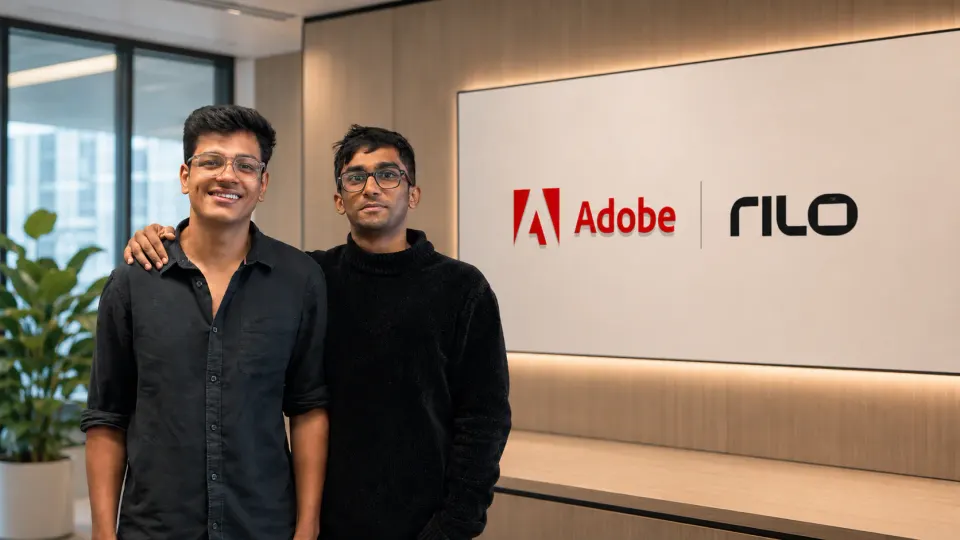
Adobe has acquired Rilo, an Indian marketing intelligence startup, in a deal involving technology licensing and the hiring of its team. Terms were not disclosed. Six people join Adobe, some of Rilo's intellectual property goes with them, and the product shuts down — existing users will lose access to it.
Dhruv Jaglan and Georgi Boby, batchmates at IIT Bombay, founded Rilo in September 2025. It let non-technical users describe a workflow in plain English and have AI agents assemble and run it across other tools. The company later narrowed onto marketing and go-to-market teams, describing what it built as AI employees: competitor intelligence, prospecting, LinkedIn outreach, Reddit marketing, content repurposing, campaign research and sales call analysis. Jaglan says more than 10,000 people tried it within months of launch.
Rilo had raised about $1 million from Peak XV Partners, DeVC and Day Zero Ventures at a $10 million valuation. Those investors receive an exit through this transaction.
The team is the asset. Jaglan previously co-founded the AI recruitment platform Babblebots.ai; Boby led technology at the cooking robotics company CloudChef. The wider group includes IIT Bombay computer science graduates, among them Bhavesh Dhingra, who placed second nationally in JEE Advanced in 2016.
This is Adobe's second acquisition of an Indian company, after the generative AI video startup Rephrase.ai in 2023. It follows Adobe's $1.9 billion purchase of the SEO firm Semrush last year and the April launch of CX Enterprise, an agentic system tying together customer data, content production and marketing workflows.
Why It Matters
Strip away the framing and this is an acquihire with an IP licence attached. That is a perfectly respectable outcome, and it is not the one most of the headlines describe.
Six people, twelve months, $1 million raised, undisclosed terms, product discontinued. Adobe did not buy a business. It bought a team that had shipped something working in a category Adobe needs and does not yet have, plus the right to use parts of what they built.
That is a reasonable trade on both sides. Adobe is assembling an agentic marketing stack by purchase rather than construction: Semrush at $1.9 billion for the search and visibility layer, CX Enterprise in April for orchestration, and now a small team that has actually built plain-English workflow execution across hundreds of tools. Enterprise software companies are slow at this by nature, and buying people who have already done it once is faster than briefing an internal team.
For Jaglan and Boby, the timing looks deliberate rather than lucky. Rilo was competing directly against Claude Cowork and ChatGPT's work tools, products built by the same companies that supply the models Rilo ran on. That is a difficult place to stand, and it does not get easier. Selling into a distribution-rich incumbent at twelve months, with investors made whole, is a clear-eyed read of a window that was closing.
Rilo is joining Adobe to help bring AI to Fortune 500 marketers. — Dhruv Jaglan, co-founder, Rilo
The Strategic Read
The number that should temper the celebration is 10,000.
That is how many people tried Rilo, and it is the only usage figure anyone has published. There is no revenue number, no paying-customer count, no retention data. Ten thousand sign-ups on a prosumer AI tool in 2026 is a normal launch week for anything with a good demo video. It is evidence of interest rather than of a business, and the absence of any other metric a year in is itself informative.
Which leads to the harder point. The product is being switched off. Whatever those 10,000 users built inside Rilo, they now have to rebuild somewhere else. A platform genuinely running a marketing function would not be shut down on acquisition; it would be migrated, or kept alive alongside, because customers would object loudly. Shutting it down is what happens when the customer relationships were not the thing being bought.
None of which makes this a bad outcome. It makes it a specific kind of outcome, and the difference matters for anyone drawing lessons from it. The lesson is not that small AI teams become valuable by solving workflows global software companies want to scale. It is that in a market moving this fast, a strong technical team with a working prototype carries an acquisition value largely independent of commercial traction — and that this value has a shelf life, because the model providers keep absorbing the layer directly above them.
The broader Indian read is more encouraging. Adobe has now bought two Indian companies, and in both cases the draw was engineering depth rather than market access. Peak XV, DeVC and Day Zero backed a company at a $10 million valuation and got liquidity inside a year, which makes the next pre-seed cheque in this category easier to write. Fast, modest exits are how an early-stage ecosystem builds a working bottom rung. They are simply not the same thing as building large companies, and the framing around this deal should not blur the two.
For daily, sharp analysis of the biggest moves in the Indian business and startup ecosystem, follow StartupFox.