


The Story
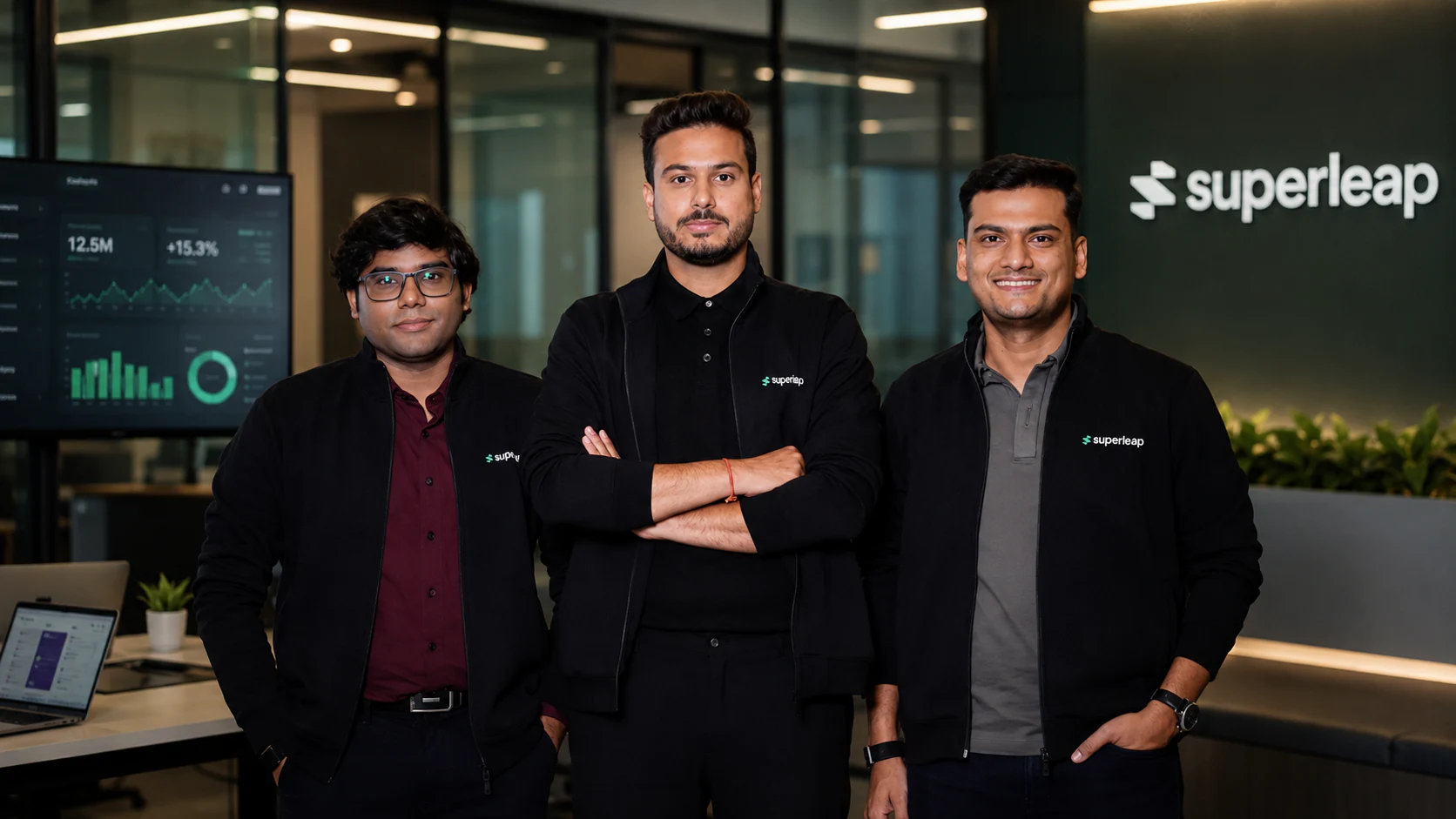
Superleap has raised ₹36 crore, about $3.7 million, in a pre-Series A round led by Surge, the seed-stage programme run by Peak XV Partners. The round was announced on 4 August 2026. Gruhas and Supermorpheus Group also back the company, alongside angel investors including Zomato's Deepinder Goyal, Kunal Shah, Unacademy co-founder Gaurav Munjal, Anupam Mittal, Mukesh Bansal and Nikhil Kamath. The valuation, the dilution and the size of any earlier round have not been disclosed. The capital will go towards enterprise go-to-market operations, developing the CRM platform and strengthening product capabilities. Superleap sells an AI-native CRM to sales and revenue teams, combining revenue data, customer intelligence and AI agents to automate work across the sales cycle. Its stated product set includes SuperOS for data management, SuperSense for customer intelligence and SuperAgents for automating revenue tasks, along with voice bots and integrations with WhatsApp, Slack, Microsoft Teams, Claude and ChatGPT. Named customers include Razorpay, Aakash Education, MediBuddy, HCL GUVI, Cars24, PagarBook, Plum, Qube Cinema and Superhealth. The company says Razorpay migrated more than 10 million data records to the platform in 45 days, and that Aakash Education moved around 5,000 counsellors across 400 locations in under 60 days. It claims to have grown 10X over the past year, without stating the base. Accounts of the company's age differ. The announcement and startup databases date its founding to 2024, by former Unacademy operators Subham Kumar Boundia, Alok Maurya and Saurabh Maheshwari. Peak XV's own portfolio page lists Superleap as founded in 2021 and partnered in 2022. Neither the company nor the investor has reconciled the two. Every operating figure here comes from the company. No revenue, contract value, seat count or retention data has been published.
Why It Matters
CRM is the hardest enterprise software to displace, and the reason has nothing to do with features. A company's CRM holds every customer record, every pipeline stage and every integration built over years, and moving it means moving the sales organisation's daily habits at the same time. That switching cost, not product quality, is what has protected Salesforce, HubSpot and Freshworks through several technology cycles. Superleap's wedge is aimed directly at that cost. The two deployments it publicises are migrations, not greenfield installs: Razorpay moving more than 10 million records in 45 days, and Aakash moving roughly 5,000 counsellors across 400 locations in under 60 days. Both are statements about how quickly a company can leave an existing system, which is the objection every CRM buyer raises first. The product argument sits on top of that. Where incumbents have added AI features to a system designed for humans entering data, Superleap says its platform assumes agents are doing the work, with the data layer, the intelligence layer and the automation layer built as one. Selling that requires displacing an installed system rather than filling a gap, which is why the money is going into enterprise go-to-market rather than distribution. None of the economics are visible. Superleap has not disclosed revenue, contract values, seat counts, gross retention or how many of its nine named customers are in full production. The 10X growth claim has no denominator attached, and a small company growing ten times from a small base is a different proposition from one doing it at scale. At $3.7 million, this round funds the attempt to find out.
The Strategic Read
The assumption being underwritten is that AI changes CRM enough to reopen a market that closed twenty years ago. The argument is that a system built around agents from the start behaves differently from one that has agents added to it, because the data model, the permissions and the workflow engine all have to assume software is doing the work rather than a person filling in fields. If that is right, the incumbents' advantage inverts. Salesforce's install base becomes the reason it cannot rebuild, and every enterprise re-evaluating its CRM for AI reasons is a door that was previously shut. If it is wrong, and AI turns out to be a feature the incumbents ship on their existing data, then the entire category of AI-native CRM companies is competing on price against vendors with twenty years of integrations. Superleap's answer to that risk is the migration record, which is the most substantive thing in the announcement. Ten million records in 45 days at Razorpay, and five thousand users across 400 locations at Aakash in under 60 days, are claims about the specific barrier that keeps companies on systems they dislike. A company that can genuinely compress switching from a year to a quarter is attacking the moat rather than the product. The scale is where the caution belongs. This is a pre-Series A of $3.7 million, which in a market whose incumbents spend that on a single enterprise account team is a seed cheque with a different name. The named customers are recognisable Indian technology and education companies, which suggests contract values sized for the Indian market rather than the global one. The angel roster reads as a distribution strategy, not an endorsement. Goyal, Munjal, Bansal, Mittal, Shah and Kamath collectively control or influence a large number of Indian companies with sales teams. That is a plausible route to the next fifty customers, and it says nothing about whether the product retains them.
For daily, sharp analysis of the biggest moves in the Indian business and startup ecosystem, follow StartupFox.