

The Story
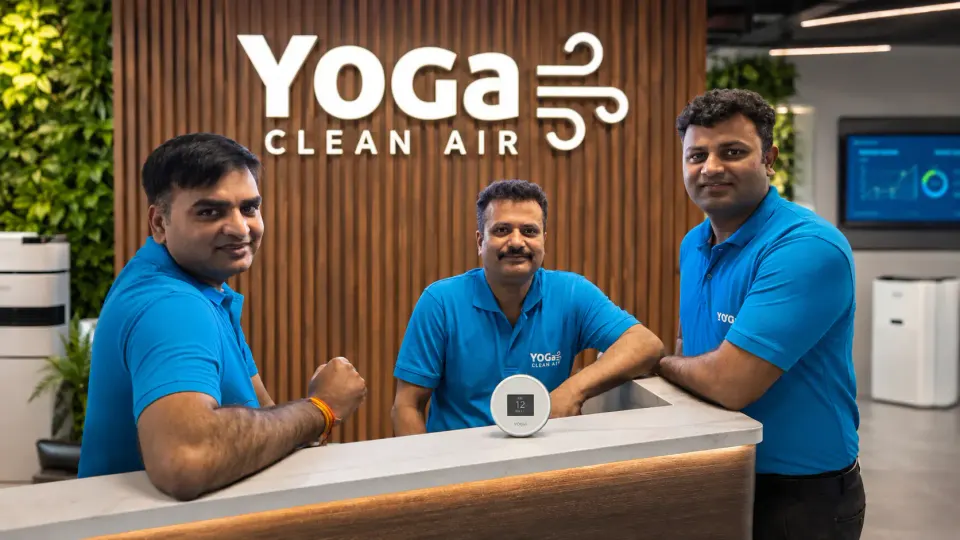
YOGa Clean Air has raised ₹20 crore in a Series A round led by Info Edge Ventures, with Deepinder Goyal, founder of Zomato's parent Eternal, and Three Words Capital taking part. The round mixes primary and secondary capital, and it is the first institutional money the Gurugram company has taken.
The capital is earmarked for deeper coverage in the cities YOGa already operates in, entry into more Tier-1 and Tier-2 markets, and an extension of its systems into public transport and other outdoor environments. The company has not said which transport operators or vehicle types it will start with.
The product is not an air purifier, and the company is careful about the distinction. Its Clean Air Bubble system filters outdoor air on the way in, then holds the room at slightly higher pressure than the air outside, so polluted air cannot push through door gaps, window frames and other openings. It also manages carbon dioxide levels. YOGa says a unit installs through a small opening in a wall or a glass pane, clears a house in roughly 55 minutes, and draws about 70 watts running continuously. It holds two patents.
By the company's own account, its systems serve more than 5,000 families and several hundred institutions — hospitals, schools, offices, gyms — across 11 cities including Delhi-NCR, Mumbai, Kolkata, Bengaluru and Hyderabad. It claims indoor readings in single digits while outdoor pollution crossed 900 µg/m³, and a 100 percent renewal rate on annual maintenance contracts. None of those figures have been independently verified.
Sachin Panwar started the business in 2010. It was incorporated as YOGAN Solutions in 2019, with Deepak Raina and Gaurav Nagar as co-founders.
Why It Matters
The interesting thing about this round is not its size. It is that the company got here without needing one.
Filed accounts for YOGAN Solutions for the year to March 2025, as aggregated by Tracxn and reported secondhand, show about ₹13 crore of revenue and a net profit near ₹67 lakh, with revenue up roughly 64 percent on the year before. Small numbers in absolute terms. But a first institutional cheque arriving at a company that is already profitable is a different transaction from the usual one. Most first rounds buy a plan. This one buys a business that works, at a size worth roughly one and a half times everything the company booked last year.
That changes the negotiation. A founder with sixteen years of referral-driven growth and, by the company's account, no conventional marketing spend does not need the money to keep the lights on. Needing it is usually the only leverage the other side has.
The product logic holds up as well. A standalone purifier cleans the air already inside a room while more of it leaks in around the edges; the positive-pressure approach makes the room rather than the machine the unit of clean air. In cities where outdoor PM2.5 routinely runs an order of magnitude above WHO guidance, that is not a marketing distinction. It is the difference between a device that helps at the margin and one that holds a boundary.
Clean air in India is not a privilege but a right. — Sachin Panwar, co-founder and CEO, YOGa Clean Air
The Strategic Read
The risk sits in the gap between ₹13 crore and the ₹100 crore Panwar has said the company is targeting this year. That is close to an eightfold jump in twelve months from a business that grew 64 percent last year. Even allowing for the mix shift he describes — retail giving way to real-estate projects and institutional orders, where one contract is worth hundreds of home installations — the arithmetic needs the B2B pipeline to convert almost perfectly.
Installed hardware businesses fail in a particular way. The unit economics look excellent until the service load catches up: every Clean Air Bubble is a filter to replace, a fan to maintain, a customer who notices the day the air stops feeling different. That 100 percent AMC renewal rate is the company's strongest number, and it is also the one most exposed to fast expansion. Service quality is what a referral engine runs on, and referrals are how YOGa reached this point without marketing.
Public transport is the more speculative line item. A bus or a metro coach opens its doors every ninety seconds. Positive pressure, which is the entire mechanism, does not survive that. Whatever YOGa deploys in transit will be a different product solving a different problem, sold to procurement departments rather than to families who heard about it from a neighbour.
The competitive field is filling in around it. Airth retrofits air conditioners into purifiers, Clairco and uBreathe work the commercial and plant-based angles, Atovio sells wearables, Biomoneta is chasing medical-grade air, and Pune-based NovorbisItus raised ₹13.35 crore this year for emission control. India's air purifier market is projected at roughly $1.2 billion by 2030 — large enough to support several of these companies, small enough that whoever owns the institutional channel takes most of it. Hospital chains, school groups and developers writing air quality into building specifications are where the volume sits. That channel, more than any city count, is what ₹20 crore is actually buying.
For daily, sharp analysis of the biggest moves in the Indian business and startup ecosystem, follow StartupFox.